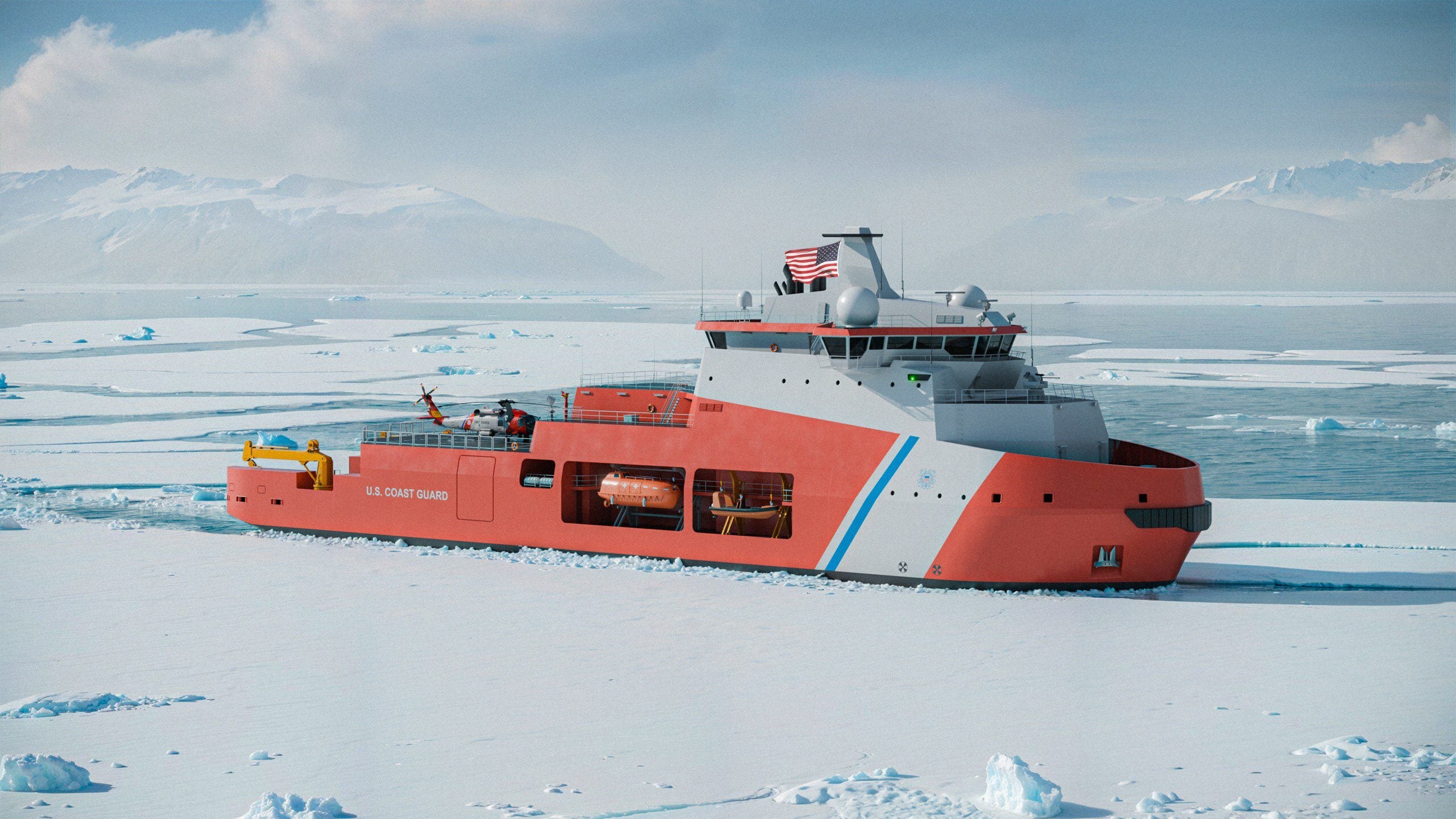
The US Coast Guard has confirmed plans to spend $323 million expanding and modernizing its Seattle icebreaker base, underscoring the service’s push to strengthen its Arctic presence as new heavy icebreakers enter the fleet later this decade.
The commitment was confirmed during congressional questioning when Ranking Member Sen. Maria Cantwell (D-WA) asked Coast Guard leadership to verify the scale of planned investment at the Seattle facility. “I believe that’s correct, ranking member,” U.S. Coast Guard Commandant Kevin Lunday responded, confirming the $323 million figure for expansion and modernization of the base.
The planned expenditure builds on an initial $137 million contract awarded to Whiting-Turner to modernize Pier 36, the historic waterfront facility that anchors the Coast Guard’s icebreaking operations in Seattle. That earlier contract focuses on adding a new berth and deepening the basin, upgrades designed to accommodate the deeper draft and larger footprint of the future Polar Security Cutters (PSC). Once complete, the work will allow the next generation of heavy icebreakers to enter and operate from the port without restriction.
Pier 36 has long served as the Coast Guard’s primary West Coast hub for polar operations and is currently home to the medium icebreaker Healy and heavy icebreaker Polar Star. The modernization effort reflects the facility’s evolving role as Seattle prepares to become the homeport for the service’s new heavy icebreakers as well.
According to Lunday, “The critical part of the work there is to rebuild and build out the capability for our polar security cutters that will be homeported there as well as Healy which continues to be homeported there.”
When Cantwell pressed further on whether Seattle was part of the Coast Guard’s long-term infrastructure prioritization, and when lawmakers could expect to see new ships arriving in Puget Sound, Lunday pointed to the construction timeline.
The first PSC, currently under construction in Mississippi, remains on track for delivery in 2030. While a specific arrival date in Seattle has yet to be finalized, Lunday said delivery to the Coast Guard is “right now on track in 2030.”
Seattle’s expansion is part of a broader recapitalization of the Coast Guard’s icebreaking fleet. The service plans to field up to 11 Arctic Security Cutters (ASC) alongside three Polar Security Cutters.
All PSCs are expected to be stationed in Seattle, while some ASCs are likely to be based in Alaska.
Lunday told lawmakers the Coast Guard is “rapidly expanding our icebreaking fleet to secure our northern border and maritime approaches in the Arctic,” adding that contracts have already been awarded to build six ASCs, two in Finland and four in the United States, with additional contracts planned to bring more shipbuilding into US yards.
“We recently awarded two contracts to rapidly build and deliver six Arctic security cutters, two to a shipyard in Finland, four to a shipyard in the United States, and we’re working on rewarding an additional contract for five more that will onshore more ship building into US shipyards and strengthen America’s industrial base,” Lunday confirmed.
Alaska is also seeing significant infrastructure investment. Icebreaker Storis will be home-ported in Juneau, supported by roughly $300 million in shoreside improvements.
Sen. Dan Sullivan (R-Alaska) asked whether that effort was on schedule. Lunday replied that the Coast Guard is moving quickly to execute the funding and have the pier and infrastructure ready by 2029, aligning with the expected 2028 delivery of the first two ASCs. Housing remains a challenge, however, with additional funding still needed to support crews and families.
“And so we’re moving quickly to be able to execute that funding and have that peer and infrastructure there ready by 2029,” the Admiral confirmed.
Beyond ships and piers, the expansion carries major personnel implications. Manning 11 ASCs and up to three PSCs will require a significant influx of trained sailors.
“Just to give one quick example,” Lunday said, “the 11 Arctic security cutters that we’re building…will require 1,300 new Coast Guard people that don’t exist today.” Recruitment and training, he emphasized, will be critical as the service scales up its Arctic operations.
Editorial Standards · Corrections · About gCaptain

 Join The Club