Don’t Miss Your Daily Briefing for the Maritime Industry
Join the leading maritime news network
— trusted by our 105,878 members
FILE PHOTO: U.S. President Donald Trump and Russian President Vladimir Putin hold a press conference following their meeting to negotiate an end to the war in Ukraine, at Joint Base Elmendorf-Richardson in Anchorage, Alaska, U.S., August 15, 2025. REUTERS/Jeenah Moon/File Photo
From Alaska With Love: Russia’s Shadow LNG Fleet Set Sail for China As Trump-Putin Summit Unfolded
Five sanctioned LNG carriers, part of Russia’s shadow fleet, got underway as the Trump-Putin meeting took place in Alaska, or changed course in the hours that followed.
“LNG carriers Iris, Zarya, and Voskhod all synchronously lifted their anchors to head to Asia, […] hoping for sanction-liberated buyers,” said Kjell Eikland, managing director of data provider Eikland Energy, in a public Linkedin post.
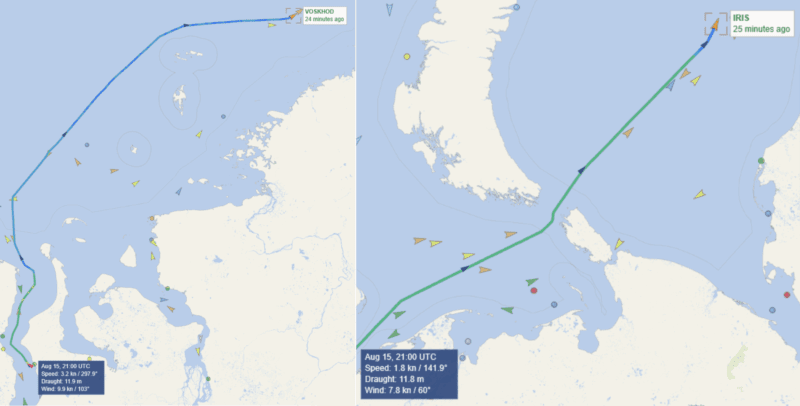
AIS records show Iris, Zarya, and Voskhod getting underway around 90 minutes into the Alaska sit-down meeting. All three vessels are currently heading east toward Asia along Russia’s main Arctic shipping lane.
“I can confirm it. It happened while they were still in talks because the movements took place at 21:00 UTC,” said Samir Madani, co-founder of TankerTrackers, a research and maritime intelligence company.
The direct talks between Presidents Trump and Putin concluded with a brief press meeting at 21:45 UTC ahead of a press conference at 22:55 UTC. The Kremlin confirmed that talks had ended at 22:22 UTC.
AIS data showing Voskhod and Iris getting underway at 21:00 UTC. (Source: Vesselfinder)
Two additional sanctioned LNG carriers, Arctic Mulan and Arctic Vostok (recently renamed from East Energy), already located in Asia also set sail or changed course in the hours following the Alaska summit. All five LNG tankers are flying the Russian flag.
According to daily traffic logs published by Russia’s Northern Sea Route Administration, at least one vessel is headed to China. The listing shows Voskhod’s destination as the Beihai import and regasification terminal operated by PipeChina in southern China.
Several industry analysts called the spike in activity “remarkable” and speculated about a connection between the vessel’s sudden movements and the Alaska summit.
“Quite something to see all Arctic LNG 2 carriers suddenly on the move,” one expert remarked.
Russia’s October revenues from crude and petroleum-product exports hit the highest since May as the ongoing Iran war bolstered oil prices, according to the International Energy Agency.
The European Union paid an estimated €8.7 billion for liquefied natural gas from Russia’s Yamal project in the first 10 months of 2026, exceeding the estimated total for all of 2025, as the countdown to a ban on Russian LNG imports enters its final weeks.
The German government will go ahead with a planned 24-terawatt-hour crisis gas reserve to be funded by user surcharges, the economy ministry said, following criticism over missed storage targets for the winter heating season this year.
November 11, 2026
Total Views: 600
Get The Industry’s Go-To News
Subscribe to gCaptain Daily and stay informed with the latest global maritime and offshore news
— just like 105,878 professionals
Secure Your Spot
on the gCaptain Crew
Stay informed with the latest maritime and offshore news, delivered daily straight to your inbox
— trusted by our 105,878 members
Your Gateway to the Maritime World!
Essential news coupled with the finest maritime content sourced from across the globe.

 Join The Club