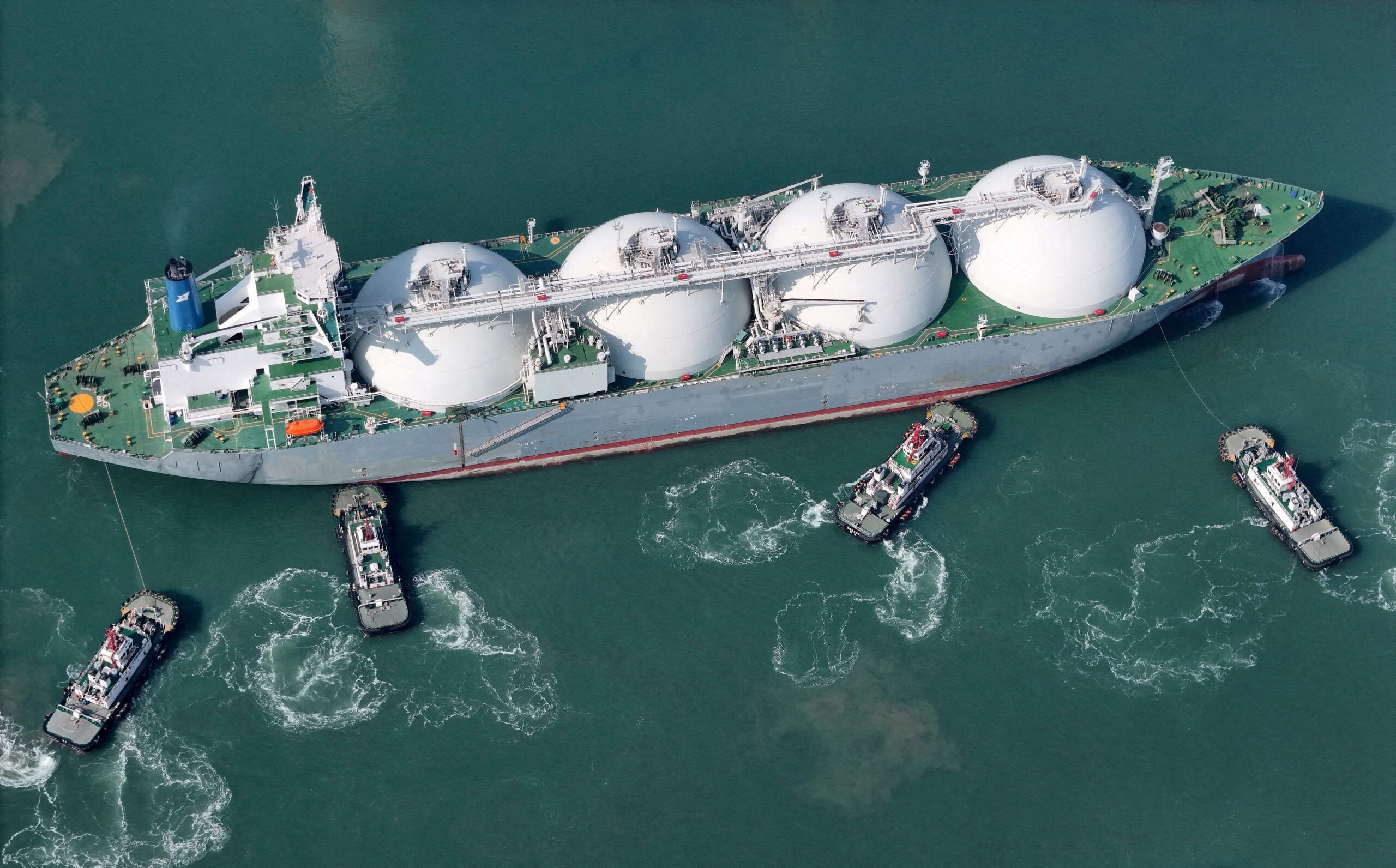
gCaptain’s photo of the week is a helicopter shot of LNG Tanker Lokoja (IMO# 9269960). Built by the Korean shipyard Daewoo in 2006 she is owned by BW Gas and chartered to Suez LNG.
What makes this the photo of the week is both the amazing perspective and the photographer himself. gCaptain believes every mariner has a specialty, hobby or interest that makes him unique and we love to showcase their work. This is a great example because, like our friend OneEighteen’s best work, Carlos Ferreira, the photographer, took this shot while performing his everyday duties at sea. Carlos also happens to have a day job that every mariner deeply appreciates, Rescue Captain aboard Spain’s Rescue Helicopter “Pesca 2″.
For more of Carlos’ amazing photos CLICK HERE.
Tags: · coast-guard, helicopter, LNG, lng tanker, Photo, rescue-swimmer

The latest news from South Korea:
Today Her Highness Sheikha Mozah Bint Nasser Al-Missned named the first Q-Max (266,000 CBM) LNG Carrier, “MOZAH”, the world’s largest LNG vessel built to date. The special ceremony was held at Samsung Heavy Industries shipyard on Geoje Island.
Muhammad Ghannam, Nakilat Managing Director, said; “The naming of the LNG carrier “MOZAH” is a very special and key milestone for Nakilat as we are celebrating the very first of our 14 Q-Max ships. “MOZAH” is also the first of twenty-five wholly-owned LNG carriers in our fleet of 54 vessels which are being built in the Korean shipyards to serve Qatar’s massive LNG expansion projects.”
“MOZAH” will be used to ship LNG produced by Qatar Liquefied Gas Company Limited (II), known as Qatargas 2, to customers in Europe.
The Q-Flex and the even larger Q-Max are a new generation of LNG mega-ships. The Q-Max has 80 percent more capacity than conventional LNG carriers with about 40 percent lower energy requirement due to the economies of scale created by their size and the efficiency of the engines. Q-Max LNG carriers are unique and purpose built for Nakilat, the sole owner of the vessels. “MOZAH” will be on a long-term charter to Qatargas.
Click HERE for a virtual tour of the shipyard which built her.
Tags: · LNG, lng carrier, Shipyard, world-record

What happens when you let a comedian and elementary students paint a ship? No, the answer isn’t the Norwiegan Gem, it’s the Dream Tanker. Pink Tentacle tells us;
The Dream Tanker, one of the largest liquified natural gas (LNG) tankers in the world, now travels in style. Comedian-turned-painter Jimmy Onishi and 40 elementary school students have designed monster-sized psychedelic murals for the ship’s spherical tanks. The total area covered by the murals is large enough to cover 100 buses.
The 120,000-ton Dream Tanker, owned by an affiliate of Osaka Gas, measures 289.5 meters (950 feet) long and 49 meters (160 feet) wide. With 4 independent spherical tanks measuring 43 meters (140 feet) in diameter, the tanker can hold up to 67,000 tons of LNG.
Osaka Gas decided to decorate the tanker with graphics in celebration of the company’s 100th anniversary. The company asked Kansai-area elementary school students to draw pictures, which Jimmy Onishi then incorporated into his giant images of a fish, crab, shrimp and turtle. Sumitomo 3M Ltd. then used computers to process the images and printed them onto a special adhesive film, which was attached to the tanks. Read More…
Photos from her commissioning in 2006 can be found HERE.
Tags: · artist, design, elementary_school_students, gas_lng, jimmy_onishi, liquified_natural_gas, LNG, lng carrier, lng tanker, Maritime, murals, ship, students, sumitomo, Tankers
Like It Or Not; It’s Here
Fighting LNG Ship Fires
Originally Published Sept 2007
By Tom Guldner, Marine Firefighting Inc.
First, let me state that this article is neither FOR nor AGAINST Liquid Natural Gas (LNG) in the USA. Its purpose is to understand what it is and how the vessels crew and Land-Based Firefighters and first responders can deal with emergencies. Opponents of LNG have come up with many false statements about the dangers of LNG while the LNG industry may lead us to believe there is absolutely no danger in handling LNG. We as firefighters (marine or land-based) and as the mariners who work with the LNG vessels must look at this issue in a more unbiased view. Anything is dangerous if used improperly. Even water has been found to be the culprit of many devastating oil tanker explosions when used under pressure to clean the vessels tanks. The static electric charge the water builds up can create a spark which can rip apart a huge oil tanker. We have also seen that water has caused many vessels to capsize and sink when too much of it has accumulated aboard a ship during firefighting operations.
My company, Marine Firefighting Inc., has been involved in providing informational seminars to the tug boat crews who have the task of escorting some of the large LNG ships into US waters. The tug boats being used are specially designed for this task. Each is equipped with state of the art firefighting equipment. MFI has been providing the familiarization with this new firefighting equipment and also familiarization with the properties of the LNG they will be working with.
Much controversy surrounds the Liquid Natural Gas (LNG) industry in the United States. A good deal of the criticism comes from the “Not in my back yard” syndrome. Most of us realize that our energy needs will soon outpace our supplies. With new emerging economies such as China and India the world’s existing oil reserves are going to be drawn upon much more than at any time in our history. LNG has been presented as one of the answers of bridging the eminent energy gap between users and suppliers. However, no one wants to live next door to an LNG plant.
What is LNG? Liquid Natural Gas (LNG) is a colorless, odorless, liquid which is natural gas in a liquid form. Previously, the world’s large supplies of natural gas have not been available to areas remote from these gas wells. The cost of shipping natural gas in its gaseous state was simply too expensive. Liquefying natural gas reduces its volume 600 times (see diagram left.). Because of this reduction in volume it became profitable to export natural gas in its liquid form (LNG). The process of liquefying natural gas differs from the liquefying of other gasses. The main difference is that LNG does not require pressurization to keep this gas in a liquid state as is the case with Liquid Petroleum Gases (LPG) such as Propane. (Marine transport of Propane may use refrigeration to reduce its pressure during transit.) LNG is formed by subjecting natural gas to extremely cold temperatures. At minus 260 degrees F (-161°C ) the gas becomes a liquid at atmospheric pressure. Liquids at these temperatures are considered “Cryogenic”.1 [Continue Reading →]
Tags: · Firefighting, liquid-natural-gas, LNG, lng-tankers, marine-firefighting, natural-gas, ship-fires, Ships

Our ship model of the week is the Malaysia International Shipping Company’s (MISC) LNG Tanker Bunga Cenderawasih. The model is of the 17 year old Korean built ship prior to being refurbished by Keppel Verolme in 2005.

This model was built by Maritime Replicas.
Photos of the Bunga Cenderawasih
Tags: · boats, LNG, lng_tanker, maritime_museum, maritime_replicas, models, ship_model