Cosco Busan - ECDIS Tracking w/ Google Maps

Published: December 9th, 2007 by John | Comments |


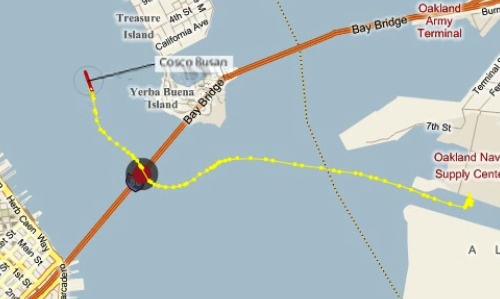
AIS Track of the Cosco Busan

So the gCaptain team has been exceptionally busy in the last few weeks and we have the Cosco Busan partially to thank. In addition to the server traffic and time spent researching the incident we were motivated by the events to embark on some new projects. You already now the good news, the successful launch of a new maritime podcast! Unfortunately, however, we also had a time consuming failure.

Vesseltrax Logo - WhiteA little history…. Shortly after the ship allided with San Francisco’s Bay Bridge we pointed you to the amazing website BoatingSF.com. Run by Michael Slater, a former Adobe Engineer, the site uses AIS vessel tracking data taken from VHF radio antennas Michael has erected near the bay and uses this to plot ships to a live interactive map embedded on his site (LINK). The post that day, however, displayed recorded data showing the track of the Cosco Busan during her short voyage. The display was impressive and attracted a considerable amount of attention.

cosco busan track closeup Cosco Busan   ECDIS Tracking w/ Google MapsAt this point of the story we had just finished reading an amazing article written for Geo: Magazine by John Astad, our friend from Vesseltrax. The subject of the article was Shore-Side Maritime Applications of Google Earth and discussed his ability to visualize 3d images of ships running the Houston Ship Channel. Even cooler was the ability to fly around a vessel as she moved about the bay… in real time! (LINK) So I contacted Michael and asked if he would send the data file to John for 3d conversion!

The stars seemed to be aligning until we discovered a problem (read about it here) that resulted in John not being able to convert the data for use in his program. Discouraged? Yes but in stepped a gCaptain reader who we can’t thank enough. He transposed the timestamps from regional AIS beacons and helped us create a ShipPlotter version (Disclaimer here and ShipPlotter results here) of the events. Not quite accurate but close enough for our next team to start work…

Jakota Cruise Systems

Jakota “is engaged in the development and sale of solutions aimed at the commercial sector and public services, as well as the field of research and science. We supply solutions for tracking, fleet management, positioning and security- and alarm systems.” Translated; they make the best 3d ship graphing websites on the planet. They also provide amazing tools for tracking fleets of ships that are visually stunning, effective and well thought out.

Digital SeasYou ask, how did we find Jakota? We asked our friends in silicon valley to search for a company that provides AIS vessel tracking systems that first, have visually attractive solutions, second use the latest tools of web 2.0. The overwhelming response was “Check out Digital-Seas.com“.

Fast forward through the time changes, international calling codes and German accents… we finally got in touch with Lars Krueger, one of the nicest and most professional person we have met. Lars took a programmer off his job to work on our project full time… the results were stunning but the harder we work the more faulty data we found.

The bottom line… we worked hard, had fun, met some amazing people and built relationships for the future. The final result is not 100% accurate and was compressed to meat BoatingSF’s needs but still looks amazing (you should see the original!!) We also started on a new project, global AIS and vessel tracking… but that’s for another post. In the meantime, if your a marine superintendent Lars is a person you need to know. If you’re a mariner interested in tracking ships so you don’t have to spend days in sitting in the union hall… Digital-Seas is the website you will know.

Many thanks to all who helped and stay tuned for more on the amazing people and products we met while working on this project. For a preview visit these amazing sites;

Enough discussion… to see the Cosco Busan’s Track CLICK HERE

Note: The source of our problem was the USCG’s reluctance to release the official AIS data files. If you wish to see the amazing visualizations of Digital Seas… in full size… with accurate data… call your congressman and ask for the file to be released to the public.

Related Articles

Related Link: USCG Talk - Chat with other Guardians on our forum!

Related Link: Marine Incident Forum - Share photos, videos and marine incident reports online.

Categories: Container Ship · Interesting · MARPOL Incidents · Marine Technology · Video · Web 2.0

Tags: · , , , , , , , , , , , , ,


-

  • Diethard Kersandt
    Some of my findings :

    1. I’m able to prove that the navigation by Cota were certain and reliable up to 4 minutes before allision.
    2. The most important signal acting as a stimulus on Cota appeared only for abaout 15 seconds. He recognized this situation and ordered a course changing manoeuvre towards to the middle of the span as usually.
    3. After the beginning of this manoeuvre the signal disappeared. Cota changed his information source and went to the ECS.
    4. The ECS contained a bad planed wrong track . The captain confused the centre of the span with the middle of the RACON-signals “B” and “Y”.
    5. In this moment of getting situation knowledge by the pilot the VTS called. The pilot was distracted.
    6. Supported by an unforeseeable changing of RACON-signal from “Y” to “B” the pilot
    attained the impression of an exact position regarding “centre”.

    That were some of my findings and could be able to explain the background for Cota’s mental model.
    As you can see I didn’t waste any word on blame. But somebody is able to deduce prevention measures.

    Dear Bob, we should finish our conversation now. If you or anybody is interested on my report please don’t hesitate to contact me. (report : 100 pages (pdf-datei); 3 presentations of about 200 slides (in power point); in the moment in German language.
  • Let me start off by saying that I don't believe bringing criminal charges was wise or helpful, but I suppose lawyers have to earn their nexy Bermuda holiday home somehow.

    The influence of the human element is long recognised. That is precisely what bridge team management is intended to address. It is also what Colregs are about, to mitigate the effects of false cognition.

    (I've very aware of cognitive psychology/neurology. You might consult a book called "Forbidden Knowledge", by Lutterworth Press)

    Did Cota, or the master, act appropriately under the conditions?

    Knowing that the radar is faulty, do you then continue to proceed at full manouvering speed in fog?

    Frankly, it sounds to me you've got Cota bang to rights!
  • Diethard Kersandt
    "The answer to your questions is very simple : If we investigate the causes for accidents at sea by means of traditional methods only we will get all the old and well known answers : the human being doesn’t work according our expectations and written and unwritten rules.

    What are the consequences of such a statement ? We are able to put our finger at a guilty person. And the court of justice has the basis to find a judgement accordingly as well as the insurance companies can work as usually.

    But now let me put my question : does that deliver any new knowledge for avoiding future errors and accidents ?

    I think that the “case Cota” sticks fast on this stage exactly.

    Therefore I am interested in that “case”. My starting point is the cognitive process of information processing by that person, which is responsible for decision finding and action plan. I try to find out what information was available, what information was needed, what kind of information has caused what kind of behaviour. During the analysis of the last 15 minutes up to the allision I found out, what the basis for Cota’s decisions was. And I found a lot of failures and lacks located in the technical equipment, in sea charts, in administration and at last in voyage planning by the captain.

    This and only this findings are suitable to recognize possibilities for preventive measures.

    And that could be the source for arguments of Cota’s lawyer.


    Many thanks for commenting my comment. I hope the very interesting initiative “Prevention Through People”, started by U.S. Coast Guard, will find the needed attention by mariners.
  • Dr. Kersandt makes interesting points, accidents are usually more complex than often assumed and human beings are almost inevitably a part of that complexity.

    One must always, however, err on the side of caution. The ship's passage plan itself is in question with Fleet Management having been charged with falifying it after the incident. This is the result of poorly trained USCG investigators in the first instance who failed to secure documents on the bridge, thus there is a question regarding their evidence trail.

    Unfortunately, given the enthusiasm for throwing cluster-bombs of criminal charges around, it is unlikely that the depth of information will come to light to contribute to navigational safety.

    Let me make it clear that in what follows that I intend to make no assumption of liability on behalf of the pilot or the master. I am merely considering how Dr. Kerstandt's views might play.

    If Dr. Kersandt will permit me a moment of being a hypothetical prosecutor. I accept, hypotheically,his comments on the visibility of the racon, the change of signal and the quality of the display and the potential interference of the VTS. All this would have been apparent to the pilot. The question for me would be whether the pilot took appropriate action, was the vessel's speed appropriate to the conditions, which include his uncertainty?

    Did he do his due diligence and adhere to Rule 6 of Colregs?

    Dr. Kerstandt will need to demonstrate that the pilots decisions were appropriate to the situation.

    One of the functions of good bridge team management is to mitigate an individual's loss or lack of situational awareness – did the pilot, or the master, use the good bridge team management principles?

    Let me return to the issue which Dr. Kerstandt begins with – the passage plan. When a pilot boards a vessel ut is good practice for the pilot and the master to discuss the passage plan and for the pilot to explain what his intentions are, where he intends to make his turns and so forth, so that at least the master knows what he's up to and, in a best case scenario, the rest of the bridge team know what to expect.

    If that was done, then the pilot would be in a position to confirm or deny the allegations against the ship manager, Fleet Managemnt, that the ship's passage plan was not in accordance with US law. If he was aware, and said nothing, then he is complicit in an illegal act, if he wasn't aware because he had not followed good practice, again he's in trouble. If he saw the plan and it was in accordance with US Law then Fleet Management is off the hook on at least one if its indictments.

    As I suspect any pilot might tell you, ship's passage plans are often inadequate within an area of compulsory pilotage, especially when the person responsible is inexperienced in that particular port. It is the pilot's job to make sure the necessary adjustments are made. Indeed, Pilot's usually have their own passage plan for the area of their responsibility, or a simulacrum thereof.

    In brief, it is not the ship's passage plan which informs the pilot but the pilot who informs the ship's passage plan in the area of his responsibility.

    What changes to the ship's passage plan did the pilot make? Did he communicate those to the bridge team? Did they fully understand his intentions?


    Pilots do not meekly follow the ship's passage plan, nor does the wise master meekly follow the pilot's advice.

    While a pilot may only be an 'adviser', I would say that he has what is in effect a fiduciary duty towards the safety of the vessel. Did he carry out that duty?

    I would reiterate, my intention is not to discuss liability but to demonstrate the complexities of the issues involved. Recently, the US courts have decided that a government official cannot be indicted on criminal charges for making poor decisions because the legal situation is 'too complex'. I leave you to comment upon that.
  • Diethard Kersandt
    M/V “Cosco Busan” : alliason with delta tower of San Francisco-Oakland Bay Bridge

    Most of all publications concerning this accident found out that the pilot (Mr. John Cota) of the ship is responsible for that occurence.
    Everybody ascertains the so called „human error“ very quickly.
    But what is the background for human errors ? In any cases of accidents at sea one can find a very complex construction of different factors causing at last the “result” : the error, the mistake.
    I investigated a lot of papers in the last few month’s, published in Internet.
    I can’t agree all official ascertainments and personal opinions or judgements.
    In my report I am able to prove that Mr. Cota is only limited responsible for the accident.

    A very important part plays the voyage plan of the Captain. In my opinion he was not informed where the center of the span is. His track leads to an accident directly. Please look at waypoint 3.
    But the most important meaning one can find in the radar. An exact analysis of the visibility of racon signals, the change of signals and the different quality of displayed information dependent on the range leads to a lack of situation awareness in a moment of necessary concentration. Further more the pilot was distracted by VTS- call.

    I am ready to offer the results of my research to Mr.Cota’s lawyer or the attorney of the Government of the State of California or the NTSB.

    Dear Paul, you wrote in
    “Oakland Tribune” , Nov 13, 2007 :
    “UPDATE: Ship transponder data shows Cosco Busan changed course and ...”
    "The $100 million question is why did he choose to turn when he did?” (said Michael Slater )

    I am able to answer that question . Please keep an eye on your money ! It would very well if you are able to make a contact to Mr. Cota or to start a helpful discussion between maritime experts.

    My name is Dr.Ing.habil. Diethard Kersandt, Lecturer of a Maritime Academy in Germany for 21 years,
    Master Mariner, researcher in the field of “human errors”, accident investigation, expert systems for risk assessment in navigation, 65 years, retired.
    More information : http://www.competence-site.de/1779/mitglieder.n...

    With kindly regards
    Diethard Kersandt
blog comments powered by Disqus


Search This Blog


Prefer Google? Click HERE


Subscribe Via Email

Daily Updates


Bi-Weekly Newsletter


Browse Categories


Authors


Recent Comments


Tags


Twitter License Plate