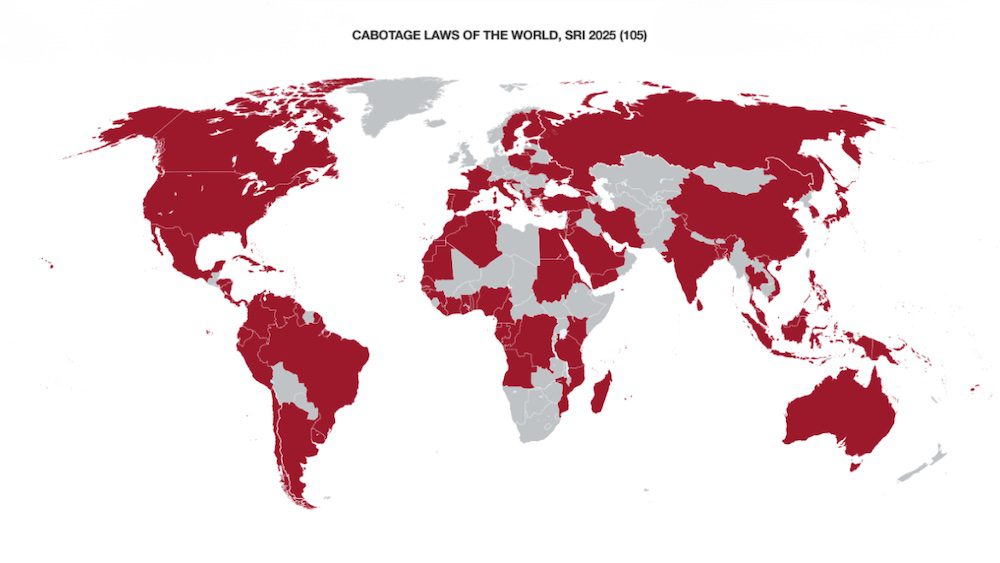
The number of countries enforcing cabotage laws has jumped from 91 in 2018 to 105 in 2025, representing the fastest expansion in the centuries-long history of such maritime regulations, according to a newly released study by Seafarers’ Rights International.
The report, titled “Cabotage Laws of the World” and commissioned by the International Transport Workers’ Federation, finds that these 105 nations now control 85% of the global coastline. Cabotage laws restrict the waterborne transportation of goods or passengers between two points within the same country to domestic carriers, ensuring that critical services remain reliable within a country in times of crisis.
“Countries appear no longer to be viewing cabotage as merely economic policy, but also as essential to national security and strategic autonomy in an increasingly unstable geopolitical environment,” said Deirdre Fitzpatrick, co-author of the report and Executive Director of SRI. “These 105 nations represent a remarkably diverse group controlling 85% of the global coastline. We are proud that interest in our first report appears to have translated into concrete action, with nations strengthening maritime strategies for a world grown more uncertain since the pandemic.”
In the United States, maritime cabotage is governed by the Jones Act, a law passed in 1920 that requires vessels transporting cargo between U.S. ports to be U.S.-built, U.S.-owned, U.S.-flagged and U.S.-crewed. Similar laws exist for airplanes, trains and trucks transporting cargo in the country.
David Heindel, President of the Seafarers International Union and Chair of the ITF Seafarers’ Section, said the report provides “a compelling and independent affirmation of what the maritime community has long recognized — the Jones Act serves the best interests of the United States, its mariners, and our economic and national security.”
“The United States remains the global benchmark for strong cabotage and maritime policy, and it is no surprise that nations confronting today’s geopolitical challenges are reinforcing their own cabotage frameworks to preserve sovereignty and safeguard critical maritime infrastructure,” Heindel said.
“The United States must take the lead in securing our own maritime border and domestic supply chain and not let foreign governments or foreign carriers decide our fate,” stated Jennifer Carpenter, President of the American Maritime Partnership. “Just as we wouldn’t allow foreign airlines to transport passengers between U.S. cities or foreign trucks to ply U.S. highways, the same principle has long applied for maritime,” she said.
The Jones Act supports an estimated 650,000 jobs and contributes $150 billion to the U.S. economy annually, while also contributing to the strategic sealift capacity needed for America’s armed forces. The United States maintains approximately 40,000 vessels in the Jones Act fleet.
Other nations with strong cabotage laws similar to the United States’ Jones Act include South Korea, Japan, Israel, Brazil, Turkey and China.

 Join The Club