By Gavin van Marle (The Loadstar) – Container freight spot rates on the Asia-Europe trades largely returned to pre-Iran conflict levels this week, as container supply chains settled after the war’s outbreak and settled into what appears to be the normal seasonal slowdown.
According to the World Container Index (WCI) produced by Drewry, spot rates on the Shanghai-Rotterdam corridor fell 4% week on week, to finish at $2,147 per 40ft, while the Shanghai-Genoa leg declined 8% from the previous week, to end at $3,071 per 40ft.
By way of reference, on 26 February the WCI’s Shanghai-Rotterdam reading stood at $2,094 per 40ft and Shanghai-Genoa at $3,071 per 40ft.
Drewry argued that the Asia-Europe declines were “driven by weak seasonal demand and excess capacity”.
The Xeneta freight rate platform showed similar trends, according to its chief analyst, Peter Sand.
“On the European ocean container shipping trades, these new routing patterns are now established and carriers have reorganised capacity, meaning freight rates are easing from the spike in the immediate aftermath of conflict,” he said.
“Compared with one month ago, average spot rates from Far East are down 6% to North Europe and 13% to [the] Mediterranean,” he said.
The chief question for both trades now is how carriers decide to manage capacity.
Drewry noted that only three sailings next week had so far been blanked, and planned 1 May FAK increases largely scrapped, with Linerlytica reporting that it “appears to be doomed after Maersk extended their end April rates through the first two weeks of May”.
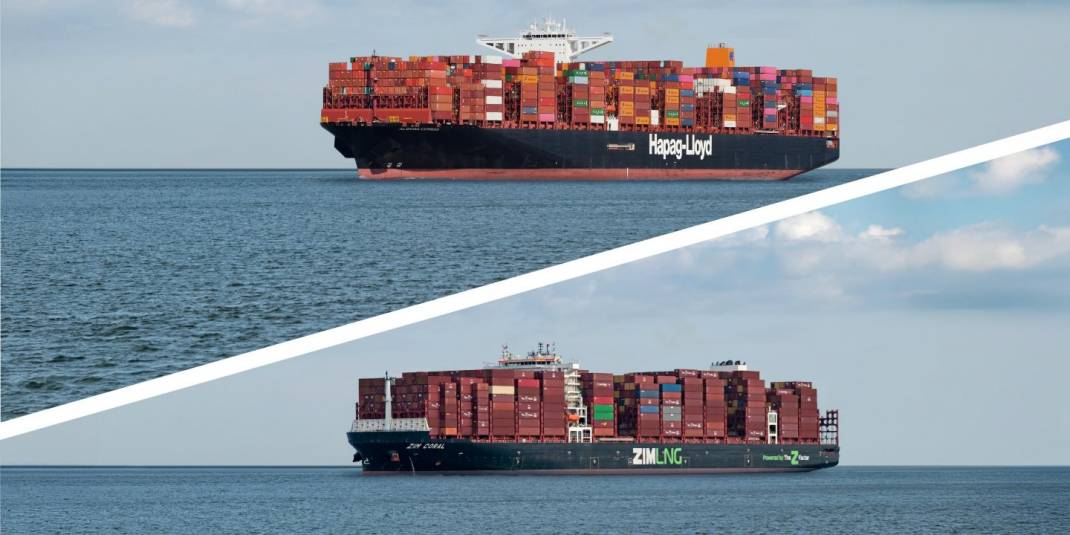
Meanwhile, both Hapag-Lloyd and CMA CGM issued new FAK Asia-Europe levels for implantation on 15 May of $3,500 per 40ft on Asia-North Europe and $4,500 to the West Mediterranean.
The success of these will depend on capacity, and Mr Sand said Asia-Europe carriers were finally beginning to address the excess supply.
“Carriers are actively managing capacity to prevent rates from falling freely on the European trades, while also keeping the US-bound trades tight,” he said. “Four of the five major fronthaul trades saw capacity decline this week, with Far East to North Europe down 6.6%.
“That combination of crisis-driven congestion and deliberate supply management is why rates remain elevated across the board, even where the direct impact of the conflict should be limited,” he said.
That same tactic appears to be working on the transpacific, where the WCI’s Shanghai-Los Angeles leg rose 4% week on week, to end at $2,934 per 40ft, while the Shanghai-New York was flat, at $3,562 per 40ft.
“Carriers are wary of sending the wrong signals by dropping rates ahead of the conclusion of the annual service contracts by 1 May,” Linerlytica said, adding there had been a mini volume bump due to public holidays in South-east Asia.
“Capacity utilisation is holding up better than on Asia-Europe, supported by the seasonally higher volumes ahead of the Songkran holidays in Thailand and Reunification Day holidays in Vietnam, as well the 1 May Labour Day holidays in many parts of Asia.
“However, the weaker post-holiday volumes will reduce carriers’ ability to push for any meaningful rate hikes in early May,” it added.
US west coast forwarder Freight Right said the underlying volume weakness meant that high-volume shippers were able to secure some discounts on spot rates into the west coast and had been paying $2,100-$2,200 per 40ft this week, but that a series of blanked sailings had made the trade increasingly volatile.
“There is a notable rise in ‘rolled’ bookings, where cargo is pushed to later vessels due to the reduced number of active sailings.
“Schedules have become highly unreliable – in one instance, a scheduled sailing for the final week of April disappeared from carrier websites entirely, with the next available slot pushed to early May,” it said, and added that if demand did not recover next month, “the gap between special discounted rates and official sticker prices may widen, eventually forcing a correction in general market rates”.
The Loadstar is known at the highest levels of logistics and supply chain management as one of the best sources of influential analysis and commentary.

 Join The Club