Don’t Miss Your Daily Briefing for the Maritime Industry
Join the leading maritime news network
— trusted by our 106,406 members
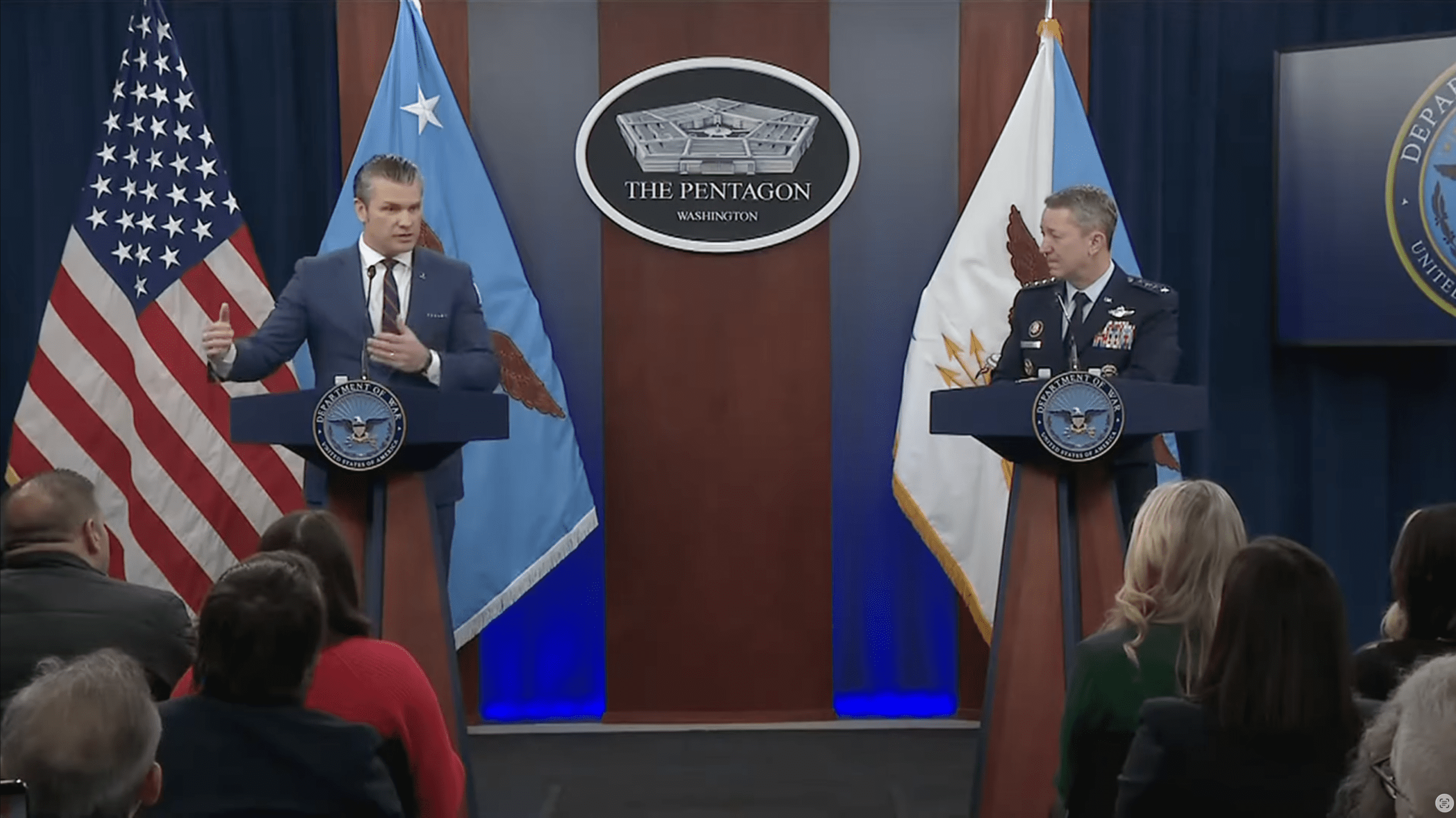
Department of War Secretary Pete Hegseth and General Daine Caine hold a press conference on Operation Epic Fury, the U.S. and Israel joint operation that carried out strikes in Iran and killed Supreme Leader Ayatollah Ali Khamenei.
Secretary of War Pete Hegseth stood at the Pentagon press podium this morning and named Iran’s threat to “global shipping lanes” as a core justification for Operation Epic Fury — the largest American aerial campaign since the invasion of Iraq. He cited Iran’s swelling arsenal of ballistic missiles and killer drones. He cited the Navy of a regime that has harassed, seized, and attacked commercial vessels for four decades. He declared the objective in plain language: destroy Iran’s Navy.
“Iran’s stubborn and self-evident nuclear pursuits, their targeting of global shipping lanes, and their swelling arsenal of ballistic missiles and killer drones are no longer tolerable risks,” said Hegseth. “Iran was building powerful missiles and drones to create a conventional shield for their nuclear blackmail ambitions. Let me say that again,a conventional shield for their nuclear blackmail ambitions. Our bases, our people, our allies, all in their crosshairs.”
This isn’t the first time the Trump administration has gone to war over shipping lanes. In March 2025, Hegseth and Trump launched Operation Rough Rider, a 52-day air campaign against the Houthis in Yemen with the stated goal of restoring freedom of navigation in the Red Sea. That operation ended with a deal that protected U.S.-flagged ships but left commercial shipping largely exposed.
Roughly 20% of the world’s petroleum transits the Strait of Hormuz every day and right nowU.S. naval forces are actively engaged with the Iranian Navy across the Persian Gulf. Over 1,000 targets were struck in the first 24 hours, including Iranian naval forces and coastal infrastructure along the southern flank. Hundreds of Iranian ballistic missiles have been intercepted by Patriot batteries and BMD-capable Navy destroyers. Four Americans are dead.
Freedom of navigation is a priority but nobody at that podium gave pratcial advice for mariners and nobody mentioned the Strait of Hormuz by name. Nobody addressed commercial vessel routing. Nobody discussed the status of maritime warning zones. Nobody mentioned Iran’s mine warfare capability, the largest mine inventory in the Middle East, and the most obvious asymmetric response from an IRGC Navy that knows it’s being destroyed.
Vice Admiral Kirk Renshaw, commanding U.S. Naval Forces Central Command, is “engaged with the Iranian Navy and projecting American naval combat power from the seas.” The Gerald R. Ford carrier strike group sprinted across the Atlantic from the Western Hemisphere to set the theater. The Lincoln strike group was already in position. Tomahawk cruise missiles from Navy surface combatants were the first shooters at H-hour, 9:45 AM Tehran time on Saturday, February 28th. Two carrier air wings are flying strike missions. BMD-capable destroyers are running integrated air and missile defense across the region.
General Caine named air defense contributions from Qatar, UAE, Kuwait, Jordan, and Saudi Arabia. He named zero naval coalition partners. The Royal Navy, near-permanent Gulf presence for decades, unmentioned. Combined Maritime Forces, headquartered in Bahrain, unmentioned. Either coalition naval participation is classified, nonexistent, or only partially assisting. Any of those answers has significant implications for commercial shipping.
General Caine did mention the great work of US Transportation Command, buy did not mentioned if TRANSCOM is loading any sealift ships like we witnessed at the start of the Iraq and Gulf wars.
The campaign is 57 hours old. CENTCOM is running offense and battle damage assessment simultaneously, adjusting fires in real-time. Three F-15Es were lost overnight to non-combat causes under investigation. The administration has deliberately avoided committing to timelines. When pressed, Hegseth deferred to the president. Caine said it “could move forward, could move back.”
The Conventional Shield Theory
The most strategically significant argument in Hegseth’s briefing explains why this target set, why now, and why the Navy is on the list.
His framing: Iran built its conventional arsenal, missiles, drones, naval forces, as a shield behind which to pursue nuclear weapons with impunity. “A conventional gun to our head,” he said, “as they tried to lie their way to a nuclear bomb.” Operation Midnight Hammer destroyed the nuclear program last June. The administration told Tehran to make a deal. Tehran stalled, buying time to rebuild missile stockpiles and restart nuclear work. Operation Epic Fury is designed to destroy the conventional capability that would have protected reconstituted nuclear facilities from future strikes.
The Iranian Navy fits this strategic theory. It was never about blue-water power projection, it was about holding the Strait hostage. About making the cost of any strike on nuclear facilities unacceptable by threatening to shut down 20% of global petroleum transit.
But the maritime industry doesn’t trade in strategic theories. It trades in risk premiums and war-risk insurance has been cancel for most ships operating in the region.
The Merchant Mariners Nobody Mentioned
Hegseth invoked his “generation of veterans” killed by Iranian-backed forces. The rage is earned. But he didn’t mention the US Merchant Mariners who have been on the front lines of Iranian aggression since before the first American soldier set foot in Iraq or the seafarers who suffered the brunt of Iran’s agression during the tanker wars of the 1980’s.
The crew of the SS Bridgeton, hit by an Iranian mine in 1987. The tanker crews running the Strait under threat for four decades. The commercial mariners seized and harassed by IRGC fast boats. The crews who sailed through Houthi missile barrages in the Red Sea while the world debated response options.
Insurance is being canceled across the region and costs are in the Gulf are spiking. Vessel routing through the Strait needs real-time naval guidance and the alerts from the US Maritime Administration are vague. The status of Iran’s mine warfare capability needs to be addressed publicly before a commercial vessel hits one. And the long-term question who will patrol Iran’s coast after the regime is gone remains open.
Hegseth closed by telling America’s warriors to “keep going” and he concluded with a prayer.
“My prayer for them is that I do pray for U.S. service members in harm’s way right now. My wife prays for them,” he told reporters. “Our family prays for them. None of this is done on a whim. I’ve been in their boots. I’ve been in their shoes. I’ve been in their flight suits.”
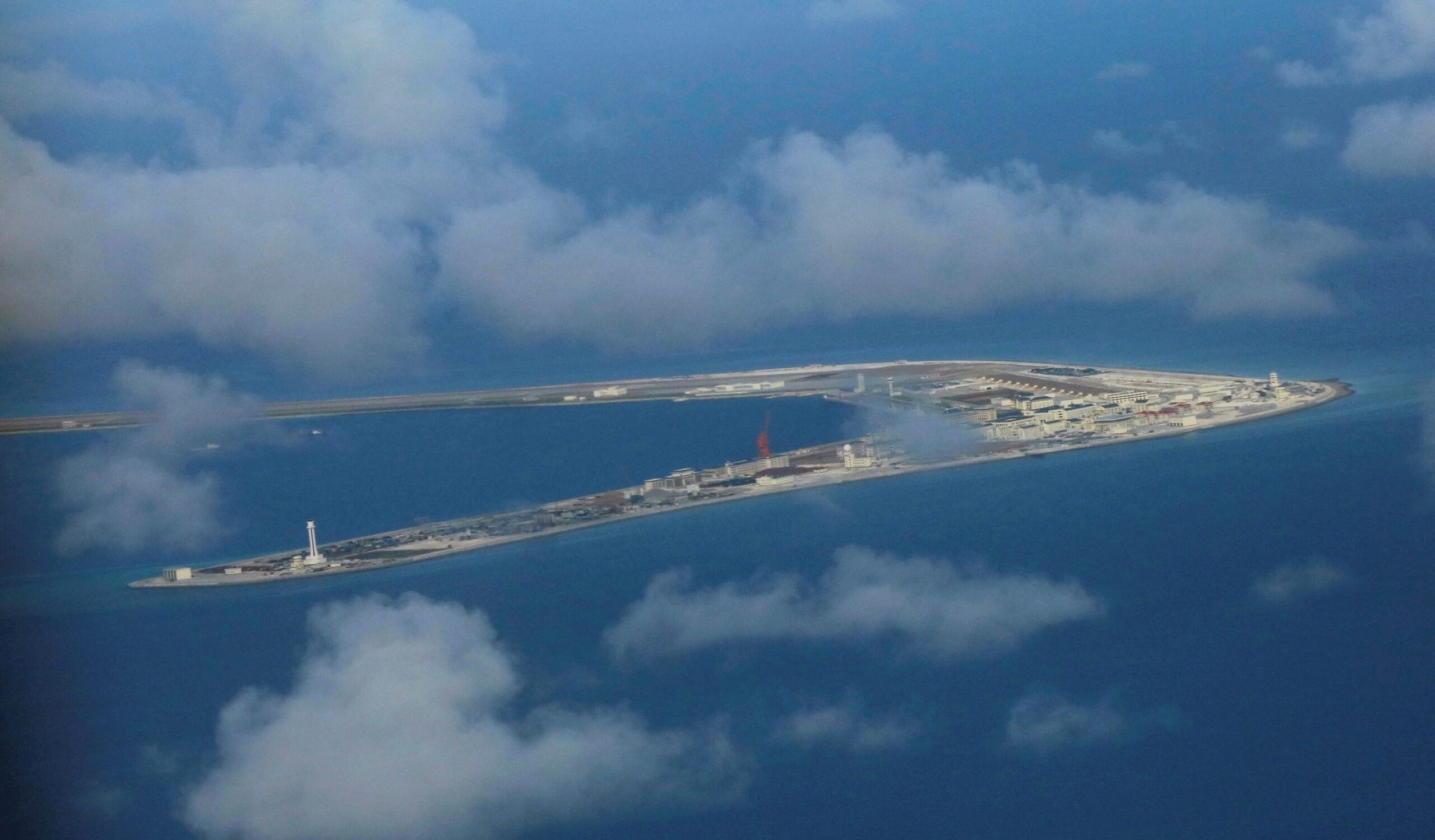
China's military said on Tuesday it had sent forces to watch a US warship that "illegally" entered waters around a disputed shoal in the South China Sea, while further north in the waterway, Taiwan reported a standoff with a Chinese vessel.
DUBAI, Oct 18 (Reuters) – Iran’s offer to the United States to reopen the Strait of Hormuz within seven days is still on the table, Foreign Minister Abbas Araqchi told Iranian media...
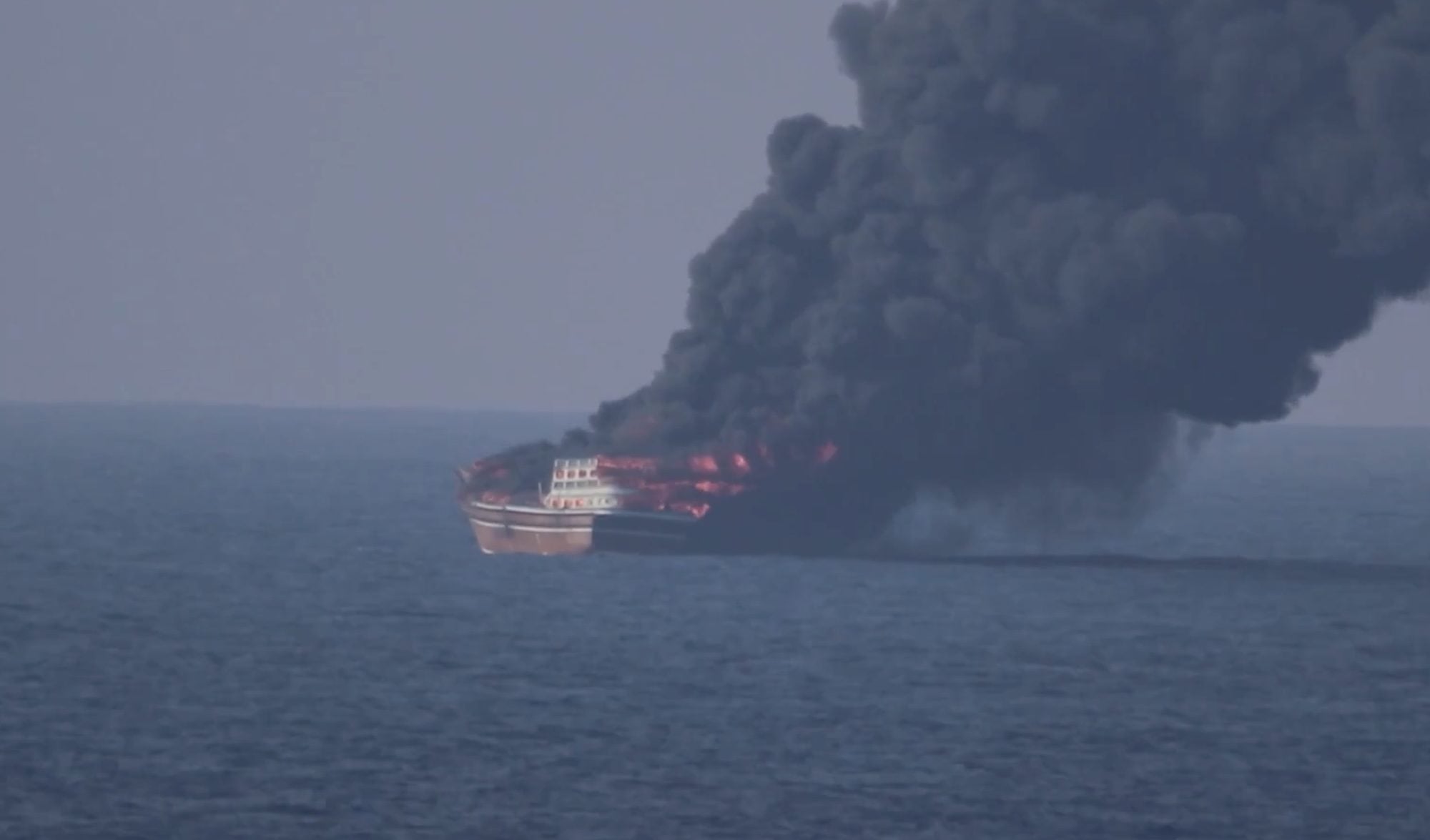
U.S. forces destroyed an Iranian-affiliated dhow in the Gulf of Oman on October 6 after determining that the vessel was conducting surveillance and helping target American warships, U.S. Central Command...
October 14, 2026
Total Views: 3654
Get The Industry’s Go-To News
Subscribe to gCaptain Daily and stay informed with the latest global maritime and offshore news
— just like 106,406 professionals
Secure Your Spot
on the gCaptain Crew
Stay informed with the latest maritime and offshore news, delivered daily straight to your inbox
— trusted by our 106,406 members
Your Gateway to the Maritime World!
Essential news coupled with the finest maritime content sourced from across the globe.

 Join The Club