By Paul Morgan (gCaptain) – The prospect of a multinational mission to secure commercial shipping through the Strait of Hormuz has moved sharply up the diplomatic agenda after European leaders gathered in Paris today, even as Iran and the United States declare the waterway “open” following a ceasefire tied to Lebanon.
Chaired jointly by Emmanuel Macron and Keir Starmer, the meeting brought together representatives from around 40 countries in what is now the clearest sign yet that Europe is preparing for a post-conflict maritime stabilisation operation. Leaders or senior representatives from Germany, Italy and a wider coalition from Europe, Asia and the Middle East were expected to participate, with some attending virtually.
For shipping markets, the symbolism is significant. For governments, it is more so. Once states begin convening coalition meetings on restoring freedom of navigation, the conversation has shifted from political messaging to operational planning—even as competing claims emerge about whether that freedom has already been restored.
Iran’s Foreign Minister, Seyed Abbas Araghchi, said that “passage for all commercial vessels” through the strait is “declared completely open” for the duration of the ceasefire, with transits to follow a “coordinated route” along Iran’s coastline. U.S. President Donald Trump echoed the announcement, stating the waterway is “completely open and ready for business and full passage,” while adding that the U.S. naval blockade would remain “in full force and effect” as it pertains to Iran.
For industry participants, those statements introduce as many questions as they answer. The reopening appears conditional, tied both to a ceasefire window and to routing guidance issued by Iran, raising uncertainty over whether vessels must coordinate movements—or seek permission—to transit.
The Strait of Hormuz remains one of the world’s most critical maritime chokepoints, carrying around 20% of global oil and substantial liquefied natural gas volumes in normal trading conditions. Any sustained disruption quickly reverberates through tanker rates, bunker prices, inflation expectations, insurance premiums and wider supply chains.
Against that backdrop, German Chancellor Friedrich Merz has already signalled Berlin’s conditional readiness to contribute. Merz said Germany was prepared in principle to help secure maritime traffic through Hormuz, but only if there were a ceasefire, an international mandate, ideally from the United Nations Security Council, and approval from the German parliament.
That position reflects both German constitutional constraints and a wider European preference to avoid being drawn into active combat operations while still protecting global trade routes—an approach that may now intersect with a reopening that exists on paper, but not yet fully in practice.
Today’s Paris summit appears designed precisely around that distinction. According to Reuters, the mission under discussion is framed as multilateral and purely defensive, focused on restoring safe passage rather than joining any offensive military campaign.
For the maritime industry, that wording matters. Defensive operations can include mine countermeasures, surveillance, traffic management, intelligence sharing and escort services for merchant vessels. These are highly specialised tasks, but they are commercially decisive—particularly if the strait’s reopening remains constrained by routing controls and ongoing security risks.
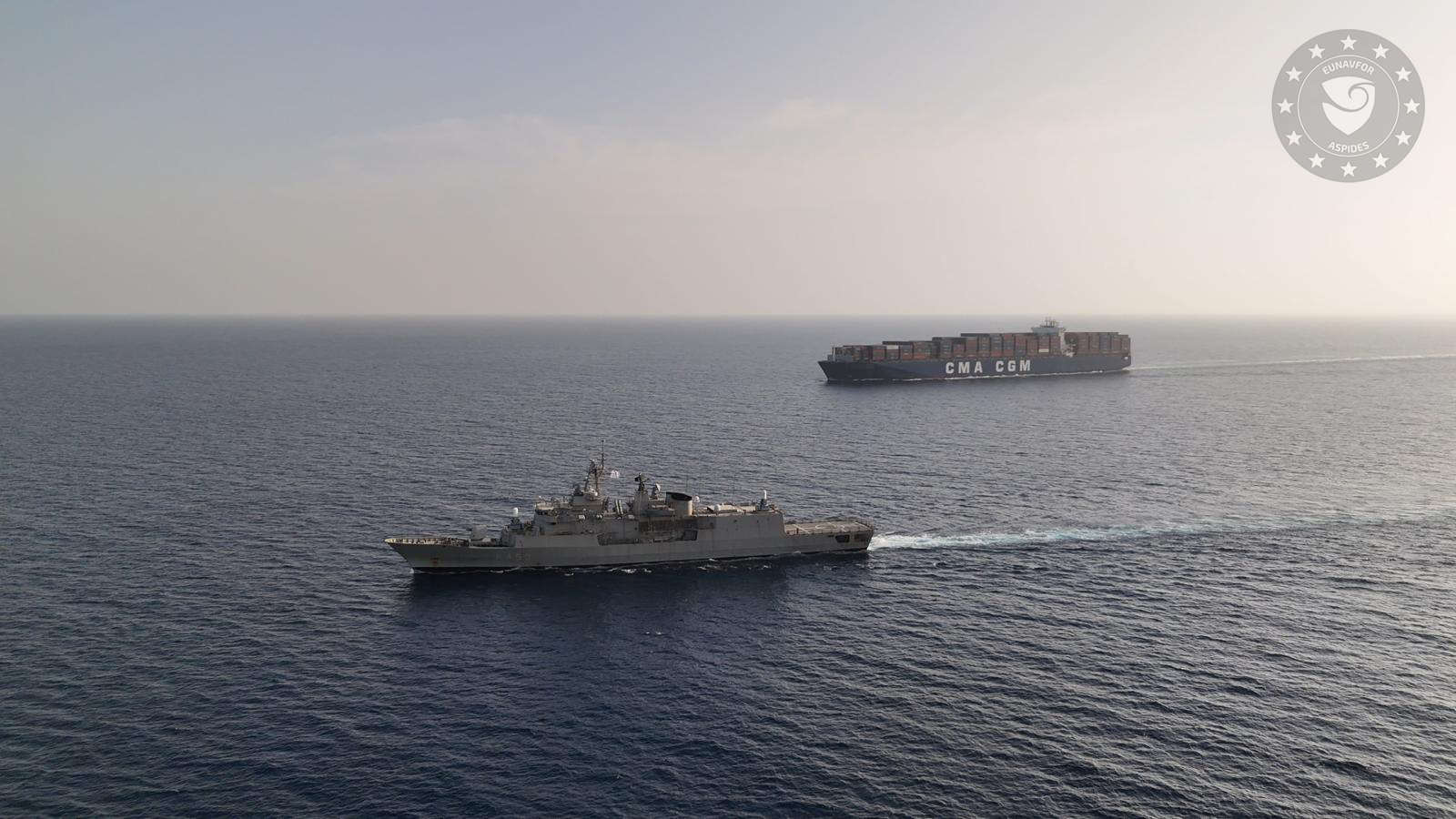
French Defence Minister Catherine Vautrin said ahead of the summit that several European countries possess the capabilities required for mine clearance in Hormuz. She specifically referenced nations such as Belgium, Netherlands and France, and added that there were capabilities available to provide “fully supported escort services” for ships transiting the strait.
That is an important operational clue. If the waterway has been mined, threatened by drifting hazards, or remains uncertain despite the reopening announcements, minehunters and hydrographic assets may be more valuable in the early stages than frigates. Reopening a sea lane is not simply about sending warships; it is about restoring confidence for commercial masters, charterers and insurers.
Reports linked to German government sources suggest Berlin could contribute mine-countermeasure or reconnaissance vessels, while frigate deployment is considered less likely. Germany has not officially confirmed a force package, but the suggestion aligns with the capabilities of the German Navy and Europe’s broader maritime strengths.
For shipowners and operators, confidence is everything. A nominal reopening of Hormuz—particularly one tied to a coordinated route and overlapping with an active U.S. blockade—means little if underwriters still classify the route as prohibitively dangerous, crews are unwilling to sail, or charterers fear delay and force majeure disputes. Any successful coalition would therefore need to provide more than a flag presence. It would need clear routing advice, intelligence fusion, rapid incident response and visible mine-clearance progress.
The political complexity remains considerable. Notably, the United States, Israel and Iran are not central participants in the current European-led discussions. Reuters reported that future coordination with Washington and Tehran may still be necessary, but the immediate purpose of the summit is to organise non-belligerent states around a stabilisation framework.
That reflects a pragmatic reality. Shipping lanes are reopened most effectively when those not directly party to the conflict can act as neutral guarantors of commercial passage—particularly when the principal actors are simultaneously declaring the route open while maintaining enforcement measures that complicate transit.
There is also precedent. Europe previously established the European Maritime Awareness in the Strait of Hormuz initiative, which focused on surveillance and reassurance patrols. A new mission would likely be larger, more robust and more technically focused on mine warfare and escorted transit if risks persist beneath the surface of the reopening.
Markets are already watching. Energy traders and freight desks responded positively to signs of diplomatic coordination and reopening rhetoric, with wider investor sentiment lifted by hopes of de-escalation in the region.
For the maritime sector, the Paris summit sends a clear message: Europe is no longer merely discussing the strategic importance of Hormuz—it is beginning to plan for the conditions required to make any reopening real.
Whether that plan becomes a functioning naval coalition will depend on ceasefire durability, legal mandates and political will. But for tanker owners, LNG carriers, insurers and commodity traders, one conclusion is already evident.
The Strait of Hormuz may now be declared open. But reopening it in practice—safely, predictably, and at scale—will still need to be organised, protected and trusted.

 Join The Club