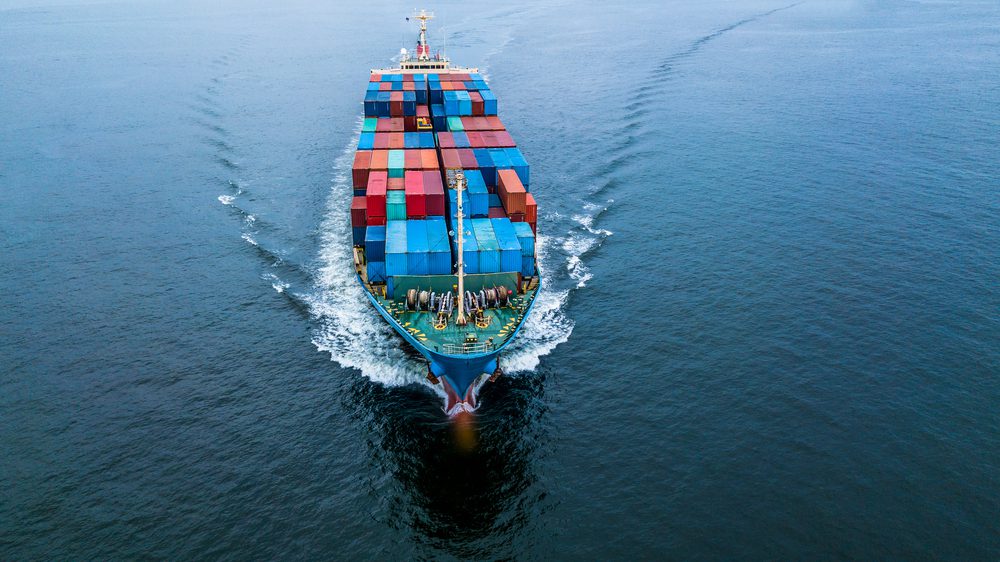
ABS has awarded Approval in Principle (AIP) for a concept design for a nuclear-powered 15,000 TEU containership developed in collaboration with the Korea Research Institute of Ships and Ocean Engineering (KRISO) and the Korea Atomic Energy Research Institute (KAERI), marking another step in the maritime industry’s efforts to evaluate advanced nuclear propulsion for commercial shipping.
The concept vessel is powered by a small modular reactor (SMR) using a marine molten salt reactor (MSR) design. The approval is part of an ongoing joint development project between ABS, KRISO and KAERI to assess the technical feasibility of nuclear-powered merchant ships and establish the technical and safety framework needed to support future designs.
According to ABS, KRISO developed the concept design for the containership, KAERI designed the marine molten salt reactor, and ABS conducted the classification review that resulted in the Approval in Principle.
“Nuclear has the potential to fundamentally alter commercial shipping in vessel design, operating range and energy economics,” said Patrick Ryan, ABS Senior Vice President and Chief Technology Officer. “ABS is focused on building the technical and safety framework needed to support that, and this AIP with KRISO and KAERI is a concrete part of that work.”
The project forms part of a broader multi-year collaboration aimed at identifying technical challenges, advancing vessel concepts and applying class and safety requirements to next-generation nuclear-powered ships.
“SMR-powered ships are a next-generation technology that will determine the future competitiveness of the shipping industry, and securing design technologies suited to the marine environment is above all essential to making them a reality,” said Keyyong Hong, President of KRISO. “KRISO will continue to enhance the marine applicability of nuclear-powered vessels through R&D in ocean engineering and international cooperation, and strive to help Korea lead related technologies and international standards.”
KAERI said it will continue refining the reactor design and its integration with the vessel while advancing testing needed to support commercialization.
“KAERI will continue to refine the interface between the MSR system and the vessel, enhancing the design to address the unique operating conditions of ships, and pursue testing and demonstration of key technologies to support the commercialization of SMR-powered vessels,” said Jinyoung Cho, Senior Vice President of KAERI.
Approval in Principle is not an approval to build a vessel but confirms that the concept satisfies applicable class requirements at the design stage, paving the way for more detailed engineering work.
Nuclear Shipping Momentum Continues
The latest approval builds on several years of work by ABS to explore advanced nuclear propulsion for commercial shipping.
In 2023, ABS and Herbert Engineering published a landmark study examining nuclear-powered containerships and tankers using advanced reactor technology. The study found that a 14,000 TEU containership equipped with two 30 MW fast reactors could operate for its entire 25-year service life without refueling while eliminating carbon emissions and potentially increasing cargo capacity by removing conventional fuel tanks.
Earlier this year, HD Korea Shipbuilding & Offshore Engineering unveiled a 15,000 TEU nuclear-powered containership concept that also received ABS Approval in Principle. In March, ABS, HD KSOE and HD Hyundai Samho Heavy Industries launched a joint development project to study a nuclear-powered electric propulsion system for a 16,000 TEU containership.
ABS has also supported nuclear-powered LNG carrier concepts and floating small modular reactor power platforms as interest grows in reactor technologies that could provide long-range, zero-carbon propulsion without relying on alternative fuels such as methanol, ammonia or hydrogen.

 Join The Club