By Paul Morgan (gCaptain) – Three separate approvals in principle for nuclear-powered commercial ships have been granted since June 2026: to a Korean consortium’s molten salt reactor container ship, to a Lloyd’s Register-backed car carrier project, and to a reactor design produced through the MIT Maritime Consortium. Each is real. None of them puts a nuclear-powered container ship anywhere near a port. The gap between those two facts is the whole story.
An Approval in Principle, or AiP, is a classification society’s statement that a concept design appears technically feasible and consistent with known safety standards at an early stage, before detailed engineering, construction or regulatory licensing. It is not a certificate to build, and it is not a permit to operate. Lloyd’s Register’s own description of the process, given in earlier reporting on its hybrid nuclear-ready concept with Australian designer Seatransport, states plainly that an AiP is not a guarantee that a design will ultimately obtain regulatory approval, nor an assurance that it can meet every applicable code.
That distinction matters more for nuclear propulsion than for almost any other marine technology, because the codes an AiP checks a design against are, in the case of nuclear ships, decades out of date.
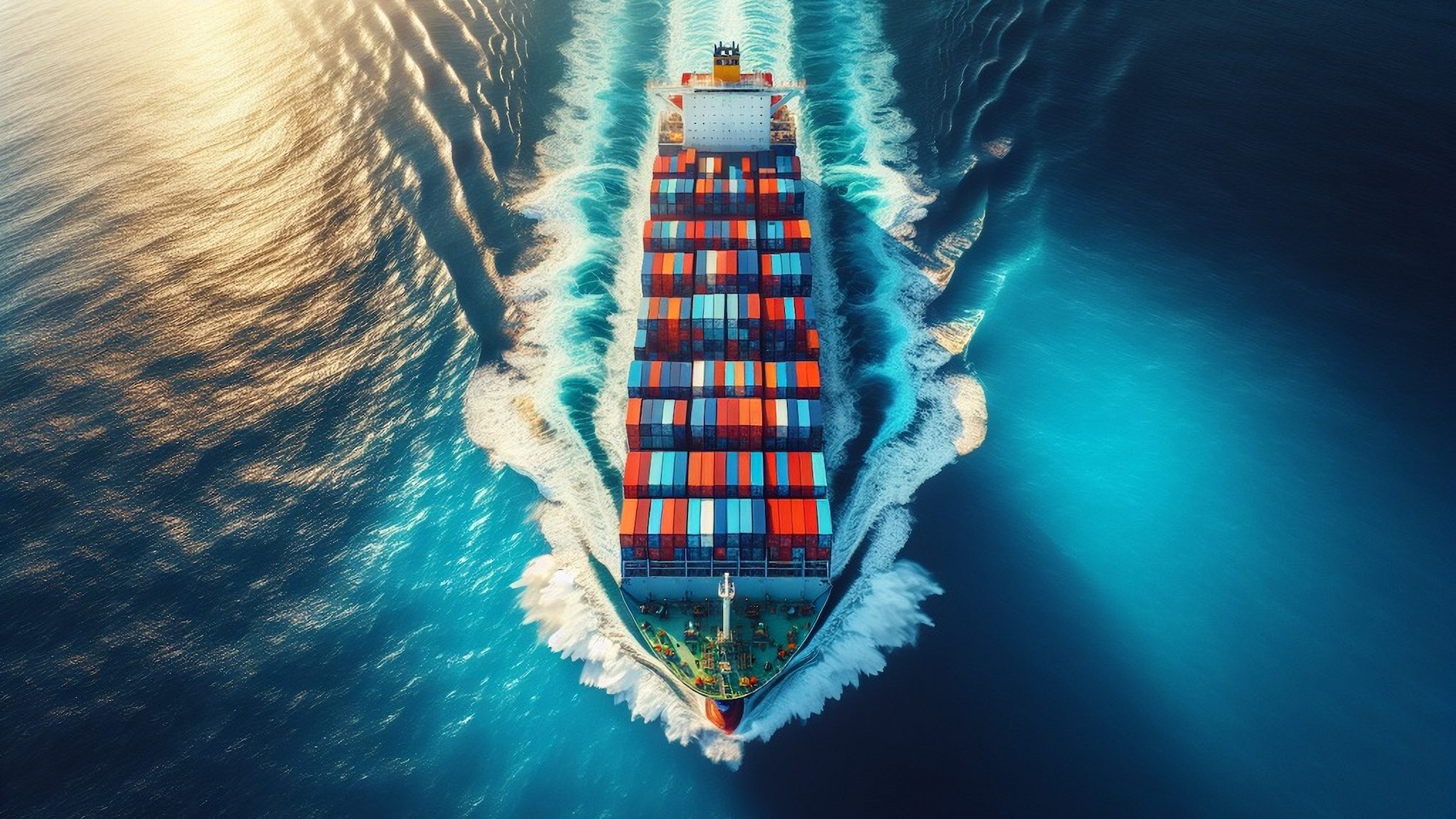
The most recent, granted by the American Bureau of Shipping in mid-July 2026, covers a 15,000 TEU container ship concept developed by South Korea’s Korea Atomic Energy Research Institute, the Korea Research Institute of Ships and Ocean Engineering, and Samsung Heavy Industries. The ship would carry two molten salt reactors, a design in which nuclear fuel is dissolved in the coolant salt itself; if the reaction failed, the mixture would solidify, encasing the fuel. The project sits under South Korea’s state-backed “K-Moonshot” research programme, and the reactor design, named MARINA, was developed at a reported cost of around 29 billion won, approximately $19.5 million. That figure comes from Korean financial press reporting rather than an official KAERI release, and should be treated as approximate.
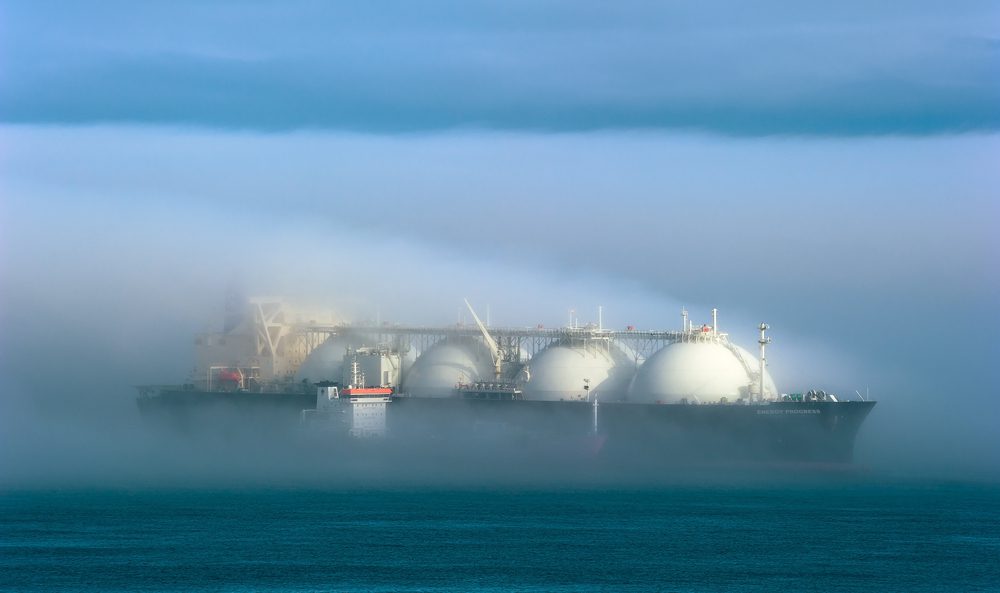
A month earlier, Lloyd’s Register approved a separate concept: a large pure car and truck carrier, based on Hyundai Glovis’s existing 7,000 CEU design, adapted to house a molten salt reactor. The joint development project involved HD Hyundai Heavy Industries, HD Korea Shipbuilding & Offshore Engineering, Hyundai Glovis as the prospective operator, ship manager G-Marine Service, and KAERI reviewing the reactor technology. The study’s scope was narrower than a full ship design: it examined how the reactor could be physically segregated from the rest of the vessel, what shielding it would need, how it would affect cargo capacity, and how its weight would alter the ship’s stability and trim.
The third, and in some ways the most interesting, came from the MIT Maritime Consortium, a research partnership whose founding members include the American Bureau of Shipping, HD Korea Shipbuilding & Offshore Engineering, Capital Maritime Group and Delos Navigation. ABS granted an AiP for a reactor design that uses a synthetic heat-transfer fluid at close to atmospheric pressure, rather than the heavily pressurised water used in conventional reactors. A lower operating pressure allows a thinner, lighter reactor vessel, which in turn opens the door to more modular construction. Current concepts in this space are generally described as operating in the range of 10 to 20 megawatts thermal, though ABS’s own materials do not give a precise figure for this specific design, and none should be assumed. Themis Sapsis, Koch Professor of Marine Technology at MIT and co-director of the consortium, described the reactor design as “one of the first concrete outcomes” of the academic-industry collaboration and said it offered “a realistic pathway towards nuclear propulsion for commercial vessels” — a quote consistent across ABS’s own press release and multiple trade outlets reporting on it directly.
All three projects are still at concept stage. None has a construction contract, a keel-laying date, or a flag state prepared to license it.
Commercial nuclear shipping has been tried before, and the pattern is consistent enough to be treated as a warning rather than a curiosity. The US-built NS Savannah, launched under President Eisenhower’s Atoms for Peace programme, entered service in 1962 and operated for roughly a decade. It was not a commercial success: built with passenger accommodation better suited to a cruise ship than a cargo vessel, it could carry only around 8,500 tons of freight, far below its diesel-powered rivals, and required a larger, more highly trained crew than a conventional ship of its size. It remains, according to US Maritime Administration records, the only nuclear-powered commercial ship to have transited the Panama Canal.
West Germany’s NS Otto Hahn, in service from 1964 to 1979, ran without major technical incident but was dogged throughout its life by the need to negotiate port entry on a bilateral, country-by-country basis, since no multilateral treaty governing nuclear ship access ever came into force. German officials later concluded that such negotiations needed to start years before a ship was built, not after.
Japan’s NS Mutsu fared worse. A shielding failure during initial testing in 1974 allowed a small leak of fast neutrons into the surrounding fishing grounds, triggering a public backlash severe enough that the ship was effectively blockaded in its home port by local fishermen. It was eventually converted to conventional diesel propulsion in 1995.
Russia’s Sevmorput, in service since 1988, is the sole commercial nuclear-powered cargo ship still operating today, and it too was barred from Russian ports amid public protest shortly after entering service, and was refused entry to the Port of Vancouver in 1990 on the grounds that the city was not equipped to respond to a reactor accident. It has not encountered comparable port-entry problems since. Outside Russia’s icebreaker fleet, no other commercial nuclear vessel exists in service anywhere in the world today, and readers should treat any suggestion otherwise as out of date.
The core international rule covering nuclear-powered ships is Chapter VIII of the SOLAS Convention, titled simply “Nuclear Ships,” which requires bilateral agreement between the flag state and any foreign state a nuclear vessel visits, and assigns emergency-response authority to the state where an accident occurs. SOLAS does not itself define detailed safety criteria; for that, the IMO adopted Resolution A.491(XII), the Code of Safety for Nuclear Merchant Ships, in 1981.
That code has not been substantively updated since. It was written around pressurised water reactor technology, the only type ever used in the small handful of ships built to date, and it draws on radiation-dose guidance that predates current International Commission on Radiological Protection recommendations. The World Nuclear Transport Institute, an industry body representing companies involved in nuclear shipping, conducted a gap assessment of the code and concluded it offers no real guidance for the newer reactor types now being proposed, including molten salt and other small modular designs. No IMO work programme to formally revise the 1981 code has yet been confirmed, and this should not be assumed to be imminent.
Classification societies have moved somewhat faster than the IMO. ABS published a code for Floating Nuclear Power Plants in 2024 that modernises elements of the 1981 IMO framework and draws on International Atomic Energy Agency safety concepts, though it is written for static installations rather than propulsion. The Russian Maritime Register of Shipping maintains the only classification code still actively used for nuclear ships in commercial service, but it too covers pressurised water reactors only, and applies domestically rather than internationally.
Only one country outside Russia has passed a dedicated national statute for nuclear shipping: the United Kingdom’s Merchant Shipping (Nuclear Ships) Regulations 2022, which apply to any nuclear vessel operating in UK waters regardless of flag, and require a safety assessment to be lodged with the Secretary of State twelve months before a nuclear ship’s arrival. In the United States, oversight would likely be split between the Nuclear Regulatory Commission, which licenses the reactor, and the Coast Guard, which certifies the ship, mirroring the arrangement used for the NS Savannah in the 1960s. The Nuclear Regulatory Commission has not yet published guidance specific to modern commercial ship propulsion, a gap that independent analysis published this year, in the MIT Science Policy Review, identifies as a significant obstacle to US-flagged nuclear shipping specifically.
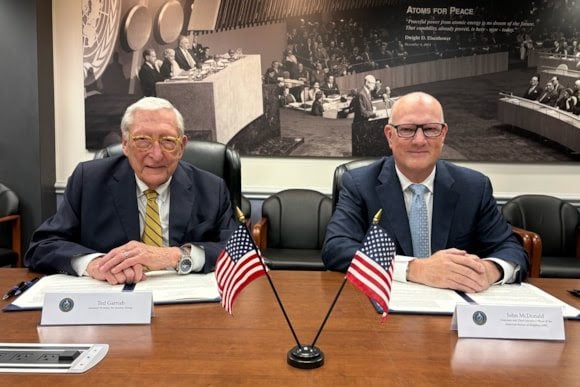
Even so, governments are beginning to lay some of the regulatory groundwork. Last week, the U.S. Maritime Administration (MARAD) and the Port of Long Beach signed a first-of-its-kind Memorandum of Cooperation to explore the future use of advanced nuclear technologies in commercial shipping and port operations. The agreement brings together MARAD, the Port, the U.S. Coast Guard, Department of Energy and Nuclear Regulatory Commission to examine safety, emergency response and regulatory issues surrounding small modular reactors. While it does not authorize nuclear-powered ships or establish new regulations, it reflects growing recognition that port readiness and regulatory coordination will need to advance alongside reactor and vessel design.
Perhaps the least visible obstacle is also one of the most consequential: there is still no international treaty in force that specifically governs liability for damage caused by a nuclear-powered ship. The Convention on the Liability of Operators of Nuclear Ships was signed in Brussels in 1962 and was intended to channel liability for a nuclear incident at sea exclusively to the ship’s operator, in the same way the Paris and Vienna conventions do for land-based nuclear installations. It has never entered into force. A related and narrower treaty, the 1971 Convention on Civil Liability in the Field of Maritime Carriage of Nuclear Material, did come into force in 1975, but it governs the transport of nuclear material as cargo on ordinary ships, not the operation of a nuclear reactor as a ship’s own power plant.
Without a functioning international liability regime, insurers, P&I clubs and flag states are left to work out coverage on a bespoke, case-by-case basis, which is itself a significant commercial barrier before any newbuild contract can be signed.
Moving from an AiP to a ship in commercial service would require, at minimum: a detailed engineering design reviewed against binding safety criteria rather than a 1981 code built around different technology; a licensing decision from a competent nuclear regulator in the ship’s flag state; bilateral or multilateral agreements covering every port the ship intends to call at, negotiated the way Germany found necessary for the Otto Hahn, years in advance; an insurance and liability framework acceptable to underwriters in the continued absence of the Brussels Convention; a trained crew and shore-based emergency response capability; and public acceptance in the communities surrounding the ports involved, given the political reaction nuclear-powered ships have generated in Japan, Canada and the Soviet Union in the past.
None of that is present yet for any of the three 2026 concepts. All three approvals are best read as evidence that classification societies now believe the underlying engineering questions can, in principle, be answered safely for at least some reactor types and ship classes. They are not evidence that the political, legal and insurance questions are close to being answered. On the historical record, those questions have consistently taken longer to resolve than the engineering ones, and there is no verified indication that this pattern has changed in 2026.

 Join The Club