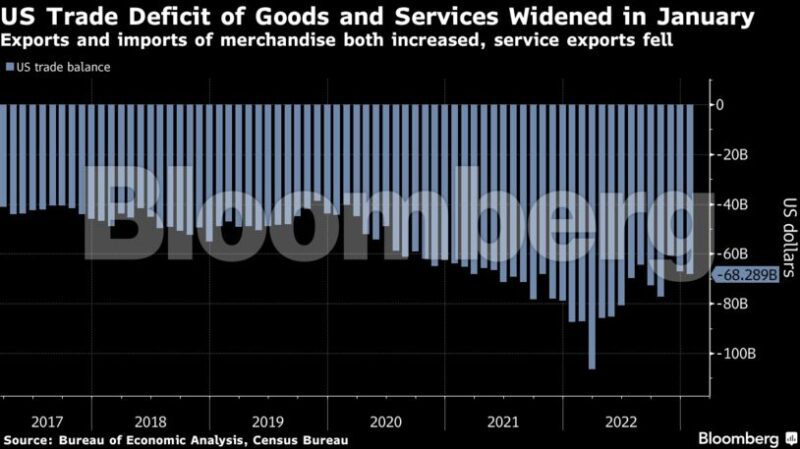
The US trade deficit grew to the widest in three months at the start of the year, reflecting a pickup in imports of merchandise.
The trade gap in goods and services increased 1.6% to $68.3 billion in January from a month earlier, Commerce Department data showed Wednesday. The figures aren’t adjusted for inflation. The median estimate in a Bloomberg survey of economists called for a $68.7 billion gap.
The value of imports increased 3% to $325.8 billion, while exports climbed to $257.5 billion.
A resilient domestic economy helped bolster demand for imports, while a months-long slide in the dollar likely helped drive overseas purchases of American-made goods.
On an inflation-adjusted basis, exports of consumer goods and motor vehicles and parts climbed to a record, while the real value of capital goods shipments overseas was the highest since March 2019.
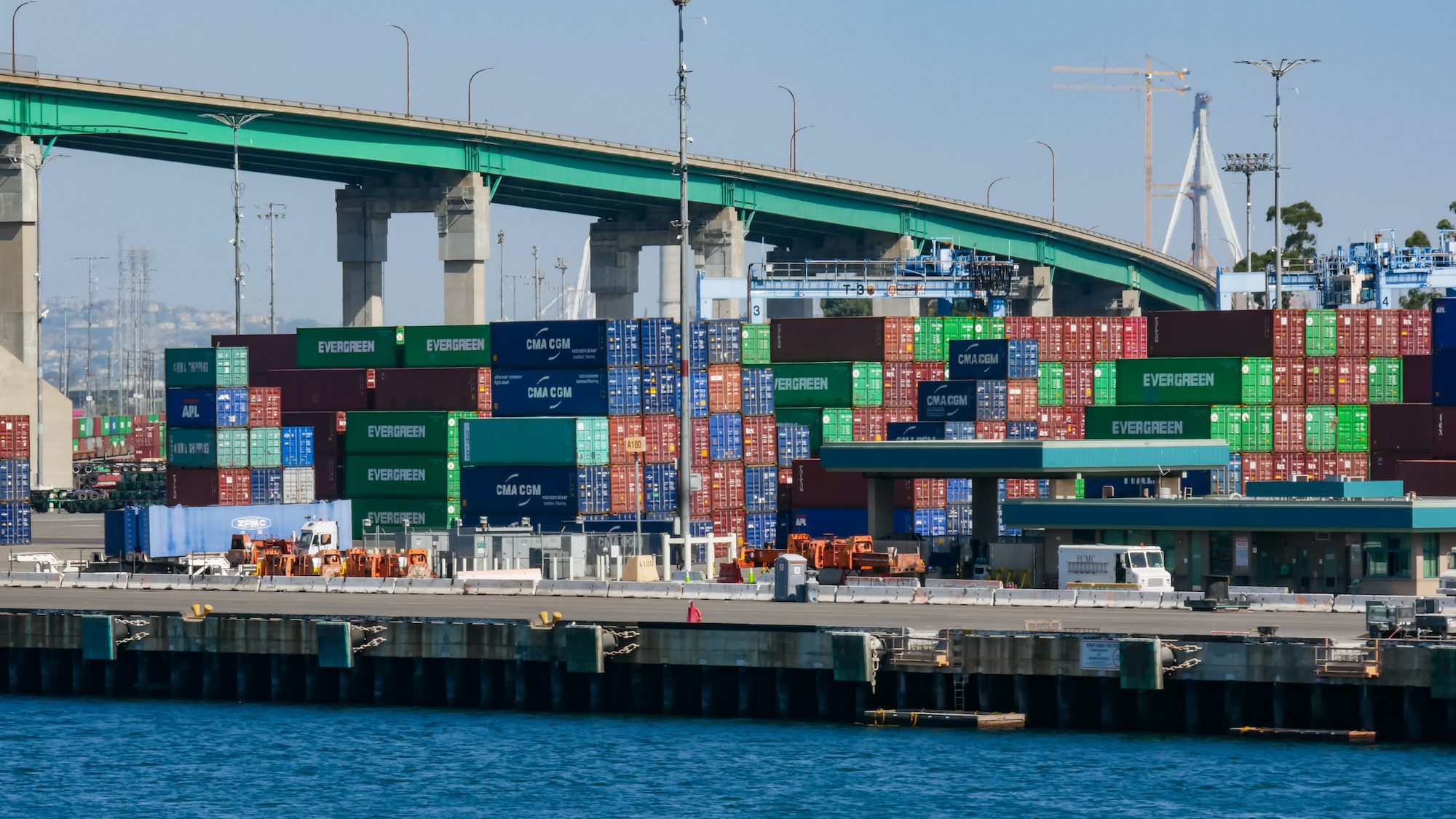
Furthermore, less shipping congestion and a normalization of global supply chains have generally helped facilitate trade between the US and other countries.
“The rebound in trade flows to start the year signals that the economy continues to carry momentum, but we do not expect the strength to be sustained in the months ahead,” Oxford Economics economists Matthew Martin and Ryan Sweet said in a note.
Prior to Wednesday’s report, the Federal Reserve Bank of Atlanta’s GDPNow estimated net exports would add about 0.6 percentage point to growth in the first quarter. That would be slightly more than trade added in the fourth quarter.
While the nominal goods-trade deficit narrowed slightly, the January merchandise shortfall on an inflation-adjusted basis widened to $101.8 billion, also the biggest in three months.
Digging Deeper
US goods exports, unadjusted for price changes, increased for the first time since August. The gain was broad and included pickups in pharmaceuticals and other consumer goods, capital equipment and autos.
Travel exports — or spending by visitors to the US — dropped to $12.1 billion
Travel imports, a measure of Americans traveling abroad, increased to $11.9 billion, matching a record
US goods-trade deficit with China, on an unadjusted basis, widened to $25.2 billion from $23.5 billion
–With assistance from Jordan Yadoo and Ana Monteiro.
Drewry’s World Container Index rose for a second straight week, with higher transpacific rates outweighing declines on Asia-Europe trades as carriers continue to manage capacity amid widespread supply chain disruption....
U.S. Central Command has confirmed that American forces fired two Hellfire missiles at the Panama-flagged containership Vela Nova in the Gulf of Oman on Tuesday, disabling the vessel after it allegedly ignored...
Maersk and Hapag-Lloyd are expanding their renewed use of the Red Sea and Suez Canal, adding a call at Saudi Arabia’s Jeddah to their AE15 Asia-Mediterranean service even as renewed...
August 10, 2026
Total Views: 1684
Get The Industry’s Go-To News
Subscribe to gCaptain Daily and stay informed with the latest global maritime and offshore news
— just like 104,396 professionals
Secure Your Spot
on the gCaptain Crew
Stay informed with the latest maritime and offshore news, delivered daily straight to your inbox
— trusted by our 104,396 members
Your Gateway to the Maritime World!
Essential news coupled with the finest maritime content sourced from across the globe.

 Join The Club