By Paul Morgan (gCaptain) – Thorium, an abundant and largely overlooked radioactive metal, is emerging as the fuel of a new generation of compact molten salt reactors that could transform how ports produce marine fuels and support the energy transition. With China achieving the world’s first experimental proof of the thorium breeding cycle, and Danish engineers designing factory-built reactors that fit inside a shipping container, the timeline may be shorter than most in shipping expect.
The maritime industry has spent the past decade searching for the energy transition’s missing piece. LNG brought methane slip in its wake. Green methanol supply remains scarce. Ammonia has not resolved its toxicity and combustion challenges. Batteries cannot carry sufficient energy for deep-sea routes. Against that backdrop, an older and largely forgotten idea is re-entering the conversation with fresh urgency.
Thorium has been discussed as a nuclear fuel for more than half a century, shelved alongside the broader ambitions of maritime nuclear propulsion after vessels such as NS Savannah, Germany’s Otto Hahn and Japan’s Mutsu demonstrated the concept but failed commercially. High capital costs, regulatory uncertainty and public resistance ensured the idea never scaled. What has changed today is not the ambition. It is the technology, and above all, the fuel.
Thorium itself is not directly fissile. Unlike uranium-235, it cannot sustain a nuclear chain reaction in its natural state. When placed inside a reactor and bombarded with neutrons, it transmutes into uranium-233, which is fissile and can drive a sustained reaction. That conversion process, known as breeding, is the foundation of the thorium fuel cycle. The fuel is not rare: thorium is roughly three to four times more abundant than uranium in the Earth’s crust, widely distributed across India, Brazil, Australia, the United States, Norway and Canada, and not concentrated in politically sensitive regions. Commercial high-assay low-enriched uranium production for conventional advanced reactors remains dominated by Russia, a supply chain vulnerability Western governments are only beginning to address. Thorium sidesteps that dependency entirely. Advanced thorium cycles are also projected to reduce long-lived radioactive waste by over eighty per cent compared to conventional uranium, with residual isotopes requiring storage measured in centuries rather than tens of thousands of years.
The reactor design that unlocks the fuel cycle is the molten salt reactor, first demonstrated at Oak Ridge National Laboratory in the 1960s, where it ran for more than 15,000 hours. In a molten salt reactor, fuel is dissolved in liquid fluoride salt rather than fabricated into solid rods, operating at atmospheric pressure and eliminating the high-pressure risks of conventional water-cooled plants. If the reactor overheats, fuel salt expands and slows the reaction automatically; in an emergency, a frozen salt plug melts and the fuel drains by gravity into a containment tank, halting the reaction with no operator intervention required. High operating temperatures above 600 degrees Celsius also make these reactors suitable for hydrogen production, ammonia synthesis and desalination alongside electricity generation. By dissolving fuel in the salt medium, they can refuel online, removing fission products during operation and recovering usable isotopes continuously.
That capability points to what may be the most commercially disruptive argument for nuclear fuel cycles: fuel need not be treated as a consumable at all. Traditional marine fuels represent a total and permanent expense. Nuclear fuel behaves differently. Even after years of operation, significant energy potential remains, and new fissile isotopes are generated in the process. What is called spent fuel is better understood as used fuel, a partially exhausted resource with substantial residual value. In the thorium cycle, irradiation generates uranium-233 that can be extracted and reused in subsequent cycles. Technologies such as the PUREX process, operated at industrial scale at France’s La Hague facility for decades, allow separation of usable material from used fuel, closing the energy loop. The result is a fuel model that behaves less like a commodity and more like a long-term energy asset. The most likely commercial model for shipping is reactor and fuel systems leased from specialist providers under energy-as-a-service arrangements, with operators purchasing power output while fuel remains within a managed supply chain, its residual value recovered across successive cycles.
The breakthrough that moved thorium from theory to experimental reality came from China. In October 2024, the Shanghai Institute of Applied Physics added thorium fuel to the operational 2-megawatt thermal TMSR-LF1 in Gansu Province, the first such loading in any molten salt reactor in the world. The reactor operated for ten consecutive days with thorium in the fuel salt, and detectors identified protactinium-233, confirming the breeding chain was functioning. In November 2025, the institute announced that TMSR-LF1 had achieved full conversion of thorium to uranium-233, providing the world’s first experimental data on thorium breeding in an operational reactor. In April 2025, Chinese scientists had also demonstrated continuous refuelling without shutdown. China’s next step is a 100-megawatt thermal demonstration reactor targeted for 2035, with a follow-on facility in Gansu designed to produce both electricity and hydrogen.
While China advances its programme within a national strategy, Copenhagen Atomics is building what it believes will be a commercially mass-produced version of the same technology. The Danish company, founded in 2014, is developing a thorium molten salt reactor designed to fit inside a standard 40-foot shipping container, rated at 100 megawatts thermal, and intended for assembly-line manufacture at a rate of at least one unit per day per production line, targeting clean power below twenty dollars per megawatt-hour at volume. Two full-scale non-fission prototypes have been built and more than 10,000 days of component testing accumulated.
In July 2024, the company announced its prototypes were ready for a critical experiment at the Paul Scherrer Institute in Switzerland, set for 2026 and representing the first such experiment with a thorium molten salt reactor in European history. European Innovation Council funding followed in mid-2025 to build a third prototype and prepare for that fission test. A UK subsidiary, UK Atomics, is managing commercial deployment under an energy-as-a-service model targeting electricity delivery below 48 dollars per megawatt-hour. Agreements are already in place with industrial partners towards a green ammonia facility in Indonesia capable of producing one million tonnes annually. The manufacturing philosophy is explicit: Copenhagen Atomics wants to build reactors the way cars are built today, not the way cathedrals were built in the Middle Ages.
The connection to shipping is not primarily about propulsion, at least not yet. It is about fuel supply. The alternative fuels transition rests on an unresolved problem: where does the clean energy come from to produce green hydrogen, ammonia and e-methanol at the volumes shipping needs? Wind and solar are essential but intermittent. Electrolysers and ammonia synthesis plants require continuous power to operate economically. A cluster of ten to twenty SMR units alongside a major bunkering port could deliver 400 to 800 megawatts of continuous electrical output plus high-temperature process heat, dramatically reducing the unit cost of zero-carbon marine fuels. Rotterdam, Singapore, Fujairah and Houston all face the same upstream energy constraint. Thorium SMRs represent one credible answer, with a supply side advantage: sufficient thorium is already produced as a by-product of rare earth mining to power current civilisation for centuries, without requiring new dedicated mining operations.
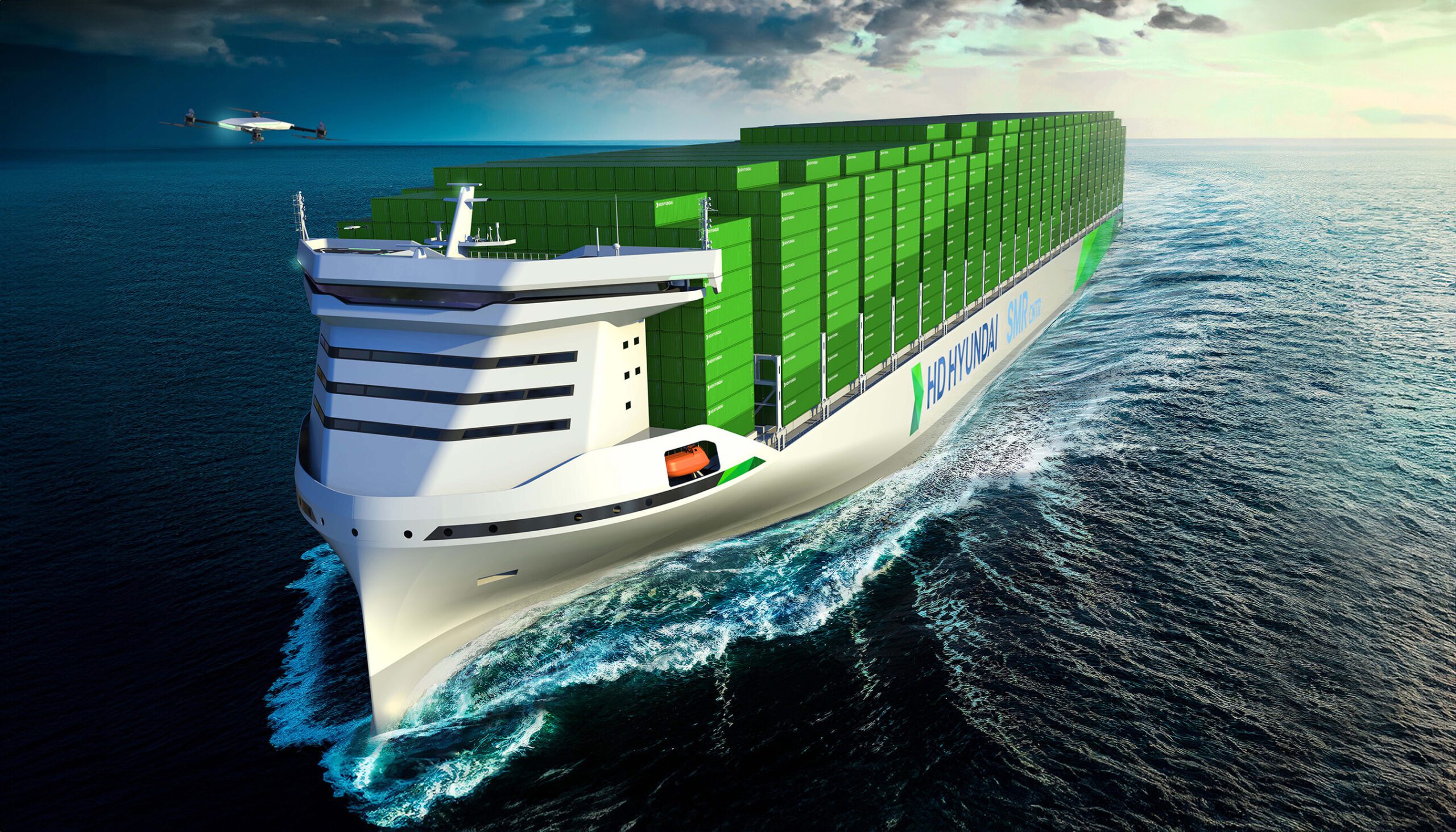
Beyond shore-based production, the longer-term trajectory points towards direct propulsion. Studies indicate that a large container vessel equipped with two 30-megawatt compact reactors could complete a 20 to 25-year service life without refuelling, eliminating bunkering logistics, fuel market exposure and lost port time, and restoring design speed operation without the fuel cost penalty that drove slow steaming. Additional cargo capacity of up to ten per cent opens up as fuel tanks and exhaust systems are removed. South Korea is targeting commercial SMR-powered vessel deployment within the decade. Norway’s NuProShip programme is advancing reactor integration studies. China has published concept designs for thorium-powered ultra-large container ships. For now, port access restrictions, insurance complexity and public acceptance mean onboard propulsion remains a longer-term prospect for merchant shipping. The immediate and commercially realistic route is shore-based nuclear supporting marine fuel production, with propulsion following as the regulatory environment matures.
The barriers are real and must not be minimised. Molten fluoride salts at 600 to 700 degrees Celsius are chemically aggressive, and pumps, heat exchangers and structural alloys must be qualified for multi-year operation. Most nuclear regulators have deep experience with solid-fuelled light-water reactors and far less with liquid-fuelled systems. No thorium MSR has yet generated a verified commercial cost figure. Siting reactors at major ports involves community relations and political will that cannot be assumed.
Thorium is not a silver bullet, and thorium SMRs will not resolve the marine fuel transition in the next five years. What they offer, if they mature as developers project, is a credible solution to shipping’s deepest decarbonisation problem: not which fuel burns in the engine room, but where the enormous quantities of clean energy needed to produce that fuel actually come from. China’s TMSR-LF1 has proved the thorium fuel cycle works in an operational reactor. Copenhagen Atomics is assembling the manufacturing model to deploy it at scale. And for the first time in the history of commercial shipping, the prospect exists of a fuel that is not burned and lost, but used, recovered and retained as an energy asset across decades. The question for shipping is not whether thorium-based SMRs will eventually matter. It is whether the industry is paying close enough attention to know when they will.

 Join The Club