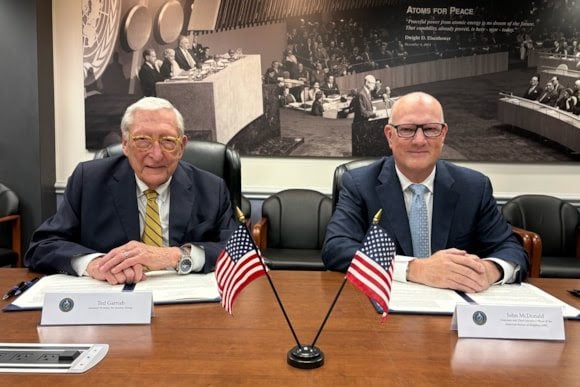
Sean Duffy’s MARAD initiative may look like another Trump-era energy dominance announcement, but beneath the politics lies a serious industrial question: can the United States build the regulatory, shipyard, insurance and port framework needed to make nuclear-powered merchant ships commercially viable before Asia takes the lead?
By Paul Morgan (gCaptain) – The real story behind the announcement made by U.S. Transportation Secretary Sean P. Duffy and the Maritime Administration on 7 May is not that America has discovered nuclear propulsion. It is that Washington has finally recognized maritime nuclear power as a shipbuilding, logistics, insurance, port-access and national-security race, and has decided to enter it. MARAD’s Request for Information, with comments due by 5 August 2026, asks industry to help develop a U.S.-built, scalable, commercially viable SMR model for marine transportation. That is a materially different ambition from funding a reactor demonstration. It is an attempt to build a complete commercial ecosystem.
The distinction was captured precisely by MARAD Administrator Stephen Carmel, whose contribution to the announcement will prove more durable than the political sloganeering surrounding it. To successfully introduce SMRs, Carmel said, we must view this through a system-transition lens rather than just as a technology demonstration. That single sentence defines the entire challenge. The reactor is not the hard part. The hard part is whether ports, insurers, classification societies, regulators, shipyards and cargo owners can collectively make nuclear-powered merchant ships commercially normal.
Shipping is uniquely suited to nuclear propulsion. The energy density argument for maritime nuclear propulsion is more compelling than for almost any other transport sector. A modern ultra-large container ship consumes between 250 and 350 tonnes of fuel per day at sea. Over a 25-year operational life, fuel can represent billions of dollars in lifecycle cost. Bunker storage, fuel treatment systems, purifier rooms, sludge handling, emissions scrubbers and the growing infrastructure of alternative-fuel compliance consume enormous volumes of space, capital and crew time. Nuclear propulsion potentially eliminates most of that complexity, a reactor fuelled for two decades or more fits within a containment space that returns cargo volume to its owners and voyage economics to their prior simplicity.
Ships are also better placed than trucks or aircraft to accommodate the physical and operational demands of nuclear propulsion. Merchant vessels already operate with highly engineered power systems and trained engineering crews. They are at sea for extended periods, away from population centres, and can physically accommodate shielding and reactor compartments within their structural envelope. Shipping economics already heavily reward energy density, which is why nuclear naval vessels have operated continuously and safely for decades. The transition from military to civilian application is genuinely achievable, if the surrounding framework can be built. Lloyd’s Register has argued that SMRs could create longer-lived, emissions-free ships if regulatory barriers are overcome. DNV has identified standardisation, modularisation and mass production as central to making the economics viable.
A Small Modular Reactor is a compact fission plant, typically generating up to 300 megawatts of output per unit, factory-built in modules for transport and installation. The physics follows the same chain-reaction principle as any nuclear plant, but modern SMR designs incorporate passive safety systems that remove the category of active mechanical failure responsible for earlier accidents: in many designs, the reactor cools by natural convection alone if power is lost.
Thorium, increasingly discussed as an alternative fuel cycle, offers further advantages. Thorium-232 converts under neutron bombardment to fissile uranium-233, is three to four times more abundant than uranium in the earth’s crust, produces significantly less long-lived radioactive waste, and is far less susceptible to weapons proliferation. Molten salt reactor designs, which dissolve thorium in liquid fluoride salt that also acts as the coolant, operate at atmospheric pressure rather than under the high-pressure steam conditions of conventional light-water reactors, removing explosive decompression risk. An approval in principle for a nuclear-powered LNG carrier using molten salt technology was granted in 2025.
The Duffy initiative must be read against the wider collapse of American commercial shipbuilding capacity. The United States now accounts for approximately 0.1 per cent of global commercial ship production. A single Chinese state shipbuilder built more vessels by tonnage in 2024 than the entire U.S. industry has produced since 1945. China commands around 70 per cent of global new ship orders; South Korea dominates advanced LNG and high-specification tonnage; Japan remains a quality builder. The U.S. has become marginal in commercial construction outside naval programmes, which is precisely why the MARAD announcement repeatedly frames SMR development as a mechanism for rebuilding domestic yards, creating strategic engineering employment, and reconnecting maritime and defence industrial capacity.
The geopolitical contrast with Europe is pointed. The European Union has approached shipping decarbonisation primarily through carbon pricing under the EU ETS, compliance penalties via FuelEU Maritime, and a fuel mandate framework that has pushed shipowners toward LNG, methanol, ammonia and hydrogen pathways whose long-term cost and supply-chain viability remain genuinely uncertain. Washington is now signalling a different logic: industrial rebuilding, nuclear-powered logistics, strategic shipbuilding, energy independence and high-density domestic energy production. While Europe debates how to tax shipping emissions, the United States is beginning to ask who will build and power the next generation of ships altogether.
South Korea is not waiting for that question to be answered. HD Hyundai has unveiled a 15,000 TEU-class SMR-powered containership concept and is working with ABS on nuclear-electric propulsion systems potentially supplying up to 100 megawatts. China has explored molten salt reactor ship concepts and is investing heavily in thorium-based systems. Russia already operates the only nuclear-powered commercial vessels in service, alongside its Arctic icebreaker fleet. The IAEA’s ATLAS initiative is building a regulatory framework for civil nuclear applications at sea, and the IMO has formally begun modernising its 1981 Code of Safety for Nuclear Merchant Ships. The Nuclear Energy Maritime Organisation was established in 2025 to coordinate global standards. Washington is arriving at a race already underway.
Duffy’s release claims that SMRs will largely eliminate fuel costs and reduce maintenance requirements. The directional argument is sound; the formulation is too simple. Nuclear fuel cost is low relative to energy output, but total lifecycle cost will include reactor capital expenditure, shielding, specialist crew certification, inspection regimes, nuclear security, decommissioning, spent fuel handling, insurance premiums and compliance with classification rules that do not yet fully exist. MARAD’s own RFI acknowledges this by asking specifically about liability frameworks, insurance structures, port-access arrangements, legal pathways and back-end fuel-cycle solutions. These are not secondary considerations. They are, as the NS Savannah demonstrated 60 years ago, the actual commercial problem.
The Savannah worked technically. Its reactor was reliable throughout its operational life. But it carried a crew a third larger than a conventional equivalent, needed a subsidy throughout its service, and was withdrawn in 1971 because the surrounding commercial framework never materialised. Port authorities demanded government-to-government negotiations before allowing entry. Dock workers refused to handle cargo for fear of radiation exposure. West Germany’s NS Otto Hahn and Japan’s NS Mutsu told similar stories. These are not historical curiosities; they are the precise barriers the MARAD RFI now, honestly, asks industry to help solve. The insurance question alone is enormous: if a conventional vessel grounds, insurers understand the exposure; if a nuclear-powered merchant vessel grounds near a populated coastline, the liability becomes almost unquantifiable under existing frameworks.
DNV’s assessment suggests commercial scale for nuclear shipping may not arrive before approximately 2045. The credible conclusion from this initiative is therefore not that nuclear solves the industry’s decarbonisation problem immediately. It is that shipowners making 25 to 30-year fleet decisions today need to know whether nuclear propulsion will be commercially available before they commit irreversibly to LNG, methanol, ammonia or hydrogen infrastructure. The industry spent the last decade searching for a cleaner fuel. Washington may now be signalling that the real answer is not a new fuel at all, but the end of combustion itself. Whether this administration can sustain the political will, industrial investment and multi-agency coordination required to validate that signal before the next election cycle is, as ever, the harder question.

 Join The Club