Singapore and Indonesia used last week’s Leaders’ Retreat in Jakarta to put their names to a Memorandum of Understanding on carbon credits collaboration, a step that has been widely, and prematurely, described as a completed Article 6 trading agreement. It is not that yet, and the distinction matters more than the headlines suggest.
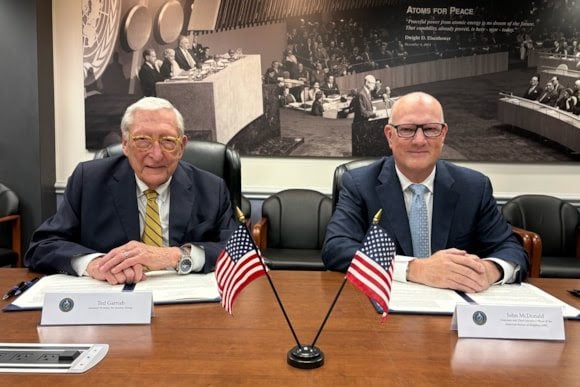
By Paul Morgan (gCaptain) – The MOU was signed on 6 July by Singapore’s Deputy Prime Minister and Minister for Trade and Industry, Gan Kim Yong, and Indonesia’s Minister of Environment and Head of the Environmental Control Agency, Mohammad Jumhur Hidayat, on the sidelines of the annual Singapore-Indonesia Leaders’ Retreat. According to Singapore’s Ministry of Trade and Industry, the document commits both governments to identifying high-integrity carbon credit projects, sharing technical expertise, and working towards an Article 6 implementation agreement under the Paris Agreement.
That last phrase is doing a great deal of work. An implementation agreement is the legal instrument that actually permits credits to be generated, verified, and transferred between the two countries with the corresponding adjustments that prevent double counting. What was signed in Jakarta is the diplomatic scaffolding for that instrument, not the instrument itself.
This is not a criticism of the deal’s substance. Framework MOUs of this kind have preceded every one of Singapore’s operational Article 6 partnerships to date, including those with Ghana, Papua New Guinea, Bhutan, Peru, Thailand and, as recently as April this year, the Philippines. The pattern is consistent: an MOU establishes intent and technical cooperation, and a subsequent implementation agreement supplies the legal architecture. Indonesia now joins that queue. What is unusual is how quickly commentary moved to describe the MOU as though the queue had already been cleared.
The commercial logic behind Singapore’s interest is straightforward and worth restating plainly, because it explains why these agreements keep appearing on the city-state’s diplomatic calendar. Singapore’s carbon tax currently stands at S$25 per tonne of carbon dioxide equivalent for large industrial emitters, a figure the government has legislated to rise to S$45 in 2026 and 2027, and then to a range of S$50 to S$80 by 2030. Companies are permitted to offset up to 5 per cent of their taxable emissions using eligible international carbon credits.
As the domestic tax climbs, so does the incentive to source credible offshore credits, and Indonesia, with its tropical forests, peatlands and mangrove systems, is one of the more obvious suppliers in the region. Singapore, for its part, continues to position itself as Southeast Asia’s carbon services and green finance hub, a role that depends on having credible bilateral pipelines to sell into.
Indonesia’s side of the ledger has moved faster than the MOU’s signing date might suggest. Three days after the Jakarta signing, on 9 July, Indonesia formally launched its Carbon Unit Registration System, known locally as SRUK, in a ceremony attended by the Minister of Forestry, the Coordinating Minister for Food Affairs, the Minister of Environment, and the chair of the Financial Services Authority. The registry is established under Ministerial Regulation and sits beneath Presidential Regulation No. 110 of 2025, which anchors the country’s Carbon Economic Value framework.
Alongside the launch, the government confirmed that trading permits had already been issued to four Forest Utilisation Business Permit holders, three at concession scale and one representing a community-level social forestry group, covering an initial tranche of roughly 31 million tonnes of carbon dioxide equivalent with an estimated transaction value near five trillion rupiah, or approximately 278 million US dollars. Officials have projected the wider Carbon Economic Value instrument could draw up to 5.8 billion US dollars in green investment and cut emissions by around 570 million tonnes of carbon dioxide equivalent over time, though those are government projections rather than independently audited outcomes and should be read as such.
This is the infrastructure the Singapore MOU will eventually need to plug into if it is to progress to an actual implementation agreement. A registry that can track the lifecycle of a carbon unit, issue it, and prevent it from being claimed twice is a precondition for any serious cross-border trading relationship, not a nicety. Indonesia appears to have understood this, moving its registry from a 90 per cent complete trial phase in March to a live public launch in July, a faster timeline than some observers expected given the country’s history of carbon governance disputes, including recent tightening of forest carbon trading rules.
The regional numbers cited in support of this deal deserve equally careful handling. The claim that Southeast Asia accounts for roughly 22 per cent of global nature-based carbon credit issuance traces back to a HAMERKOP market analysis covering five countries, Indonesia, Cambodia, Malaysia, Thailand and the Philippines, combined, using data current to April 2025. It is a real and useful figure, but it describes the region collectively rather than Indonesia alone, and it is now over a year old against a market that the same analysis says has seen credit retirement rates climb from under 20 per cent in the late 2010s to more than 65 per cent by 2025. Anyone using the 22 per cent figure to argue for near-term Indonesian supply specifically should treat it as directional rather than current.
The Jakarta retreat produced more than the carbon MOU, and the wider package is relevant to how seriously the carbon agreement should be taken. On the same day, Indonesia’s sovereign wealth fund, Danantara, signed separate memoranda with Singapore’s Keppel Electric and Sembcorp Utilities to explore cross-border low-carbon electricity imports, with both governments targeting at least 3.4 gigawatts of commercial capacity by 2035. Read together, the electricity and carbon agreements point to a bilateral relationship being constructed in layers, physical energy trade on one track and carbon accounting on another, with each expected to reinforce investor confidence in the other.
For readers with maritime interests, the relevance is indirect but real. Singapore remains the world’s largest bunkering port, and any deepening of its carbon services and offset infrastructure has knock-on implications for how shipowners and charterers based there manage compliance costs under both national schemes and the IMO’s own emerging net-zero pricing mechanisms. A credible, liquid Indonesian credit supply, properly registered and free of double counting, would matter to that trade regardless of whether the vessels themselves ever call at an Indonesian port.
None of which changes the immediate fact. What was signed on 6 July was an MOU, a statement of direction backed by real institutional movement on the Indonesian side, but still a step short of the binding trading framework that the coverage around it implies already exists.
The distance between the two is not academic. It is the difference between a market that can be modelled and one that can actually clear a transaction.

 Join The Club