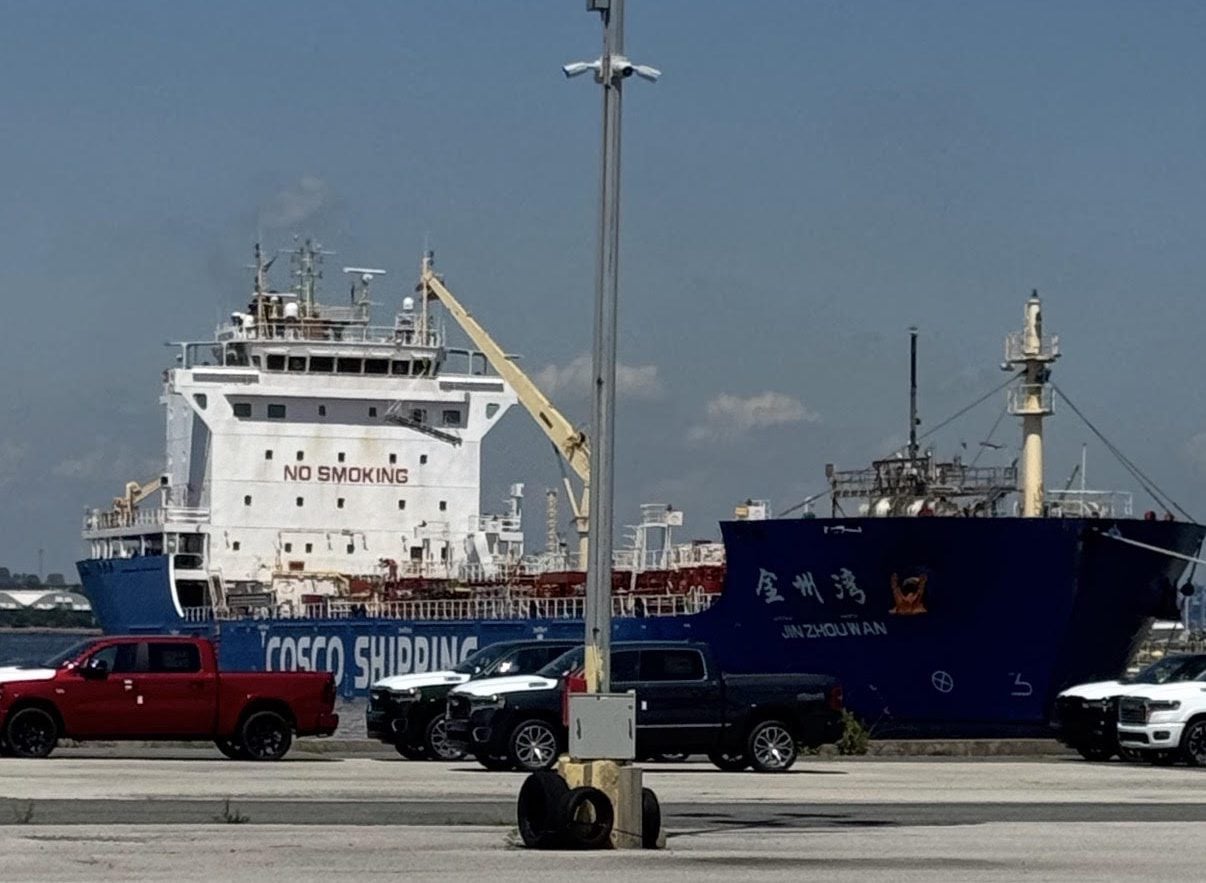
American merchant mariners staged a protest Thursday outside Marathon Petroleum’s refinery in Garyville, Louisiana, as a Chinese-flagged tanker prepared to make another domestic voyage under the Trump administration’s emergency Jones Act waiver.
Members of the Seafarers International Union (SIU) gathered outside the refinery to oppose the arrival of the Jin Zhou Wan, a Chinese-flagged asphalt tanker owned by a subsidiary of China COSCO Shipping Corporation, arguing the waiver is allowing foreign vessels to perform work traditionally reserved for U.S.-flag ships and American crews.
The demonstration comes as the vessel is expected to load asphalt in Louisiana for another coastwise voyage between U.S. ports. According to SIU, the shipment marks at least the third domestic voyage conducted by the vessel under the waiver.
The Trump administration invoked emergency waiver authority under Section 501 of the Merchant Marine Act in March, citing national defense concerns stemming from disruptions to global energy markets during the conflict with Iran and threats to shipping through the Strait of Hormuz. The waiver temporarily permits approved foreign-flag vessels to transport certain petroleum products and other energy cargoes between U.S. ports that would otherwise be restricted by the Jones Act.
“Louisiana’s mariners should not have to stand by on the dock while a Chinese state-owned shipping company takes over work that belongs on American vessels,” said Chris Westbrook, SIU vice president for the Gulf Coast. “The Jones Act creates family-supporting jobs, strengthens our nation’s maritime readiness, and helps ensure America has the merchant marine it needs when our country calls. It’s time to end this waiver and restore these jobs to American workers.”
The Jin Zhou Wan is owned and operated by COSCO Shipping Asphalt Hainan, a subsidiary of the state-owned China COSCO Shipping Corporation. The company has appeared on U.S. government lists identifying Chinese military companies operating in the United States, although COSCO has disputed aspects of those designations.
The protest reflects growing pressure on the administration to end the emergency exemption, particularly after Washington and Tehran reached a memorandum of understanding in June that reopened the Strait of Hormuz and eased the immediate supply concerns that originally justified the waiver.
Waiver Remains in Effect
MARAD records reviewed by gCaptain show the administration continues to approve domestic voyages involving crude oil, refined petroleum products, jet fuel, naphtha and asphalt under the waiver.
The latest MARAD data also confirms two previously reported domestic voyages by the Jin Zhou Wan—from Harvey, Louisiana, to New Haven, Connecticut, and from Paulsboro, New Jersey, to Baltimore, Maryland. The Garyville shipment would represent at least the vessel’s third coastwise voyage under the program.
The administration initially issued the waiver for 60 days before extending it for an additional 90 days. Maritime labor unions, U.S.-flag operators, shipping industry groups and a bipartisan group of lawmakers have since urged President Donald Trump to allow the waiver to expire.
According to SIU, recent analyses by Navigistics Consulting and Reuters found the waiver did not significantly increase domestic fuel supplies or produce measurable reductions in gasoline prices.
The union also pointed to the Jones Act’s economic importance, citing Transportation Institute estimates that the law supports roughly 650,000 U.S. jobs nationwide, including more than 70,000 in Louisiana, while contributing more than $18 billion annually to the state’s economy.
Louisiana’s congressional delegation has become increasingly vocal in opposing the extension. Speaker Mike Johnson, House Majority Leader Steve Scalise, Rep. Clay Higgins and Rep. Julia Letlow, who is running for the U.S. Senate, recently joined dozens of House Republicans in urging the administration to let the waiver expire.
The continued use of the waiver has become one of the most contentious maritime policy debates of the year, with supporters arguing the emergency authority is now being used for routine commercial shipments rather than addressing an active national security emergency.

 Join The Club