There is a particular kind of institutional irony that only the International Maritime Organization can produce with quite such reliable consistency.
By Paul Morgan (gCaptain) – In London at the end of April, MEPC 84 closed after five days of negotiations with cautious optimism all round. The Net Zero Framework, agreed in principle at MEPC 83 a year ago, is back on track. The pendulum, as the analysts at University College London noted with evident relief, has swung. The next extraordinary session is pencilled in for December. Progress is being made.
Meanwhile, in the Arctic, things are burning rather faster than the schedule allows for.
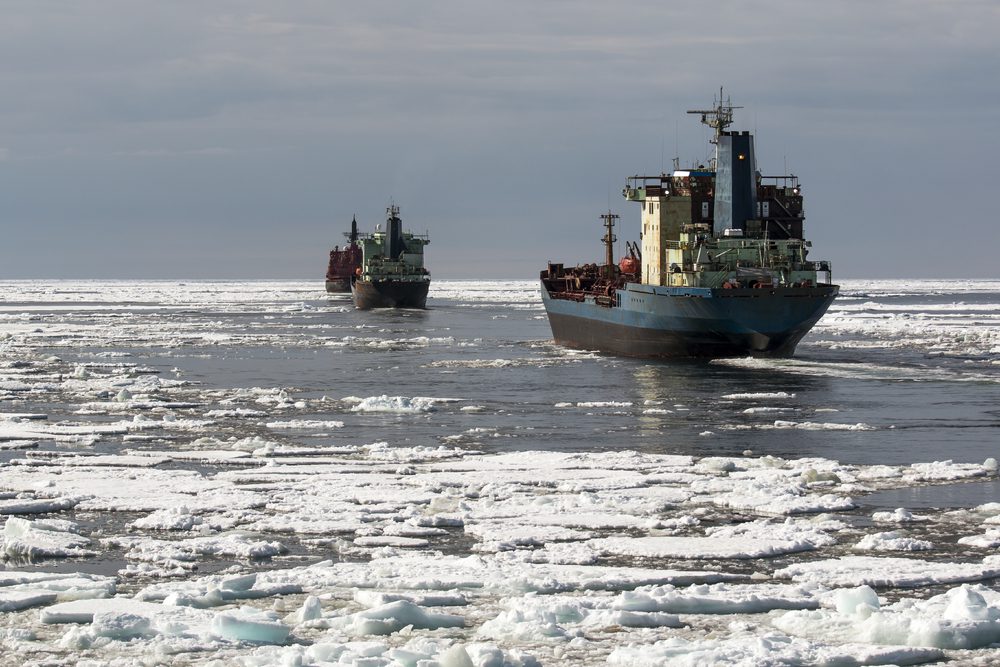
New data published by the Clean Arctic Alliance covering the five years from 2019 to 2024 shows that black carbon emissions from shipping in the Polar Code area almost tripled over that period, rising from 259 to 759 metric tonnes. In the broader AMAP geographic boundary, the increase was around 46%. These are not projections.
They are not modelled scenarios requiring a two-degree assumption and a footnote about uncertainty. They are measured emissions from vessels that are already operating in polar waters today, right now, burning residual fuels in seas that were impassable to commercial shipping within living memory.
The numbers matter for reasons that go beyond atmospheric chemistry. Black carbon is not simply another line in an emissions inventory. When particulate soot settles onto Arctic ice and snow, it darkens reflective surfaces and accelerates heat absorption. The warming feedback is disproportionate to the emission volume. Per unit of mass, black carbon carries a warming potential estimated at up to 1,500 times that of carbon dioxide. In the Arctic, where the climate system is already under acute stress, the consequences of unchecked combustion pollution are not a future problem. They are arriving on the same timetable as the ships themselves.
The commercial reality driving this is straightforward enough. Arctic sea ice is retreating. New routes are opening. The Northern Sea Route is attracting growing interest from bulk carriers and tankers seeking shorter transits between Asia and Europe. Cruise tourism is expanding into waters that were once exclusively the preserve of icebreakers and scientific vessels.
Between 2013 and 2024, the number of individual ships entering the Arctic rose by 37%, while the total distance sailed in those waters more than doubled. More ships, burning more residual fuel, in waters that are simultaneously warming and becoming more accessible. The feedback loop is not a theoretical construct.
Against that backdrop, MEPC 84 did produce one meaningful concrete outcome. A new North-East Atlantic Emission Control Area was formally approved, covering waters up to 200 nautical miles from the coastlines of Greenland, Iceland, the Faroe Islands, Ireland, the United Kingdom, France, Spain and Portugal. When it enters into force in 2027, vessels operating in the area will face the same 0.10% sulphur limit that already applies in the North Sea and Baltic ECAs, together with tighter nitrogen oxide requirements for newer engines. It is a genuinely significant piece of regulatory geography, and the IMO deserves credit for it.
Sulphur oxide emissions and associated particulate pollution in some of the world’s busiest and most environmentally sensitive shipping corridors will be substantially reduced.
The problem is that black carbon is not a sulphur problem. It is a combustion problem. That distinction matters enormously, and it is one that the regulatory machinery of the IMO has consistently struggled to translate into action with any useful urgency.
Burning heavy fuel oil produces black carbon. Burning cleaner distillate fuel produces less of it. Switching the entire Arctic fleet to distillates tomorrow would help. But the data already tells a sobering story about how much it would help. The Clean Arctic Alliance’s own analysis, and independent work by research groups at the International Council on Clean Transportation, consistently finds that even full enforcement of the existing HFO ban in Arctic waters, combined with an Arctic ECA scenario requiring a complete switch to distillates, would reduce black carbon by somewhere between 2% and 5%. That is a number that should appear on the front page of every briefing document in the IMO secretariat building.
The reason the figure is so low returns us to engineering fundamentals that the policy debate has largely chosen to sidestep. Black carbon is a product of incomplete combustion. The fuel type matters, but it is not the only variable. Engine condition, injector wear, atomisation quality, turbocharger efficiency, combustion temperatures, cylinder lubrication strategy and transient load profiles all influence particulate formation.
A poorly maintained engine operating on nominally cleaner fuel will still produce significant soot under the wrong conditions. A well-maintained engine burning residual fuel efficiently will produce considerably less than its worst-case theoretical maximum. Combustion quality is not a function of what is in the tank alone. It is a function of the entire engineering system, and of the attention, competence and investment that the operator brings to running it.
This is not a comfortable message for an industry that has organised much of its decarbonisation narrative around the fuel transition. Future fuels are genuinely important. The eventual shift to ammonia, methanol, hydrogen-derived fuels and next-generation biofuels will matter enormously for the long-term trajectory of shipping’s greenhouse gas emissions.
But the global merchant fleet will continue operating predominantly on internal combustion engines for decades. There is no realistic commercial pathway by which the world’s 60,000-plus ocean-going vessels transition to zero-emission propulsion before the middle of this century at the very earliest. Every year between now and then, combustion quality will determine how much avoidable pollution enters the atmosphere.
The MSC Opera trial, completed this month in collaboration between MSC Cruises and Eni’s Enilive subsidiary, offered a timely and concrete illustration of what is immediately achievable. One of the cruise ship’s engines operated for approximately 2,000 hours on 100% hydrotreated vegetable oil, with no modifications to the existing machinery. The results, independently verified by Bureau Veritas with technical support from Wärtsilä, showed a 16% reduction in nitrogen oxide emissions, lower particulate output, and an approximately 80% reduction in lifecycle greenhouse gas emissions compared with conventional marine fuel. The HVO used was produced from waste-based feedstocks, principally used cooking oils and animal fats, at Enilive’s biorefineries in Venice and Gela.
HVO is not a silver bullet. Feedstock availability at the volumes shipping would require remains a genuine constraint. Pricing is not yet competitive with conventional bunkers at scale. Questions about land-use competition and supply-chain sustainability are legitimate. But the MSC Opera results demonstrated something that matters considerably more than any single fuel’s long-term commercial prospects. They demonstrated that cleaner-burning transitional fuels, combined with well-maintained combustion systems, produce measurable and verifiable reductions in particulate emissions right now, using existing engines, without capital-intensive modifications.
That engineering reality is the inconvenient truth at the heart of the Arctic black carbon debate. The IMO will continue negotiating. The Net Zero Framework will evolve through the December extraordinary session and beyond. The fuel transition will continue gathering regulatory momentum as FuelEU Maritime requirements tighten and carbon pricing mechanisms extend their reach. All of that is necessary and broadly welcome. But the Arctic cannot wait for the diplomatic calendar, and the atmosphere is not keeping a note of what was agreed in principle.
Every percentage point of incomplete combustion represents wasted fuel energy, unnecessary emissions and avoidable pollution. Unlike ammonia bunkering infrastructure or green hydrogen production at scale, combustion improvement can be implemented immediately, across the existing fleet, at a fraction of the cost of any propulsion replacement programme. It requires investment in engine maintenance, injector condition, combustion monitoring, turbocharger performance and fuel conditioning. It requires the kind of engineering rigour that the industry historically understood as simply good seamanship.
The new North-East Atlantic ECA proves that the IMO can still act when the political will exists. The Arctic black carbon data proves that the political will is not yet matching the pace of the problem. The MSC Opera trial proves that practical, immediate progress is available if the industry chooses to reach for it.
The real lesson from the latest round of IMO meetings is not that shipping is moving toward a cleaner future. It is that the future is already here, and in the Arctic at least, the engineering fundamentals are not waiting for the framework to catch up.

 Join The Club