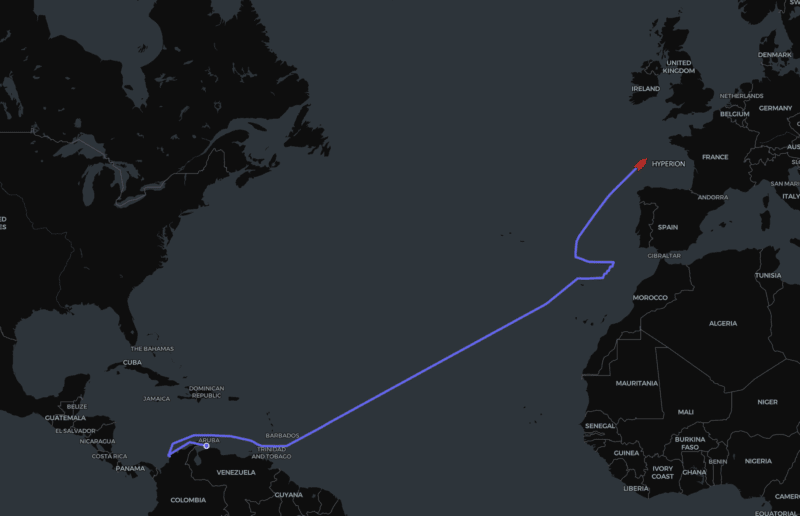
The sanctioned shadow fleet tanker Hyperion has entered the Bay of Biscay and is now heading northeast toward the English Channel. The vessel is one of just a handful of Venezuela-linked tankers that completed an Atlantic passage in recent weeks. Hyperion switched flags from the Gambia to Russia while in the Caribbean.
After reflagging to Russia in late December to try to shield itself from U.S. seizure efforts, the vessel began transiting the Atlantic on January 2 and has spent recent days zig-zagging off the northern coast of Madeira before entering the Bay of Biscay on January 20. The vessel is signaling Russia’s Ust-Luga oil port, a major Baltic Sea export hub, as its destination.
Hyperion is notable because it was the first shadow fleet tanker to establish a direct operational link between Russia’s Arctic shipping network and Venezuelan oil flows. In December, the tanker loaded a cargo of naphtha in Murmansk in the Russian Arctic and delivered it to Venezuela’s Amuay terminal, a journey that bridged two of the most geopolitically sensitive oil regions for sanctions enforcement.
That voyage, combined with its subsequent reflagging from the Gambia to the Russian registry while in port at Cartagena, Colombia on December 24, and a corporate ownership shift to New Fleet Ltd in St. Petersburg, reflects a broader pivot by shadow fleet operators toward relying on Russian protection against Western interdiction.
Unlike many other sanctioned tankers that returned to Venezuelan waters following U.S. action against Caracas, Hyperion did not reverse course. Instead the vessel headed northeast across the Atlantic, avoiding direct U.S. enforcement actions that have recently led to the seizure of other vessels.
The United Kingdom and NATO allies have increasingly monitored shadow fleet traffic through the English Channel and adjacent waters. Reports indicate that sanctioned vessels have been tracked approaching the Channel, with the UK considering both surveillance and possible interdiction plans. The Russian navy has reportedly escorted shadow tankers on several occasions.
It remains to be seen how Hyperion’s voyage history and reflagged status might affect its reception if the vessel attempts to enter the Baltic Sea. The vessel has been sanctioned by U.S., UK and EU authorities further highlighting its status as a well-known shadow fleet tanker.
Crude tanker-owner Capital Tankers Corp.’s shares fell in their Oslo debut on Tuesday, as the closure of the Strait of Hormuz has disrupted global oil transit and markets.
An LNG carrier carrying Russian gas has entered the Mediterranean Sea for the first time since Moscow began diverting shipments away from the region after an explosion aboard the tanker Arctic Metagaz earlier this month, ship-tracking data showed.
The Trump administration plans to waive a century-old maritime law that requires American ships be used to transport goods between US ports as it seeks to blunt surging oil and gasoline prices, according to people familiar with the matter.
March 12, 2026
Total Views: 612
Get The Industry’s Go-To News
Subscribe to gCaptain Daily and stay informed with the latest global maritime and offshore news
— just like 107,352 professionals
Secure Your Spot
on the gCaptain Crew
Stay informed with the latest maritime and offshore news, delivered daily straight to your inbox
— trusted by our 107,352 members
Your Gateway to the Maritime World!
Essential news coupled with the finest maritime content sourced from across the globe.

 Join The Club