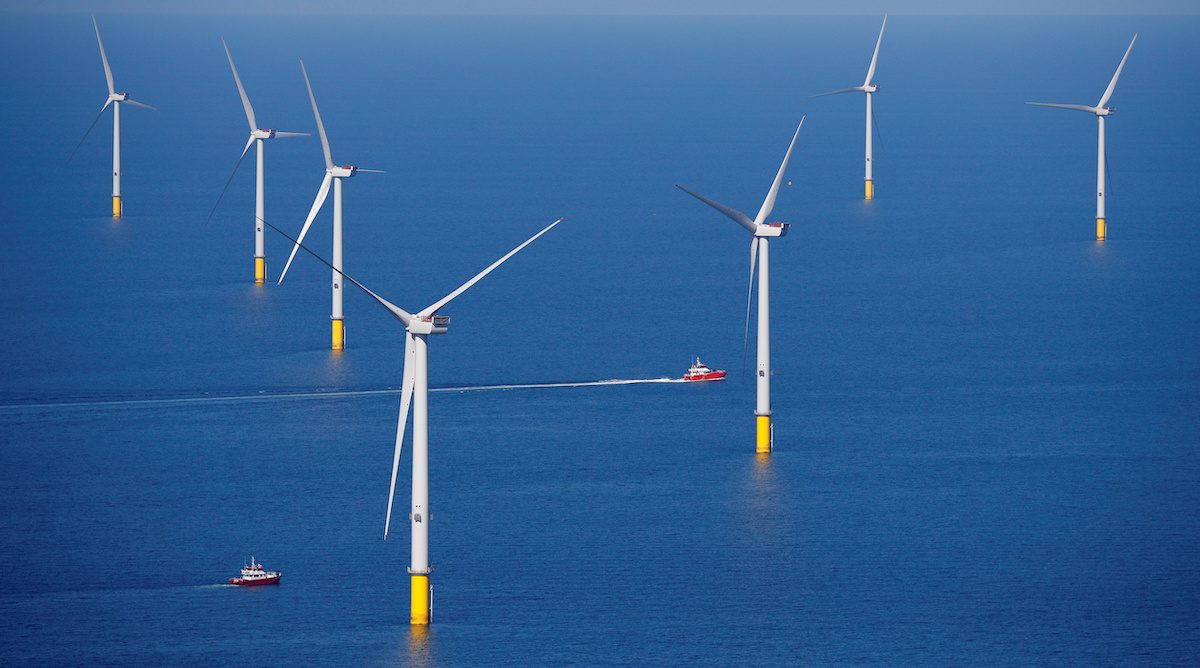
FILE PHOTO: A support vessel is seen next to a wind turbine at the Walney Extension offshore wind farm operated by Orsted off the coast of Blackpool, Britain September 5, 2018. REUTERS/Phil Noble
By William Mathis and Christian Wienberg (Bloomberg) –The world’s biggest developer of offshore wind farms issued a reality check to the industry, saying it has overestimated the amount of time its turbines are generating electricity.
Copenhagen-based Orsted A/S announced that offshore wind farms wouldn’t produce quite as much power as previously forecast. The adjustment could shave millions of dollars of revenue a year off each project. It’s also a warning to other developers who may have used similar analysis to estimate the economics of their projects.
Orsted is the leader in placing turbines at sea, with projects across Europe, Asia and the U.S. Even so, those wind farms with blades wider than the wing span of jumbo jets are relatively new, and they have relied methods to analyze wind strengths that haven’t yet racked up a long track record.
“Our findings point to a higher negative effect on production than earlier models had predicted,” Orsted’s Chief Financial Officer Marianne Wiinholt said on a call with reporters. “This is not a major setback for the industry at all. The industry will still grow. We are more competitive than gas or coal.”
Shares in Orsted sank as much as 10% in Copenhagen after the news, which came a day ahead of the company’s planned release of its financial statement. The company, which is half-owned by the Danish state, kept its full-year outlook unchanged for 2019.
Turbine maker Vestas Wind Systems A/S fell as much as 3.5%, as did SSE Plc, which recently won U.K. government contracts to support the construction of what will be the biggest offshore wind project in the world.
Despite the plunge on Tuesday, Orsted’s stock is up 31% this year, double the 15% gain for the OMX Copenhagen 25 Index and higher than the 22% gain for the S&P 500.
Industry Effect
Other developers may soon find similar problems. Orsted regularly compared its estimates to those from external consultants that are used widely in the industry, Wiinholt said. Usually Orsted’s models were actually below those benchmarks, she said, meaning more optimistic competitors could face an even steeper re-adjustment.
“It is an industry-wide issue,” Wiinholt said.
The tests show that the company’s current production forecasts underestimate the negative impact from the so-called blockage effect, which arises when the wind slows down as it approaches turbines. It also underestimated the negative effect of the so-called wake effect, in which wind speeds drop between wind parks, it said.
The change will drop what’s called the lifetime load factor to 48%, down from a range of 48%-50%. That figure represents an estimate of how much electricity the machines produce divided by the potential capacity of the turbines. Since the wind doesn’t always blow strongly enough to turn the wind turbine blades, the load factor is always lower than capacity.
The number seems small, but for a giant windfarm like Orsted’s Hornsea One off the east coast of England, a change could shift income by 10s of millions of dollars every year, according to an analysis by BloombergNEF.
“2% is a big deal,” said Tom Edwards, an analyst at Cornwall Insight. “Over the lifetime that’s a lot of energy.”
Orsted has spent recent years cementing its transformation from a utility based on fossil fuels to a renewable energy giant.
As it looks to cut costs, the company will look to trim its staff to help save 500 million to 600 million Danish krone ($74 million to $89 million). Those efforts are needed as the industry becomes more competitive, the company’s chief financial officer said.
© 2019 Bloomberg L.P
Updated: November 18, 2020 (Originally published October 29, 2019)
Editorial Standards · Corrections · About gCaptain
This article contains reporting from Bloomberg, published under license.

 Join The Club