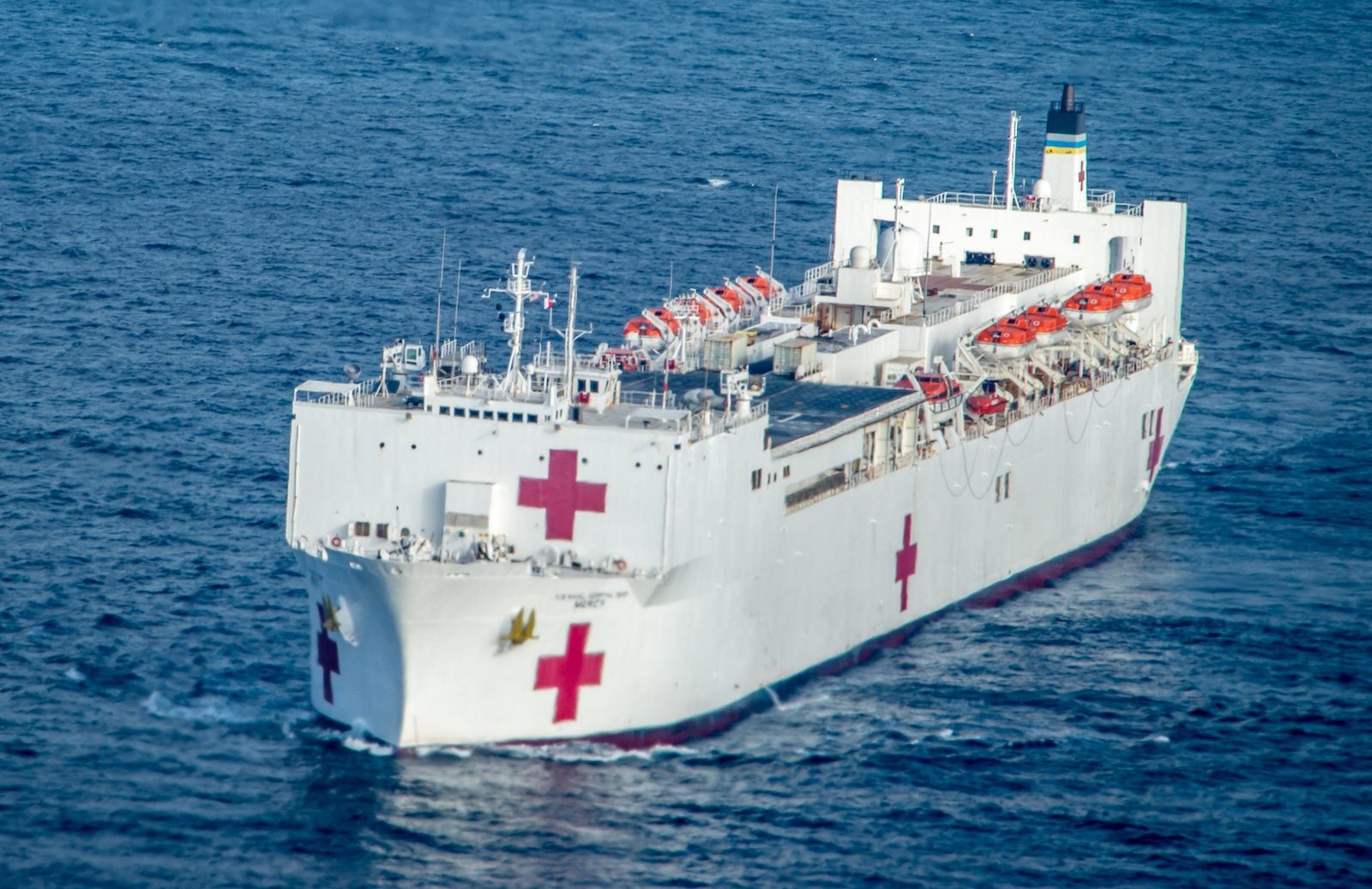
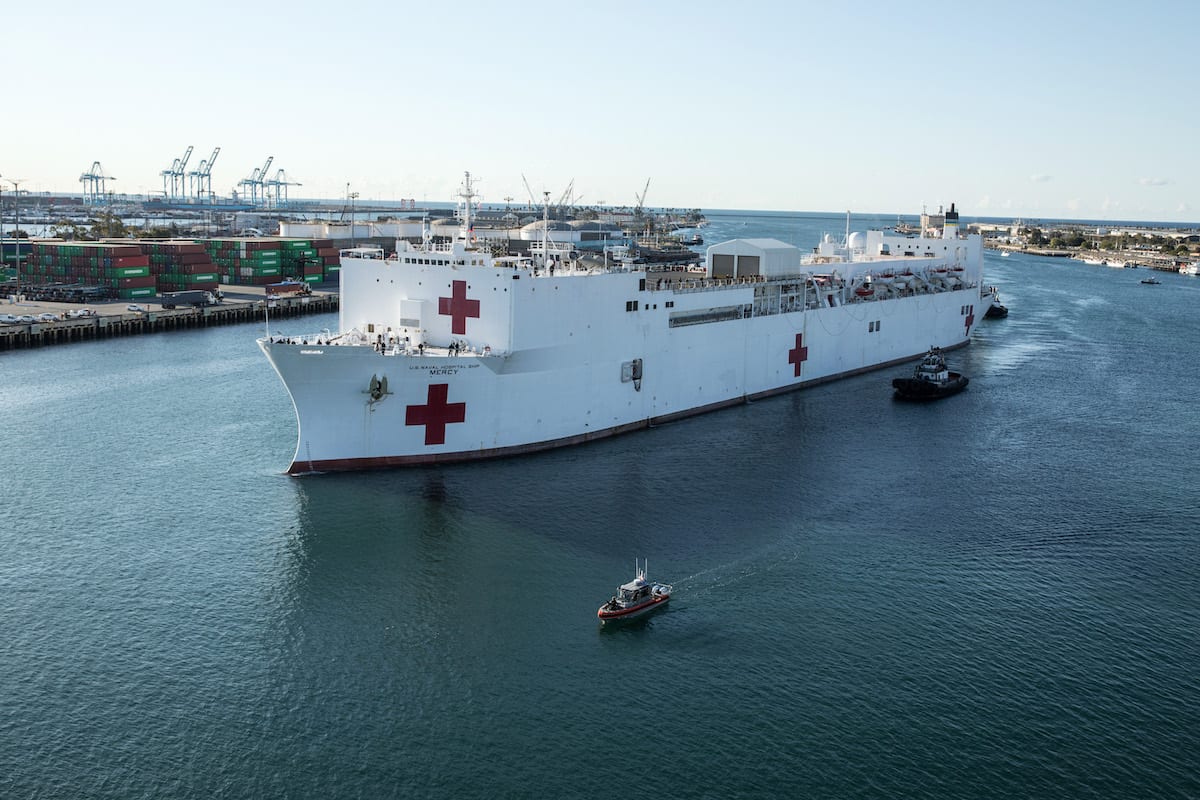
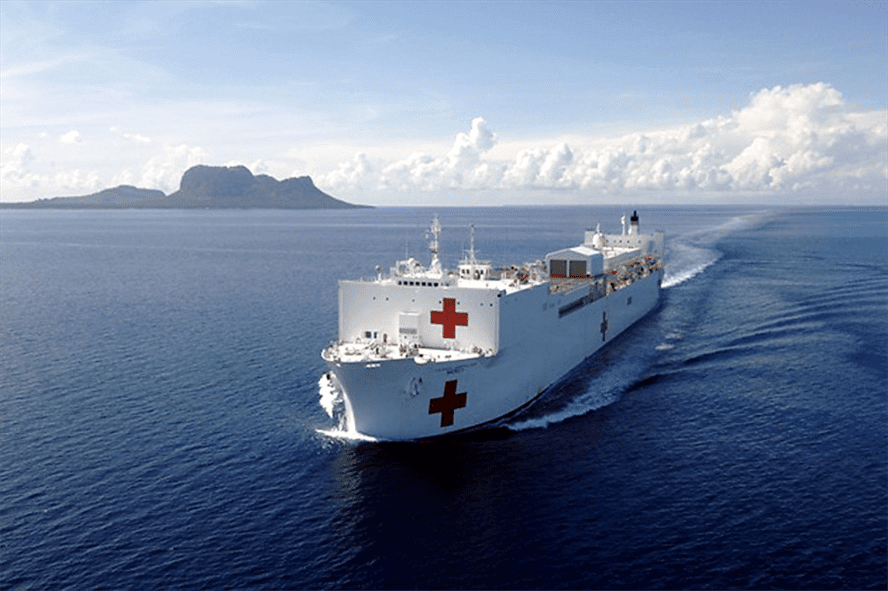
One day after departing Alabama Shipyard, the hospital ship USNS Mercy is holding a steady southbound course through the central Gulf of Mexico — and AIS data is offering the clearest signal yet about where the 1,000-bed vessel may be headed.
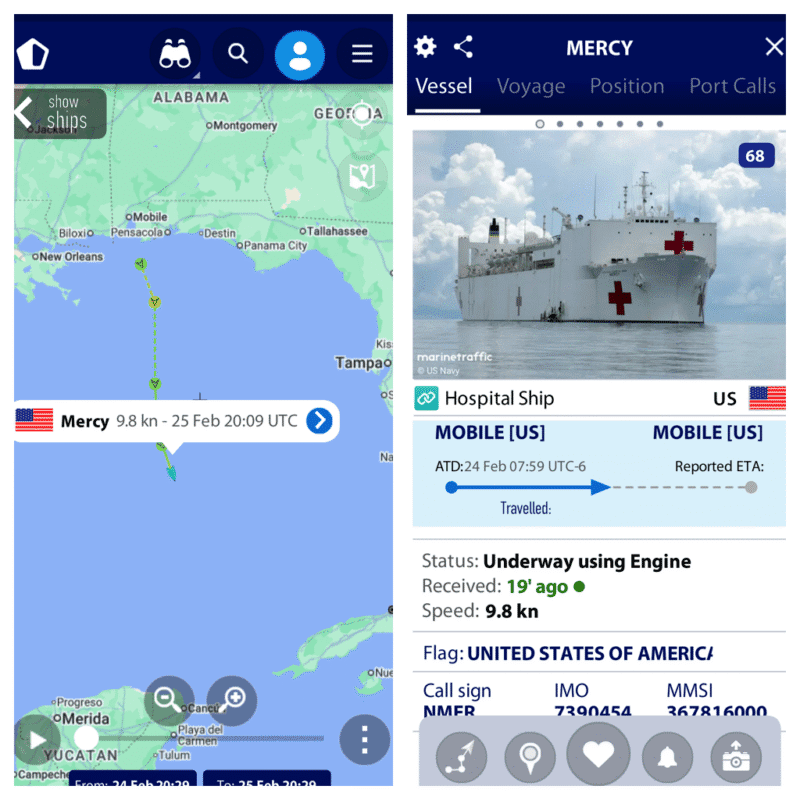
According to the latest Automatic Identification System (AIS) data from MarineTraffic, Mercy is transiting well offshore at about 9.8 knots, slightly below her typical 10–12 knot cruising speed. Her track shows a consistent run toward the Yucatán Channel, with no easterly turn toward the Florida Straits — the standard route for a deep-draft vessel sailing from the Gulf to the U.S. East Coast.
The ship’s AIS voyage data still lists both origin and destination as Mobile, a placeholder entry indicating no updated destination has been publicly broadcast.
Taken together, the heading and track are not consistent with a Greenland mission. Instead, the movement strongly suggests a transit toward the Panama Canal, likely repositioning the vessel to the Pacific and the U.S. West Coast.
Screenshots from MarineTraffic.com showing Mercy’s AIS broadcast from February 25, 2026 at 20:09 UTC. Credit: MarineTraffic.com
That assessment aligns with Mercy’s publicly disclosed schedule. The ship is due to begin a $90 million maintenance period at Vigor Industrial in Portland, Oregon, in March. Maritime analyst Sal Mercogliano previously noted the vessel was slated to return to the West Coast for shipyard availability running through September 2026.
The Alabama yard period that concluded this week addressed urgent drydock repairs tied to a ballast tank issue and was separate from the upcoming regulatory docking and inspection work scheduled in Oregon.
Greenland Questions Persist
Mercy’s departure from Mobile comes amid news about a possible deployment to Greenland after President Donald Trump posted on social media over the weekend that the U.S. would send a hospital ship there, declaring “it’s on the way!!!” and posting an AI illustration of the USNS Mercy—one of two US government-owned hospital ships.
However, The Wall Street Journal subsequently reported that U.S. officials have issued no orders to send a hospital ship — including Mercy — to Greenland. Greenland’s Prime Minister Jens-Frederik Nielsen also rejected the proposal, noting the country provides universal public healthcare. The Greenland mission was not mentioned during the President’s State of the Union address.
Operationally, a diversion north would present serious hurdles. Mercy is a converted oil tanker without an ice-strengthened hull and has never operated in Arctic waters. Late-winter conditions around Greenland routinely include pack ice and heavy drift ice, posing risks for non-ice-rated vessels. Also, Nuuk’s harbor depth — roughly 10.5 meters — would leave minimal under-keel clearance for a ship that draws about 10 meters.
Reading AIS Carefully
There are caveats to interpreting AIS data too definitively. Voyage fields are often left blank or unchanged, and ships can limit publicly visible updates for operational security reasons. Still, the absence of a revised destination — combined with the vessel’s steady southbound track — suggests no public reroute has been filed.
For now, Mercy continues making steady way toward the Yucatán Channel. Whether she proceeds through Panama for her scheduled West Coast overhaul or receives new orders remains to be seen. But as of Wednesday afternoon, the AIS picture points south — toward Panama — not north toward the Arctic and Greenland.
Meanwhile, sister ship USNS Comfort remains at Alabama Shipyard.
The U.S. Department of the Treasury escalated its economic pressure campaign against Iran today, sanctioning over 30 entities, individuals, and vessels in a coordinated strike aimed at dismantling the Islamic...
The hospital ship USNS Mercy departed Alabama Shipyard on Tuesday, transiting southbound through the Gulf of Mexico at about 10.5 knots, closing out months of drydock work while fresh questions swirl about...
President Trump’s proposal to dispatch a U.S. hospital ship to Greenland would run into a combination of environmental and logistical hurdles that make such a mission impractical in February or March, when Arctic sea ice typically reaches its maximum annual extent.
February 23, 2026
Total Views: 49574
Get The Industry’s Go-To News
Subscribe to gCaptain Daily and stay informed with the latest global maritime and offshore news
— just like 107,178 professionals
Secure Your Spot
on the gCaptain Crew
Stay informed with the latest maritime and offshore news, delivered daily straight to your inbox
— trusted by our 107,178 members
Your Gateway to the Maritime World!
Essential news coupled with the finest maritime content sourced from across the globe.

 Join The Club