By Yuka Obayashi and Florence Tan
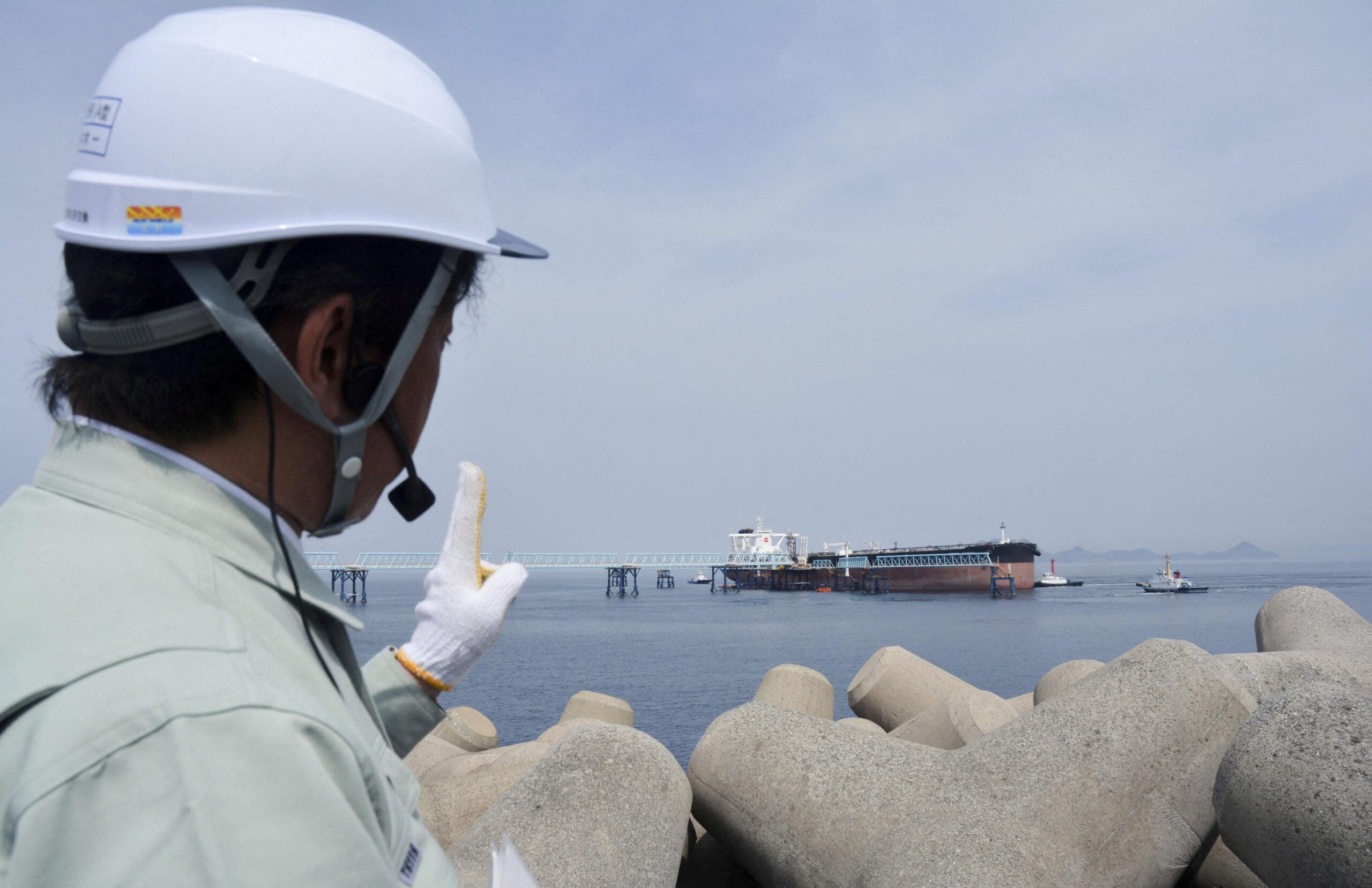
TOKYO/SINGAPORE, July 7 (Reuters) – Japan will receive a boost in Middle East crude supply this month as two more stranded Japanese-owned supertankers carrying Saudi oil were exiting the Strait of Hormuz on Tuesday, shipping data showed.
The two tankers joined a fleet of previously stranded vessels that left a day earlier, raising the total volume of crude oil aboard Japan-linked vessels exiting the strait to 16 million barrels this week, reducing the amount of oil stuck in the Gulf.
One of the tankers is owned and managed by Nippon Yusen KK 9101.T and the other is owned and managed by Kawasaki Kisen Kaisha 9107.T, LSEG data showed. Each of them loaded 2 million barrels of Saudi crude on March 1, Kpler data showed.
The companies did not respond immediately to requests for comment.
A spokesperson for the Japanese Shipowners’ Association said on Tuesday that the number of Japanese-related vessels remaining in the Gulf had fallen to 26 from 45 at the start of the conflict.
On Monday, six very large crude carriers loaded with 12 million barrels of Middle Eastern crude, two chemical tankers, a vehicle carrier and a container ship, all linked to Japan, exited the strait. The tankers are carrying crudes from Saudi Arabia, the United Arab Emirates and Qatar that were loaded in late February to early March.
Most of these vessels are managed by Japanese shipping company Mitsui O.S.K. Lines (MOL) 9104.T.
Besides the stranded vessels, five VLCCs laden with Saudi oil from Ras Tanura port are tentatively signaling for Japan after the world’s top exporter resumed loadings in late June at its largest port located inside the Gulf, Kpler data showed.
Japan, which had relied on the Middle East for 94% of its crude supply before the Iran war broke out in February, saw its oil imports slumping in April to the lowest level in more than 60 years after supply from the Gulf oil-producing region tumbled 68% on-year.
(Reporting by Florence Tan in Singapore; Chang-Ran Kim and Yuka Obayashi in Tokyo; Editing by Jamie Freed and Muralikumar Anantharaman)
(c) Copyright Thomson Reuters 2026.

 Join The Club