Don’t Miss Your Daily Briefing for the Maritime Industry
Join the leading maritime news network
— trusted by our 106,597 members
Plumes of smoke rise from what is said to be Liberia-flagged, Greek-operated bulk carrier, the MV Magic Seas that was, according to Yemen's Houthis, attacked following an alleged exchange with the captain, off southwest Yemen, in this screen grab taken from a handout video released on July 8, 2025. HOUTHI MEDIA CENTER/Handout via REUTERS
Bulk Carrier Losses Keep Falling, But INTERCARGO Warns New Risks Are Emerging
The long-term safety record for bulk carriers continues to improve, but the industry faces an increasingly complex risk environment that extends beyond traditional operational hazards, according to INTERCARGO’s latest casualty analysis.
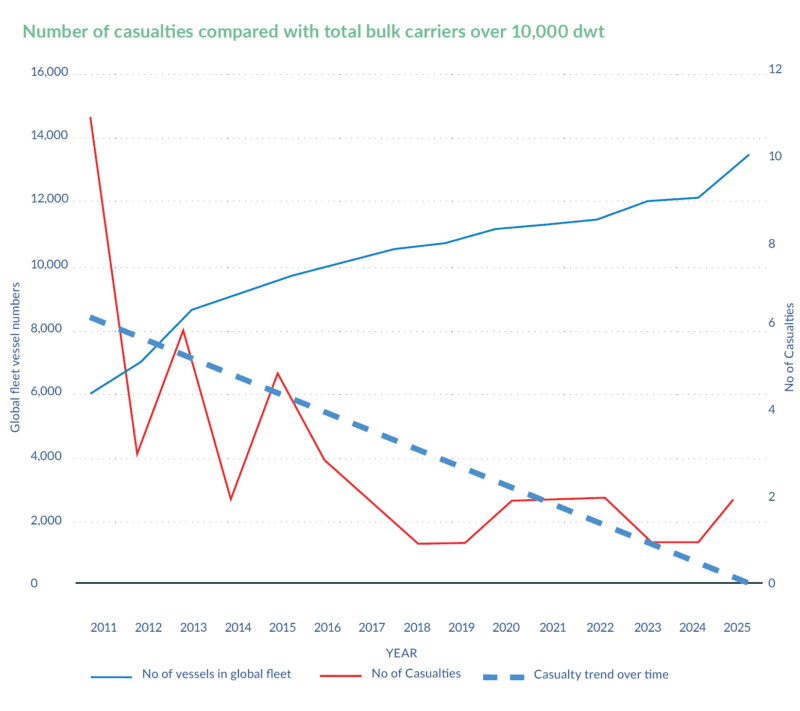
The International Association of Dry Cargo Shipowners’ Bulk Carrier Casualty Report 2026 found that 17 bulk carriers of 10,000 deadweight tons (dwt) or larger were lost worldwide between 2016 and 2025, resulting in the deaths of 71 seafarers. During the same period, the global bulk carrier fleet expanded to 13,669 vessels by the end of 2025, while the rolling 10-year average of annual losses continued its steady decline.
INTERCARGO attributed the improvement to advances in ship design, stronger regulatory compliance, better crew training, operational experience and new technologies. But the report cautions that the industry’s biggest safety challenges remain unresolved.
Cargo liquefaction continues to be the deadliest hazard, accounting for 37 of the 71 fatalities—more than half of all lives lost during the decade. Although only four vessels in the 50,000-59,999 dwt size range were lost, they accounted for 37 deaths, largely reflecting the dangers associated with nickel ore and other liquefiable cargoes.
Groundings remained the leading cause of vessel losses, responsible for seven of the 17 total losses, or 41.1% of the total. Flooding accounted for four casualties but nearly half of all fatalities, claiming 34 lives.
INTERCARGO said the findings reinforce the importance of fully implementing the International Maritime Solid Bulk Cargoes (IMSBC) Code and called for continued improvements in cargo testing and declarations, stronger enforcement by flag and port states, enhanced training for ship and shore personnel, and faster, more transparent casualty investigations.
The report also highlights how the threat landscape for merchant shipping has evolved beyond traditional marine casualties.
Five bulk carriers lost in the Red Sea and Gulf of Aden during 2024 and 2025 as a result of missile, drone and uncrewed vessel attacks were excluded from the report’s statistical analysis because they were conflict-related rather than operational casualties. Those attacks nevertheless claimed eight seafarers’ lives and underscored the growing security risks facing commercial shipping. INTERCARGO reiterated its support for freedom of navigation and the protection of seafarers operating in high-risk regions.
The association also pointed to the loss of the 56,000-dwt Devon Bay earlier this year as a reminder that cargo liquefaction remains a persistent danger. The vessel, carrying nickel ore, was lost in early 2026 with two confirmed fatalities and four crew members still missing at the time the report was prepared. Because the casualty occurred outside the report’s 2016-2025 review period, it was not included in the statistics.
“The steady reduction in bulk carrier losses over the past decades reflects the industry’s continuous efforts to improve safety,” INTERCARGO Chairman John Xylas said. “Behind these numbers are real lives, and every incident reinforces the importance of learning and acting together.”
“The risk environment is no longer defined by traditional operational challenges alone,” he added. “INTERCARGO will continue to work with its members and partners to turn insight into action, so that improvements in safety are accelerated.”
With global dry bulk trade continuing to grow, INTERCARGO said maintaining the downward trend in casualties will require continued cooperation among shipowners, charterers, shippers, ports, regulators and other stakeholders. The report’s findings will help guide the association’s ongoing technical work, including its recently published Ship-to-Ship Transfer Guidelines for Bulk Carriers.
For more than a century, commercial shipping steadily moved away from sails. Now they are coming back. Across the global fleet, shipowners are installing towering rotor sails, rigid wings and...
A key measure of bulk-shipping rates has touched a two-year high and risks climbing further, according to analysts, as bad weather crimps the availability of Capesize vessels just as exporters ramp up delivery.

 Join The Club