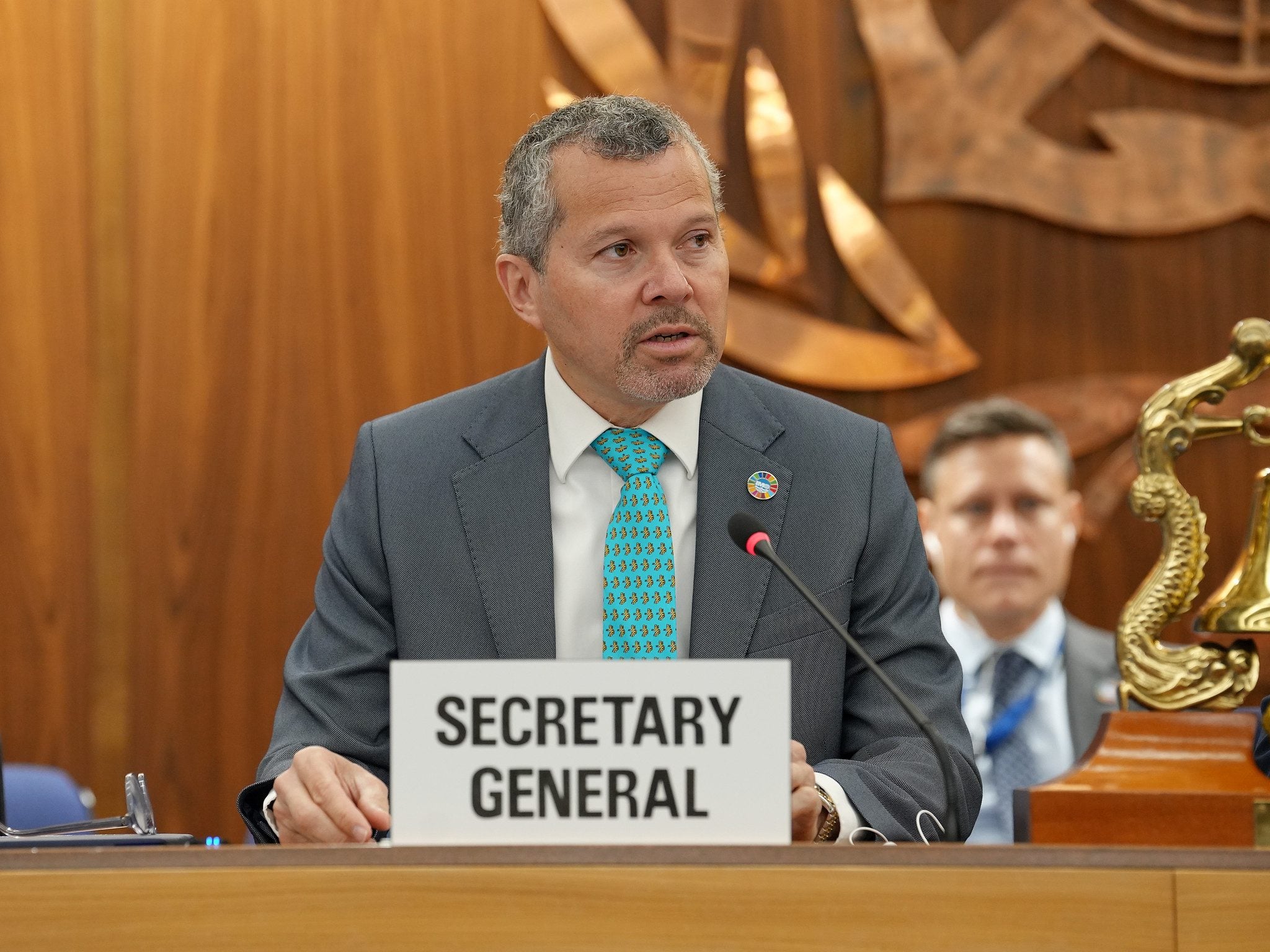
Five seafarers were killed during the rescue of a hijacked ship off Somalia last week, prompting International Maritime Organization Secretary-General Arsenio Dominguez to issue yet another statement mourning merchant mariners killed amid piracy, conflict and attacks on commercial shipping.
“It is troubling to have to make these statements so often, and even more difficult to convey in words how distressing it is continuously hear that seafarers are losing their lives simply for doing their jobs,” Dominguez said.
The five crew members were reportedly killed September 29 during the rescue of the HONOUR 25 in Somali waters. Several others were seriously injured, according to the IMO.
The statement was only the latest in a series from Dominguez this year as seafarers have been killed, injured, stranded or taken captive across the Strait of Hormuz, Red Sea, Black Sea and waters off Somalia.
His message has been consistent: seafarers are civilians, they are doing their jobs, and they should not be the ones paying for conflicts beyond their control.
On March 1, after attacks on merchant vessels near the Strait of Hormuz left at least one seafarer dead and several injured, Dominguez said there was no justification for attacks on civilian shipping.
“These crews are simply doing their jobs and must be protected from the effects of wider geopolitical tensions,” he said.
Within days, the toll was growing.
On March 6, Dominguez said at least four more seafarers had been killed and three severely injured in another attack in the Strait, while around 20,000 seafarers remained stranded aboard ships inside the Persian Gulf.
“This is unacceptable and unsustainable,” he said.
By June, the IMO had confirmed 46 attacks on international shipping in and around the Strait of Hormuz since February 28, with 14 seafarers killed. Three of those deaths came aboard the tanker Settebello following a projectile strike off Oman.
Dominguez again called the loss of life “simply unacceptable” and said protection of seafarers must remain paramount.
Later that month, the IMO temporarily suspended an evacuation operation for vessels trapped in the Persian Gulf after another ship was attacked in the Gulf of Oman.
Dominguez warned that crews should not become “collateral victims” of a geopolitical conflict.
Then in July, after another series of attacks in the Strait of Hormuz, the frustration became harder to miss.
“I regret that once again I am compelled to speak out following attacks on commercial ships and innocent seafarers, due to geopolitical circumstances beyond their control,” he said.
“No seafarer should have to risk their life simply for doing their job.”
Days later, his attention shifted to the Black Sea and Sea of Azov, where civilian merchant ships were again coming under attack.
“I must once again address attacks on commercial vessels,” Dominguez said, warning that seafarers “should never become casualties of conflicts to which they are not a party.”
The same theme surfaced again in the Red Sea.
Following renewed attacks on international shipping in July, Dominguez stressed that seafarers are civilians performing essential work and “must never be placed in harm’s way or targeted in situations of conflict or instability.”
After another deadly strike in August, he said “once again, innocent seafarers have lost their lives.”
“Seafarers deserve to be protected and allowed to do their jobs in safety and security,” he said.
By September, the scale of the violence around Hormuz alone had become stark.
The IMO said it had verified 80 attacks on merchant vessels in and around the Strait since the conflict began February 28, killing at least 22 seafarers and injuring many others.
Dominguez’s message to IMO member states was unusually direct.
“We are reaching a point where these conflicts are being used as a pretext to attack merchant vessels and innocent seafarers,” he said.
“Do not use these conflicts to attack innocent seafarers.”
At the same time, another familiar maritime security threat was returning farther west.
Renewed piracy in the Gulf of Aden left dozens of seafarers captive aboard hijacked vessels, prompting new warnings over deteriorating security in the region.
The subsequent rescue of the HONOUR 25, SEAMULL and EUREKA freed 44 seafarers.
But it also produced another death toll.
Five more seafarers. Another IMO statement. Another call for governments to protect people whose involvement in the conflicts surrounding them often extends no further than being aboard a merchant ship passing through.
“We have come together to stop piracy in this region before. We must do it again — with renewed resolve, targeted cooperation and the required resources,” Dominguez said.
“Seafarers should not have to lose their lives for the service they provide for the world.”

 Join The Club