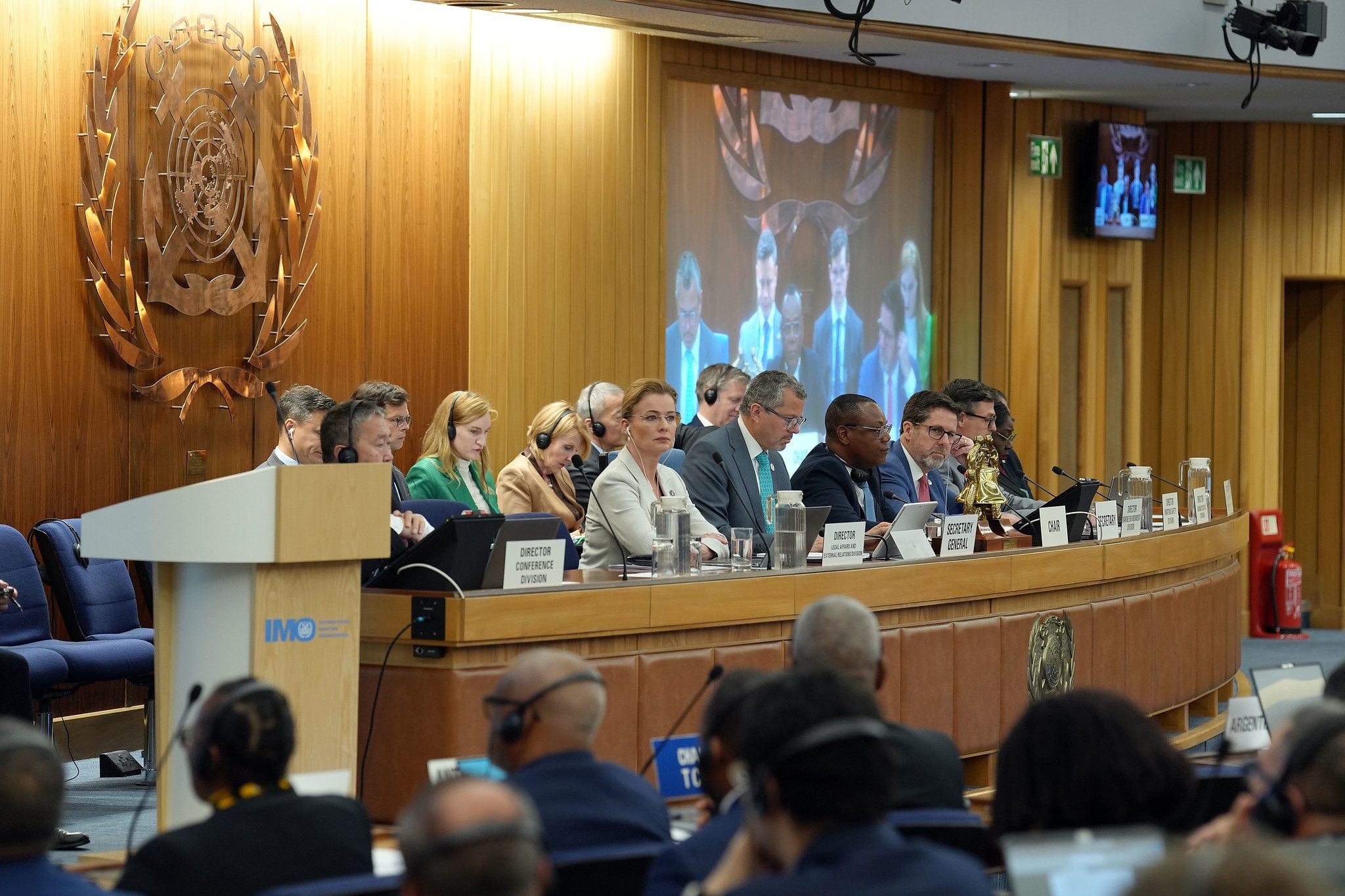
The U.S. is intensifying its push against the International Maritime Organization’s proposed global carbon pricing regime, with Federal Maritime Commission Chairman Laura DiBella urging member states this week to consider alternatives to the stalled Net Zero Framework (NZF) during high-level talks in London.
Speaking after participating in the IMO’s Marine Environment Protection Committee (MEPC 84), DiBella said the U.S. delegation engaged more than 20 countries in an effort to break the deadlock over the controversial plan, which has sharply divided the global shipping community.
The NZF—backed strongly by the European Union—would impose greenhouse gas intensity standards on ships and levy fees on non-compliant vessels, effectively creating a global carbon pricing mechanism for maritime transport.
DiBella warned the proposal, as currently envisioned, risks significant economic fallout.
She argued that ships failing to meet the framework’s fuel requirements—estimated to impact as much as 97% of the global fleet—would face charges that would ultimately be passed down the supply chain to consumers.
“Although NZF proponents may believe they have engaged in meaningful negotiations with all parties in the IMO, in reality the insistence of a minority bloc had previously overwhelmed the silent majority, until this week at the MEPC, when that silent majority finally found its voice,” DiBella said, suggesting a shift in tone at this week’s negotiations.
The U.S. delegation is now actively encouraging member states to explore alternative approaches that could reduce emissions without destabilizing global shipping markets or driving up costs for import-dependent economies.
The intervention marks a notable expansion of the FMC’s role in international maritime policy discussions, which have traditionally been led by agencies such as the U.S. Coast Guard and State Department. It also reinforces the Trump administration’s broader opposition to what it views as an inflationary and potentially anti-competitive regulatory framework.
DiBella signaled that the FMC could play a more assertive role if the framework advances in its current form, pointing to the Commission’s statutory authority to monitor and respond to “unfavorable shipping conditions” affecting U.S. trade.
“The U.S. will explore all potential remedial options to protect American consumers from a disputed and unneeded global carbon tax,” she said.
The debate over the NZF remains the central issue hanging over MEPC 84, following a contentious showdown last year that delayed adoption of the framework after a narrow vote exposed deep geopolitical divisions.
Supporters of the plan—including major shipping nations and industry groups—argue a global mechanism is essential to avoid a fragmented patchwork of regional regulations and to accelerate the transition to low- and zero-emission fuels.
But the U.S. and a growing bloc of countries are pushing back, framing the proposal as a costly intervention that could distort trade flows and place disproportionate burdens on consumers.
With no final vote expected until a later extraordinary MEPC session, this week’s talks suggest the battle lines are hardening, and that compromise, if it comes, will likely hinge on whether a viable middle ground can be found between climate ambition and economic stability.

 Join The Club