European naval forces have boarded another sanctioned tanker linked to Russia’s so-called “shadow fleet,” marking the latest enforcement action as the European Union ramps up pressure on vessels suspected of operating under questionable flag registrations.
Operation EUNAVFOR MED IRINI said its flagship, the Italian Navy’s ITS Thaon di Revel, conducted a flag-verification boarding of the oil tanker Toa Payoh on August 2 in international waters west of the Italian island of Pantelleria.
The tanker, which is subject to European Union sanctions, was sailing under the declared flag of Cameroon after departing Cotonou, Benin, on July 16 on a voyage to Istanbul. The inspection was carried out to verify whether the vessel was legitimately entitled to fly the Cameroonian flag.
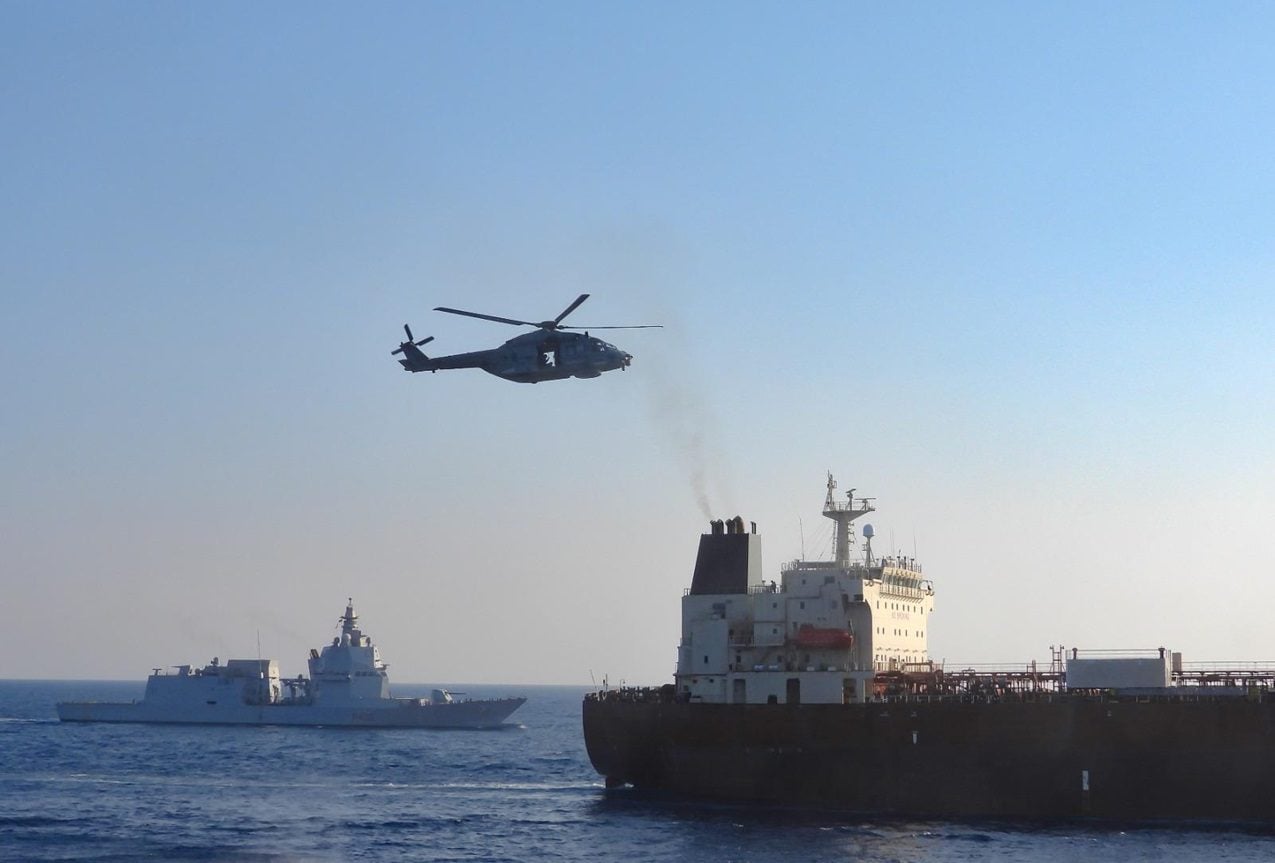
According to the mission, the vessel’s master initially declined to provide the requested cooperation. Italian naval personnel were subsequently inserted by helicopter from ITS Thaon di Revel to conduct the inspection. The boarding, supported by a Greek naval vessel and a Polish maritime patrol aircraft, lasted about two hours and concluded without incident.
The operation was conducted under Article 110 of the United Nations Convention on the Law of the Sea (UNCLOS), which allows warships to verify the nationality of merchant vessels on the high seas under specific circumstances, including when there are reasonable grounds to suspect a vessel is sailing under a false flag or without nationality.
Italian Defense Minister Guido Crosetto praised the operation. “I would like to congratulate the crew of ITS Thaon di Revel and all the military personnel involved in the operation for the professionalism, preparedness and determination they demonstrated,” Crosetto said. “This activity once again provides tangible evidence of Italy’s contribution to security in the Mediterranean and to the European Union’s efforts.”
Operation IRINI said the documentation and information collected during the inspection are now being examined.
The boarding is the latest in a series of inspections targeting Russia’s shadow fleet.
Last month, Operation IRINI boarded the sanctioned tanker South Star during another flag-verification mission after EU officials said there were grounds to question the vessel’s claimed nationality.
The European Union has steadily expanded its maritime enforcement campaign this year. Operation IRINI, originally established to enforce the United Nations arms embargo on Libya, received authority in March to conduct flag-verification boardings under Article 110 of UNCLOS. The mission carried out its first such inspection in May, and by late June had already boarded several suspected shadow fleet tankers.
EU foreign policy chief Kaja Kallas has described the effort as part of a broader campaign to match sanctions with enforcement at sea. EU member states have also authorized Operation ATALANTA, the bloc’s counter-piracy mission in the western Indian Ocean, to conduct similar flag-verification boardings, extending the reach of the crackdown well beyond the Mediterranean.
Western governments accuse Russia’s shadow fleet of relying on opaque ownership structures, frequent flag changes, manipulated vessel-tracking signals, and uncertain insurance arrangements to continue exporting oil despite Western sanctions and the G7 price cap. European officials have also warned that many of the aging tankers pose growing environmental and maritime safety risks.

 Join The Club