Dominion Energy’s massive Coastal Virginia Offshore Wind (CVOW) project has delivered its first electricity to the grid, marking a major milestone for the largest offshore wind development in the United States after months of legal battles, cost overruns, and policy headwinds.
The initial power comes from the project’s first installed turbine off Virginia Beach, as the 2.6-gigawatt development transitions from construction into early commissioning. Once complete, the 176-turbine facility is expected to generate enough electricity to supply roughly 660,000 homes.
Dominion CEO Robert Blue confirmed the milestone, saying the project delivered its first power “right on schedule” as it begins ramping up generation. He described CVOW as a key part of Virginia’s “all-of-the-above” energy strategy, with additional turbines set to bring more capacity online as the project moves toward full completion next year.
The breakthrough follows a high-stakes legal clash earlier this year. In January, a federal judge cleared Dominion to resume work on the $11.5 billion project after a Trump administration stop-work order halted construction over national security concerns tied to potential radar interference. The court found the suspension overly broad, allowing construction to restart after roughly 25 days of disruption.
That pause came at a steep cost. Dominion has since raised the project’s price tag to $11.5 billion—up $300 million—driven by $228 million in delay-related costs and another $137 million tied to tariffs. The work stoppage alone burned an estimated $5 million per day, highlighting the financial risks tied to regulatory uncertainty.
Tariffs have emerged as a major new pressure point. Dominion now faces elevated duties across key imported materials, with total tariff exposure projected to reach $580 million through early 2027. The company says trade policy is now among the largest contributors to offshore wind cost inflation in the United States.
Despite the setbacks, construction has continued to advance. The project is now more than 70% complete, with all 176 monopiles installed along with multiple export cables.
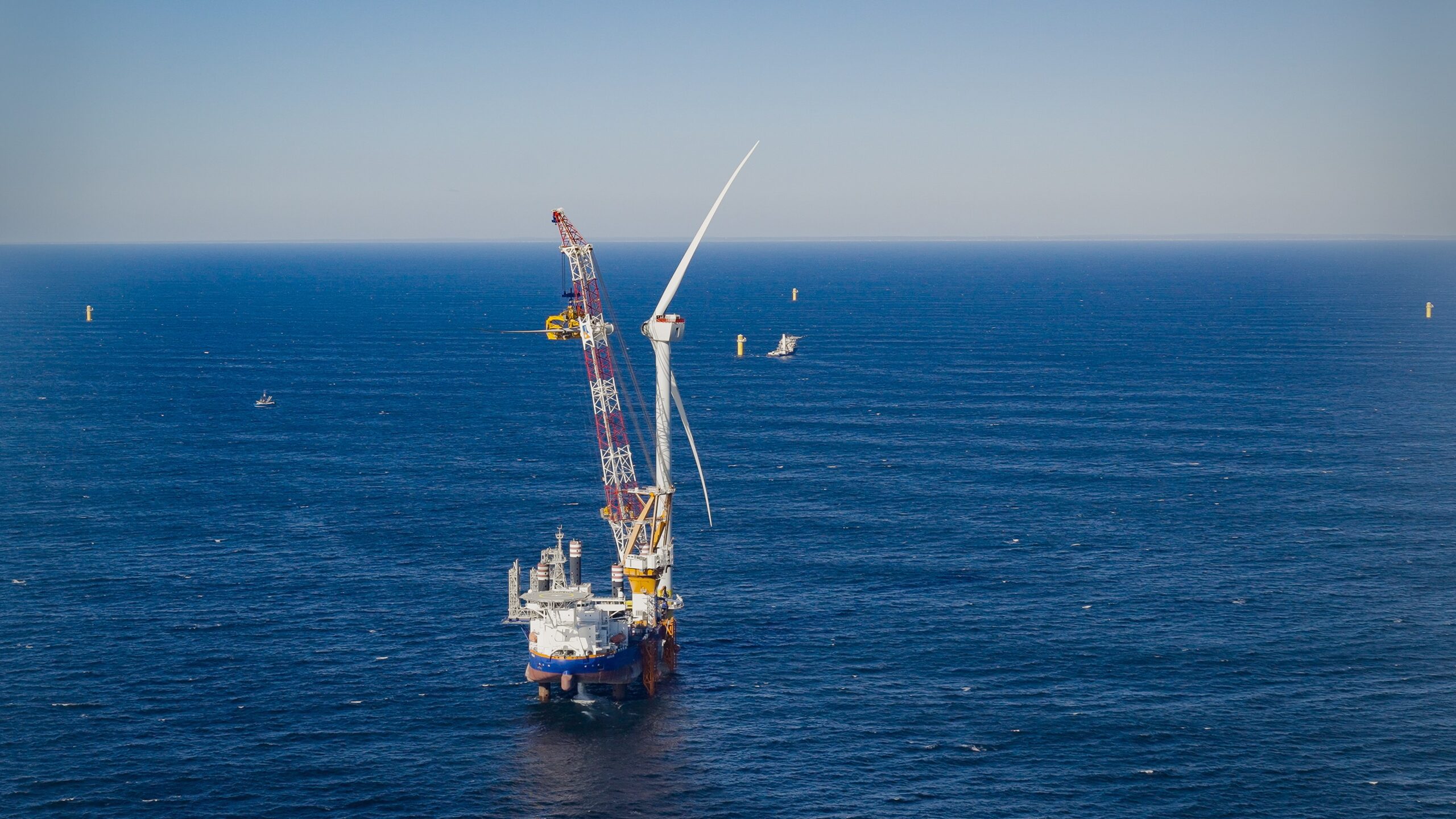
Installation work is being carried out by the U.S.-flagged wind turbine installation vessel Charybdis, the nation’s first Jones Act–compliant WTIV, which entered service earlier this year following earlier commissioning delays.
Virginia leaders quickly seized on the first power milestone. Governor Abigail Spanberger pointed to rising electricity costs as a key concern for households, saying the project will help power hundreds of thousands of homes while easing pressure on utility bills. Senator Tim Kaine called the moment the result of “years of hard work,” adding that the project positions Virginia at the forefront of the U.S. clean energy economy.
Dominion is increasingly framing CVOW as strategic infrastructure beyond climate goals, emphasizing its role in supporting growing electricity demand from AI data centers, military installations, and industrial activity along the East Coast.

 Join The Club