By Bruce Kimbrell (Policy Op-Ed) Over the past year, the White House’s Maritime Action Plan, the President’s FY2027 budget proposal, and a series of maritime and industrial initiatives across the administration have begun translating strategy into institutional execution.
Transportation Secretary Sean Duffy has announced billions in maritime and port-related funding initiatives. Acting Navy Secretary Hung Cao recently outlined an industrial-focused shipbuilding vision. Meanwhile, Maritime Administrator Stephen Carmel has emphasized logistics capacity, energy security, and commercial resilience during congressional testimony.
This synchronization across federal agencies is consequential because the nation is now applying authorities, shaping infrastructure, and rebuilding maritime capacity. Increasingly, these efforts reflect an emerging national framework centered on industrial revival, supply-chain resilience, and reduced dependence on foreign maritime infrastructure—outcomes that ultimately depend on concentrated maritime capacity.
The challenge is whether the United States can coordinate national effort coherently enough to build maritime ecosystems that align shipping demand, shipbuilding, infrastructure, freight connectivity, financing, and workforce capacity into reinforcing systems capable of sustaining activity at scale.
At scale, sustained activity rather than isolated investment is what enables concentration, and concentration is what produces maritime power. This is not theoretical. It is a pattern of maritime strength formation.
Maritime Power Forms Through Concentration
China’s maritime rise was not built by making every coastal city marginally more competitive. Instead, China concentrated shipbuilding, manufacturing, port infrastructure, financing, logistics systems, and industrial policy into a relatively small number of regions capable of sustaining industrial scale. This concentration was reinforced by structured demand through export-oriented production, state-linked procurement, and shipping corridors that stabilized utilization at scale.
The result was the growth of regional maritime systems capable of supporting global shipbuilding, logistics integration, and export dominance. The United States cannot fully replicate that methodology, particularly models of overcapacity and opaque financing.
But American leaders can still align innovation around maritime strongholds through infrastructure investment, commercial demand, regional specialization, capital formation, commercial reliability, and sustained execution that allows maritime industries, shipbuilding, and shipping networks to mature.
The United States already understands concentration in practice. Aerospace deepened in Southern California, and technology in Silicon Valley. Energy and petrochemicals concentrated along the Gulf Coast. Naval-industrial capability matured around Hampton Roads. Freight distribution systems expanded around Memphis and Chicago.
These clusters succeeded not through isolated projects, but through decades of reinforcing ecosystems. What American policymakers have not done is apply the logic of concentration deliberately to maritime competition itself.
Concentration is not a panacea, nor should every investment flow into designated zones. However, Maritime Prosperity Zones (MPZs) can provide an organizing logic for aligning national efforts with existing U.S. advantages in naval power projection, technology, logistics, and maritime services.
Maritime Prosperity Zones as an American Organizing Logic
That is where Maritime Prosperity Zones become operationally important.
A Maritime Prosperity Zone is a geographically and functionally defined maritime region where infrastructure, logistics systems, industrial activity, workforce development, financing, maritime security, and commercial demand are deliberately coordinated to deepen maritime strength in strategically important maritime regions.
Not every region requires equal concentration. MPZs identify where coordinated public and private alignment can generate durable national advantage over time.
The objective is not centralized economic control but coordinated alignment to concentrate effects. MPZs are not generalized economic development zones or permanent subsidy systems. They are mechanisms for developing durable maritime strongholds through the alignment of existing authorities and private incentives.
Their purpose is to improve American maritime capacity, resilience, and strategic reach through sustained coordination between public authorities, private investment, and the maritime industry. This includes strengthening U.S. control over strategic cargo movement tied to energy systems, critical minerals, fisheries, undersea infrastructure, and defense logistics.
Why Alaska Should Host the First Maritime Prosperity Zone
If the United States intends to rebuild maritime capability seriously, it should begin where geography is becoming increasingly consequential.
Energy flows, resource competition, military positioning, undersea infrastructure, Arctic shipping access, and great-power competition are converging in the High North.
Russia has already militarized substantial portions of the Arctic, while China increasingly views the region as a future commercial corridor and strategic access point. Cargo volumes along Russia’s Northern Sea Route reached approximately 38 million tons in 2024, more than double a decade earlier—still modest in global trade terms, but strategically meaningful as an indicator of emerging Arctic maritime activity shaped by sustained routing, infrastructure investment, and state-backed logistics coordination.
Meanwhile, the United States risks entering the next era of Arctic competition with insufficient infrastructure, limited industrial depth, and fragmented maritime presence. This is not a matter of awareness; it is a gap in sustained implementation capacity at the speed the region now demands.
An MPZ in Alaska reflects a broader strategic shift in which Arctic geography is becoming more consequential than legacy patterns of infrastructure investment. In this context, an MPZ is not simply a maritime program. It is a mechanism for establishing sustained U.S. access, presence, and competitiveness in a region that is becoming increasingly consequential to national power.
Operationalizing the Arctic MPZ
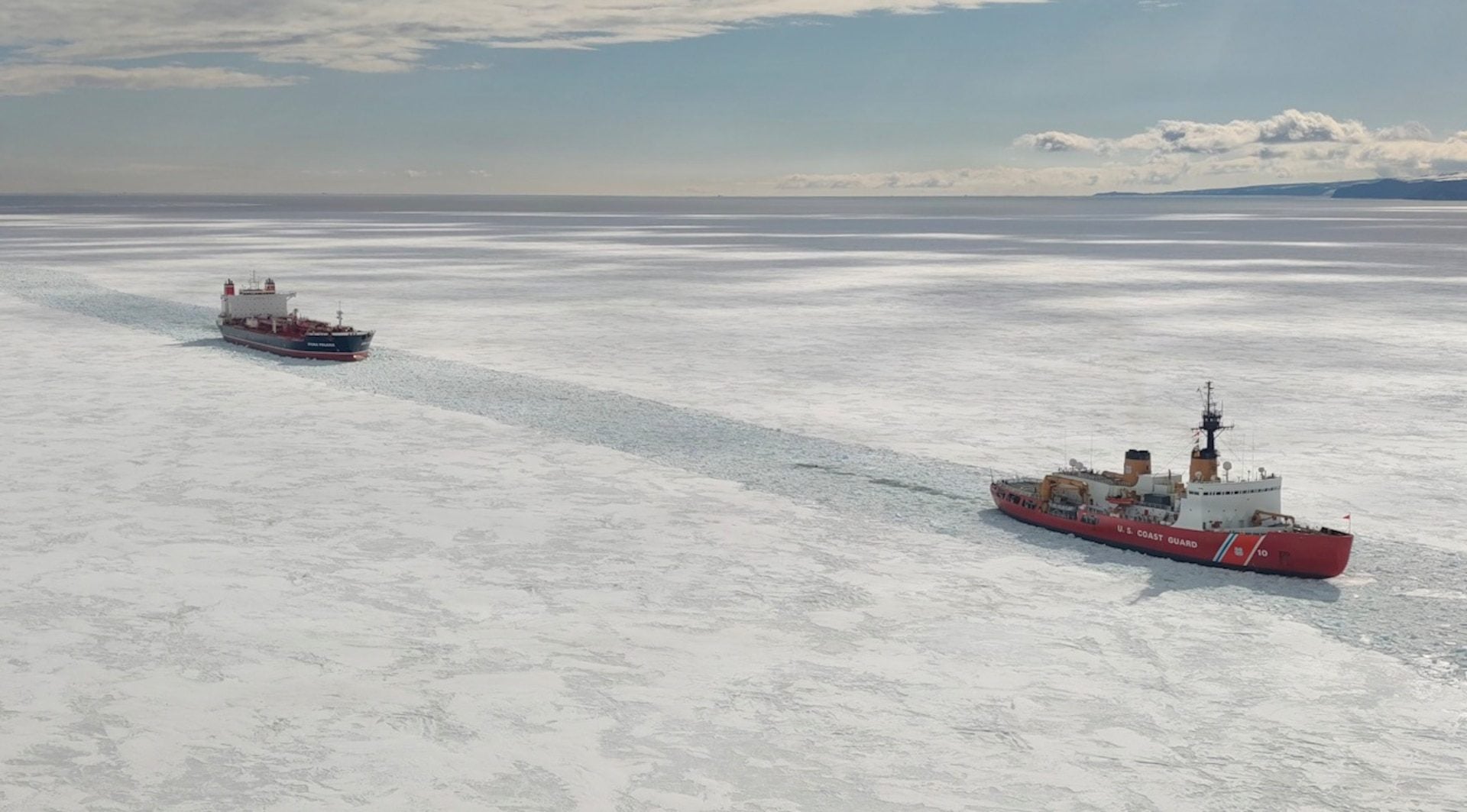
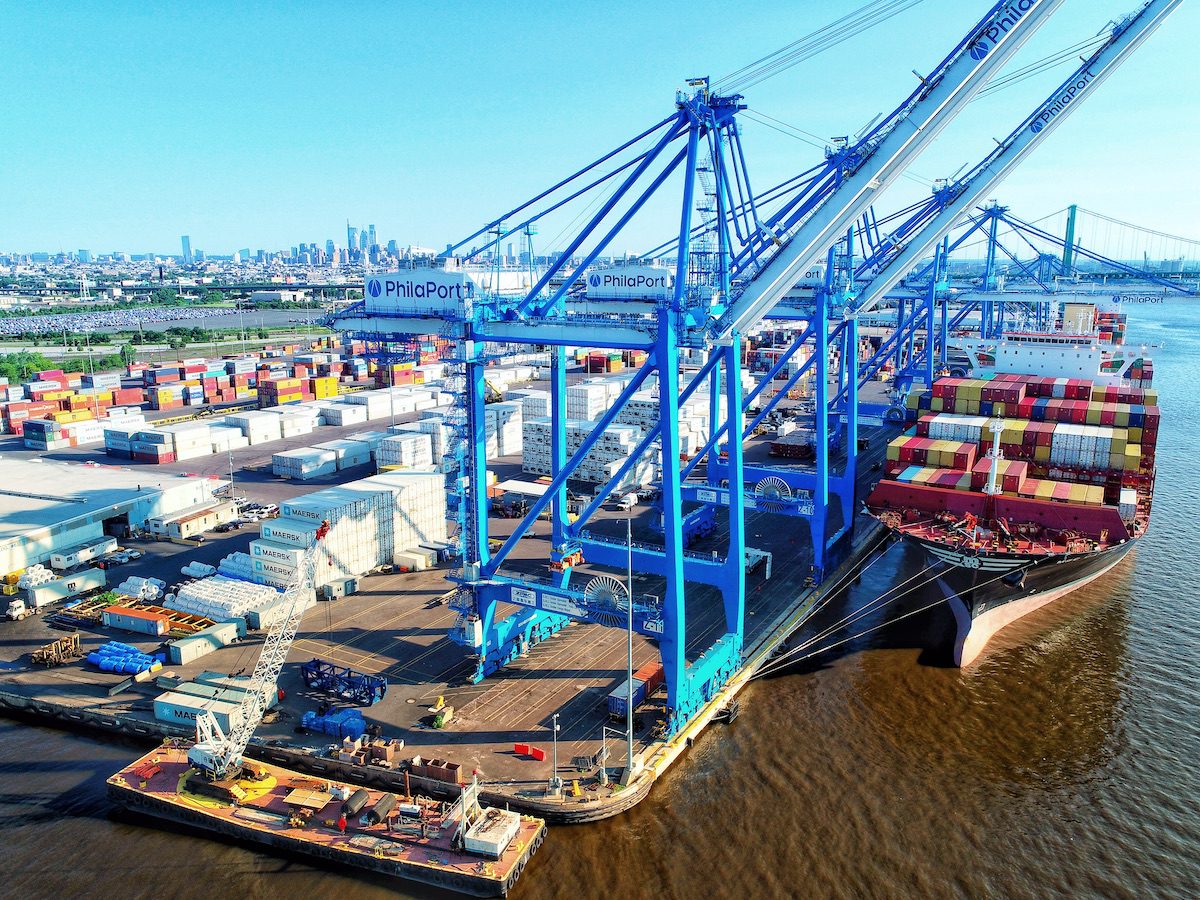
Initial implementation should focus less on headline announcements and more on building continuity across the Arctic maritime environment. That begins with port modernization at Anchorage, Nome, and Dutch Harbor, alongside improvements in fuel storage, sealift support capacity, logistics infrastructure, and Arctic-capable repair and maintenance capability.
The first practical steps are straightforward: prioritize existing contracts, convene an interagency MPZ task force through the Department of Commerce and MARAD, and use targeted federal capital and operating support to align commercial and defense demand signals. These actions can begin immediately using authorities already in place. More importantly, they translate strategic intent into measurable early momentum, helping create the conditions in which private operators, investors, and maritime industry stakeholders see a durable path forward.
The region should also support closer operational integration between commercial operators and the Coast Guard, alongside expanded Arctic navigation, surveillance, and offshore operational capability.
Federal coordination can help enable durable U.S.-flag shipping activity servicing Arctic routes and regional freight demand. Early activity will necessarily be incremental, but it must be persistent and repeatable rather than episodic.
Over time, this environment can support expanded port capacity, vessel maintenance capability, offshore energy servicing, logistics technology deployment, unmanned maritime systems testing, fisheries support industries, and military sealift operations linked to recurring commercial and defense demand.
The objective is not a single infrastructure project, but a functioning maritime operating environment that sustains continuous commercial, industrial, and security activity.
Once operational, an Arctic MPZ in Alaska would provide a reference model for future Maritime Prosperity Zones in other U.S. maritime regions.
How Maritime Prosperity Zones Mature
Maritime regions do not transform automatically, and no federal designation or funding program is sufficient on its own to generate durable maritime capacity. MPZs work by aligning the conditions necessary for recurring industrial production, freight throughput, and operational maritime activity over sustained time horizons.
Carriers, shipyards, manufacturers, and infrastructure investors respond to predictable throughput conditions and recurring demand environments. It is within these environments that maritime industries scale.
Scaling occurs when demand becomes structured rather than episodic. Structured demand stabilizes routes, increasing vessel utilization.
Defense logistics contracts, sealift activity, repair demand, and smaller vessel procurement contribute to continuity across segments of the industrial base, particularly where they reinforce private-sector activity rather than substitute for it.
Even relatively small recurring commitments matter because they signal the early formation of a functioning maritime investment environment.
A dedicated commercial shipping route. A repair ecosystem linked to offshore or subsea infrastructure activity. A vessel built for specialized undersea mission requirements. A private-sector effort to rebuild critical port equipment manufacturing capacity.
These are not isolated transactions. They are indicators of whether a durable deal-making environment is forming—one in which maritime demand, capital formation, and industrial capability begin to reinforce one another.
MPZs mature when this type of transactional density becomes routine rather than exceptional, gradually shifting investment, talent, and institutional attention toward maritime activity.
The Authorities Already Exist
The United States does not need to create an entirely new federal architecture to begin designating and advancing MPZs. Most relevant authorities already exist across the federal government.
As directed in President Trump’s Maritime Action Plan, the Department of Commerce can designate MPZs while the Maritime Administration coordinates implementation through a task force alongside key federal agencies, state governments, port authorities, and private industry.
MPZs would give fragmented authorities, infrastructure investment, and private incentives a common strategic direction. They can also help reduce permitting delays, regulatory fragmentation, and infrastructure approval timelines that discourage private capital formation and slow maritime industrial development.
The role of government is not simply funding. It is also convening by bringing together ports, carriers, shippers, labor organizations, infrastructure investors, manufacturers, and operators around regions where coordinated growth serves broader national interests.
Trade and logistics authorities can reduce friction and improve cargo flow through Foreign-Trade Zones, trusted shipping arrangements, and trade corridor alignment.
Infrastructure and industrial authorities can accelerate development through FAST-41 permitting coordination, MARAD grant programs, Army Corps dredging authorities, port modernization initiatives, rail and freight connectivity investments, and shipyard-related financing support.
Security and operational authorities can reinforce commercial confidence through Coast Guard operations, maritime domain awareness, Military Sealift Command activity, and strategic sealift support.
States such as Michigan, which has begun advancing its own maritime industrial strategy, demonstrate how state and local governments can align with these federal efforts on permitting, workforce development, tax incentives, industrial planning, and infrastructure priorities. A genuine strategic opportunity emerges when stakeholders align around regional advantages long enough for private investment and demand to deepen.
The Cost Problem Is Real
Critics of American maritime revitalization may point to a hard reality: U.S.-flag shipping, shipbuilding, and labor cost more.
It is true American costs are higher, but that reality is also a consequence of decades of fragmented maritime policy and uneven industrial support. Foreign industries benefited from concentrated industrial scale, lower-cost manufacturing, long-term state support, and ecosystem density sustained across decades.
Meanwhile, the United States often underwrote the security architecture underpinning global maritime commerce while allowing substantial portions of its own commercial demand to flow into foreign shipping and industrial systems. Over time, this helped foreign maritime powers capture the scale and recurring demand necessary to reduce costs and deepen industrial capacity while American-controlled systems operated with weaker demand concentration and less industrial continuity.
Cost and pricing challenges are valid concerns, but the United States cannot wait for a hollowed-out maritime system to become globally cost competitive before rebuilding strategic capacity. Waiting will degrade economic resilience and national security. Advancing MPZ implementation can instead create conditions under which structural maritime weaknesses become more manageable over time.
The case for an MPZ in Alaska illustrates the point clearly: revitalization is not solely a cost-efficiency exercise. MPZs can generate industrial resilience and long-term national security advantages by cohering infrastructure, investment, and maritime activity around economic and national security priorities.
The Real Challenge Is Sustained Alignment
That alignment will not occur automatically. Federal agencies, state governments, port authorities, carriers, labor organizations, infrastructure investors, and industry stakeholders must align competing incentives, timelines, and priorities.
A revival of American maritime power depends on sustained unity of effort across both public and private actors. America’s comparative advantage is not centralized direction, but the ability to sustain coordination through institutions that combine ingenuity, persistence, and adaptive capacity at scale.
If the administration intends to lead a serious American maritime revival, it should make that visible by launching the nation’s first Donald J. Trump Maritime Prosperity Zone in Alaska as a flagship effort to deepen American strength, Arctic access, and strategic presence in the High North.
Not as another isolated program, but as a national demonstration that the United States can still rebuild maritime power through sustained alignment between industry, infrastructure, logistics, and national priorities.
America either rebuilds maritime ecosystems deliberately or continues ceding industrial depth, strategic access, and demand concentration to competing powers.
Commander Bruce Kimbrell is a career naval officer with deployments in Europe, Africa, the Middle East, and Asia. He has deployed with U.S. Carrier and Expeditionary Strike Groups. He previously served as a Director with the National Security Council at the White House and has supported strategic maritime initiatives as staff for the Office of the Chief of Naval Operations and the Office of the Secretary of the Navy. He also served as a national security and defense staffer for U.S. Congressman Michael Waltz of Florida’s 6th Congressional District.
The views expressed are those of the author and do not reflect the official policy or position of the U.S. Navy, the Department of Defense, or the U.S. Government.

 Join The Club