Photo By Cayusa
Note: This article was originally posted in The Maritime Executive Newsletter and can be found HERE.
The dynamic in the Gulf Of Aden is changing by the day. The last two weeks brought news of two separate attacks on Cruise Ships and a determined attack against a convoy under the protection of an Italian navy destroyer. The one constant in the region is a general lack of answers to the question; “How do we keep our vessels and crews safe?” The international shipping community, government organizations like the European Union and corporations like Global Rescue LLC, a US based rescue, evacuation and security company (LINK), are engaged in developing solutions. [Continue Reading →]
Tags: · ISPS Code, maritime security, piracy

Without question, piracy off the soast of Somalia is a problem that is costing time, money, headaches and lives. As of right now there is really no end in sight. Many shipping companies are taking extreme measures, like re-routing their vessels around the Cape of Good Hope, in order to avoid the possibility of being hijacked. Broken down, this means that the costs associated with avoiding Gulf of Aden (i.e. fuel, daily charter rates, longer transit times of cargo) are less than the of the risk associated with a vessel being hijacked and held for ransom.

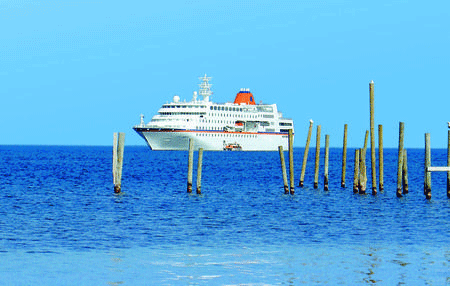
Last week we reported on the attempted hijacking of two cruise ships holding hundreds of passengers, one of which was even fired upon withing the UKMTO Transit Corridor. Now, one cruise line company is deciding to take measures to protect its civilian passengers from any harm. AFP reports:
The MS Columbus cruise ship will drop off its 246 passengers before the ship and some of its crew sail through the Gulf on Wednesday, the Hamburg-based company said in a statement, without saying exactly where they would disembark. It said the passengers would take a charter flight Wednesday to Dubai and spend three days at a five-star hotel waiting to rejoin the 150-meter (490-foot) vessel in the southern Oman port of Salalah for the remainder of a round-the-world tour that began in Italy.
The company said it was sending its passengers on the detour as a “precautionary measure,” given rampant piracy off the coast of lawless Somalia that recently has targeted cruise ships as well as commercial vessels, including a Saudi oil tanker and a Ukrainian ship carrying tanks and other weapons.
For this company, the costs of detouring the passengers through the area far out-weigh the risk of any harm or inconvenience done to them. Now void of any tourists, we will just have to see how the MS Columbus fares in the dangerous waters.
In fact, it would be interesting to see the analysis that these companies are doing before making the decision to avoid the area.
Tags: · Cruise Ship, ISPS Code, piracy, somalia

The United States Coast Guard is trying to remind mariners and the American public in general to remain vigilant. They have a short journal entry concerning the America’s Waterways Watch program on their Coast Guard Journal. It reads: [Continue Reading →]
Tags: · ISPS Code, maritime terrorism, maritime_safety, USCG
Earlier today gCaptain received reports from Australia that the M/V Athena was attacked by 29 pirate boats while transiting the Gulf Of Aden. This was the second cruise ship to be attacked and the first to witness an attack at this scale. The shear number of boats and the coordination of this many individual assets left us in disbelief. We spent this afternoon looking for the facts.
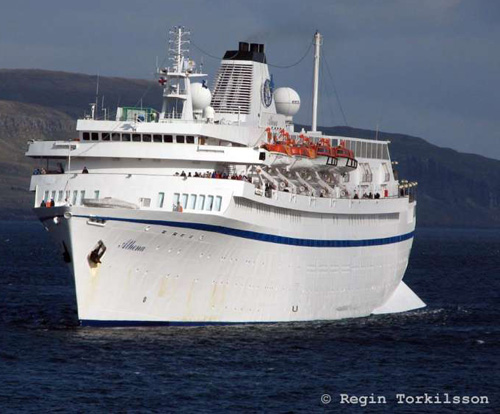
M/V Athena
Photo By Regin Torkilson
The M/V Athena is owned by Classic International Cruises and operated by World Cruise Agency, both of Portugal. According to Equasis the vessel was built in 1948 and operates under the Italian flag. The company provides us with an overview of the vessel:
Athena was originally built as a trans-atlantic ocean liner and in 1994 the vessel changed ownership and was virtually stripped to her hull and re-constructed and restored as a beautiful new premium rated contemporary cruise ship. With a handsome profile and a traditional walk around promenade deck, Athena is a medium to small sized cruise ship by today’s standards carrying about 550 passengers and offering a wide selection of well appointed public lounges and comfortable cabin accommodation spanning eight passenger decks serviced by two lifts.
In a phone call to World Cruise Agency we have been told the number of pirate vessels was 24. We are awaiting a reply from the company on details of the attack and will post then here once available.
Convoy

In researching the Athena attack we learned from multiple sources that just yesterday a convoy of merchant ships under the direct protection of an Italian Penne Class Destroyer was attacked by 20 boats while transiting the Gulf Of Aden.
Naval Technology provides insight on the capabilities of this naval asset:
The Durand De La Penne Class destroyers were built by Fincantieri for the Italian Navy. The first-of-class ship, MM Luigi Durand De La Penne (D560), and the second, MM Francesco Mimbelli (D561), were commissioned in 1993. The ships were constructed at Fincantieri’s Riva Trigoso shipyard.
The Durand De La Penne destroyers are 5,000t multi-role warships able to perform anti-air defence for protecting task forces and convoys, anti-submarine and anti-surface warfare operations, assistance during landing operations and coastal bombardment.
The ship is equipped with a helicopter deck and a hangar with facilities for two helicopters such as the Agusta Bell AB 212, the Sea King SH-3D or the EH-101. More Information…
gCaptain will be reporting on this breaking news as more information becomes available. Regardless of the upcoming details the coordination of pirate assets is deeply troubling. We consider this an elevation of the current threat and ask you to pass this new information to all mariners transiting the region.
gCaptain is also working towards a solution to the problem. We have coordinated efforts with an outfit that provides rescue services to mariners and travelers worldwide. The underlying problems in Somalia are:
- Under-Manning Of Vessels
- Lack Of Specific Training
- Political Instability In The Region
While we have little ability to change the political situation in the country itself we believe new ideas are needed to harden potential targets and assure the safety of mariners transiting the region. Increasing the number of watchkeepers and providing on board training and advice is within our capabilities. If any companies or mariners are planning on transiting the region in the coming days/weeks please contact us directly, otherwise, stay tuned for breaking developments on this story and our plan to coordinate the maritime community’s efforts to protect our shipmates.
UPDATE:
Classic International Cruises Australia has changed their account of the M/V Athena attack. The Australian reports:
A spokeswoman for Classic International Cruises Australia, which owns the Athena, said the boats had turned out to be local fishing vessels whose crew were “very friendly”.
“Precautions were taken when the boats were sighted but there was never any suggestion that the boat was going to be attacked,” Classic Cruises sales and marketing manager Ann Hope said.
She said water cannons were dropped from the side of the ship as a standard measure, but were not used at any stage.
Ms Hope said the company had exchanged emails with the Department of Foreign Affairs and had sent a message to all its travel partners to inform them there was no piracy attempt.
“We would like to advise you that Athena has not in any way been under attack by pirates or even under direct threat and the current situation on board is as it was at the beginning of the cruise,” the email said.
This is in stark contrast to the phone conversation gCaptain had with Classic International Cruises just yesterday. Also of note, the company promised to send us a maritime advisory drafted after the attack. This email never arrived and the company representative has been unavailable for a follow-up conversation.
UPDATE 2:
gCaptain received the following report from a maritime security group working in the area. They write:
The on-again/off-again, it happened/it didn’t happen, attack on the Australian cruise ship ATHENA did, in fact, happen, and we should no longer doubt the extraordinarily large number of pirate skiffs involved, originally reported by eyewitnesses as about 30 to ATHENA’s port side and 12 to starboard. When the press heard eyewitness accounts from passengers onboard, the cruise line acknowledged the attack initially, only to deny it 24 hours later, referring instead to passengers who were mistaken about the “very friendly” fishermen whose boats surrounded the ship (but nonetheless prompted the crew to deploy fire hoses). Companies have their reasons for saying things, and the cruise line wishes its passengers aboard ATHENA a “memorable cruising experience.” It is not the company’s fault that pirates tampered with the memories of her Gulf of Aden passage December 2nd.
The latest version of the corporate story has compelled Portuguese Captain Antonio Morais to explain to passengers that the “very friendly” fishermen his cruise line first described in version 2.0 were, version 3.0, pirates on a recce/training mission. Doubtless, Classic International Cruises should award the captain a medal for saving his ship and her souls (not to mention a judge’s spot on “Dancing With The Stars” for the deft corporate waltz he was compelled to perform).
Nevertheless, the facts remain: after two and possibly three boarding attempts, pirates mounted a full-on effort to capture his ship. Fortunately, Portuguese mariners rock, and speed kills, sometimes thankfully: Captain Morais and ATHENA outran their attackers.
And the number of boats makes sense. Two to four boats (nominally as many as 24 combatants) capture tankers and freighters with crew of 20 or so. Some 40 boats with 200 combatants, pirates figure, can take and hold a defenseless cruise ship with hundreds of passengers and crew.
Despite the cruise line’s denials, this attack was evaluated by our people, and others with a stake in the game, as totally authentic, and it involved the approximate number of boats initially reported by ATHENA passengers. I also believe it figured solidly behind a German cruise line’s decision to pull passengers and much of the crew from the cruise ship COLUMBUS December 8th, fly them to Dubai and put them up in a five-star hotel to await that ship’s arrival, all at considerable expense.
I also believe SECSTATE Rice and/or our people at the UN referred to ATHENA to build support for the U.S. initiative circulated at the UN to go ashore, if need be, to pursue pirates (full Security Council vote slated for December 16th). If and when we go ashore in Somalia, it is very much game-off for pirates and a most serious game-on for President-elect Obama, our Navy, Marines and special forces, and the international forces fully committed in the region. It also represents a unique challenge to General William E. Ward, U.S. Army, first Commander of U.S. Africa Command.
Perhaps it’s a sign, too, that pirates made a grave error by targeting a ship named after the Goddess of Wisdom.
Tags: · ISPS Code, Maritime Security Incidents, piracy

Just when we thought things couldn’t get any more chaotic in the Gulf of Aden, the ‘pirate mother’ ship that was sunk last week by an Indian Navy warship is now being reported to be a Thai fishing trawler. CNN reports:
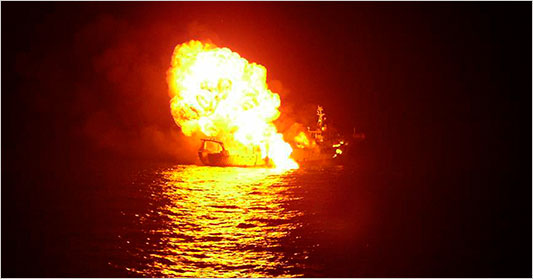
Fourteen sailors are still missing from a Thai trawler that was sunk last week by the Indian navy as a suspected pirate ship, the vessel’s owner said Tuesday.
One crewman was found alive after six days adrift in the Gulf of Aden, and one is confirmed dead, said Wicharn Sirichaiekawat, owner of the Ekawat Nava 5.
Last week, India’s navy reported that the frigate INS Tabar had battled a pirate “mother vessel” in the gulf November 18, leaving the ship ablaze and likely sunk. Wicharn said that vessel was his ship, which was in the process of being seized by pirates when it came under fire.
Indian authorities insisted that their ship had acted against a pirate vessel that had threatened to attack the Tabar.
“We fired in self-defense and in response to firing upon our vessel. It was a pirate vessel in the international waters, and its stance was aggressive,” said Commodore Nirad Sinha, a navy spokesman. He said the ship the Tabar fired upon was laden with ammunition.
The image above, released by India’s Defense Ministry shortly after the incident, is reported to be of the vessel that was left ablaze.
Tags: · incident photos, ISPS Code, Pirate attacks, pirates, somalia

In light of the recent piracy news gCaptain has recieved a number of media requests to answer basic questions about piracy. Below you will find just a few of the questions we have been asked along with my answers.
Why Somalia?
Pirates need a few things to prosper: weak national security of a host state or political unrest, access to weapons, ships transiting close to shore, cooperative weather and an abundance of high value ships.
Somalia certainly meets the first two requirements but, like in real estate, it’s Location, Location, Location. As seen in the diagram of shipping routes below, somalia lies in the direct path of traffic transiting between Asia and the Suez canal. The manner in which Somalia just coupled with the amount of shoreline in close proximity to shipping lanes gives the pirates easy access to ships. [Continue Reading →]
Tags: · ISPS Code, piracy, Pirate attacks, pirates, somali, somalia
gCaptain made an unscheduled stop this week at the Maritime Security Expo in Long Beach. The event showcases new technology and ideas that improve the security of ports and vessels. The following is a sampling of the best new technology we tested at the event:
Incident Commanders’ Radio Interface

The Incident Commander’s Radio Interface is a system developed by C-AT to allow ‘bridges’ any two incompatible radio, cell, satellite, and landline phones, providing interoperability across frequencies. Developed to allow firefighters, police and other first responders to communicate together this device also has many uses aboard ship.
Having worked aboard a offshore drillship there were times, like during well testing, when half a dozen or more third party companies were working on deck. Each company operated a different type of radio broadcasting on a separate channel. This worked well during normal operations but during emergencies communication with these teams of workers became difficult.
How does it work? [Continue Reading →]
Tags: · Gear, ISPS Code, LRAD, maritime security, security, technology

Following this weekends hijacking of the Saudi VLCC loaded with crude, gCaptain has been flooded with numerous emails and phone calls from different news organizations trying to lock down information on the surge of world wide pirate attacks.
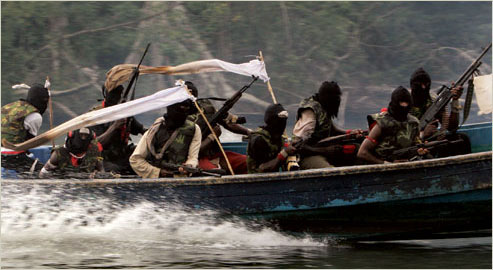
Want the lowdown? Well here it is. The following is a review of last weeks international Pirate attacks posted by the ICC Commercial Crime Service
Weekly Piracy Report
11 – 17 November 2008
Suspicious crafts
None reported
Recently reported incidents
- 16.11.2008: 0430 UTC: Posn: 04:08N – 006:50E, Bonny outer road anchorage, Nigeria.
Six robbers armed with automatic weapons opened fire at a refrigerated cargo ship at anchor. Robbers in a speedboat circled 4 times around the ship and left. No injury to crew.
- 13.11.2008: 1000 UTC: Mamonal ‘A’ anchorage, Cartagena, Colombia.
Robbers armed with gun and knives boarded a cement carrier at anchor. They tied up one crewmember and stole ship’s stores. Coast guard boarded vessel for investigation.
- 31.10.2008: 0000 LT: Bakasi Peninsula, Kole oil terminal, Cameroon.
Heavily armed pirates boarded an off shore supply vessel and kidnapped some crewmembers. Further report awaited. [Continue Reading →]
Tags: · imb, ISPS Code, piracy, pirates, somalia
Tags: · brm, ism, ISPS Code, marpol, poll, stcw

Depending on how you look at it, CNN reports some good news from the Gulf of Aden:
Five attempts to hijack ships off the coast of Somalia were thwarted Tuesday by the ships’ crews, the U.S.-led coalition that monitors the region said Wednesday.
“Even when shots were fired during two of these attacks, the crews of commercial shipping vessels conducted evasive maneuvering and used fire hoses to repel their attackers,” the Combined Maritime Forces, a U.S.-led naval coalition involving several nations, said in a statement.
Vice Adm. Bill Gortney, commander of the Combined Maritime Forces, praised the commercial ships’ crews.
“The proactive measures taken yesterday by merchant vessels are exactly what we have been recommending,” he said in Wednesday’s statement.
While it is good to hear that some vessels are taking action to fight off pirates, the fact that there were five attacks in one day WITH, among others, 7 NATO warships in the area really speaks to the severity of the problem.
Tags: · ISPS Code, piracy, pirate, pirates, somali