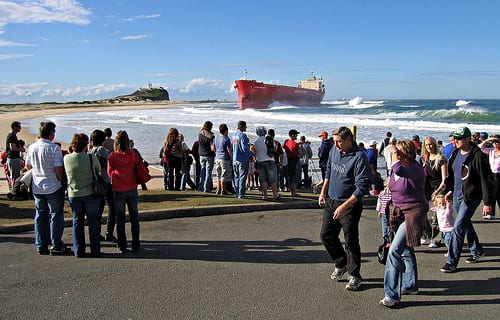
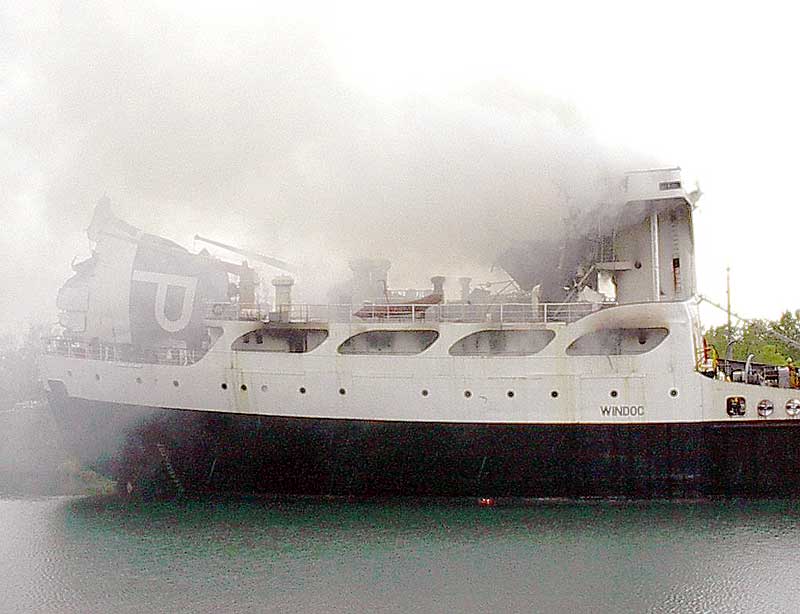
Photo By suburbanbloke
In a post unusually harsh for gCaptain standards I asked some tough questions about actions taken by the captain of the doomed ship, Pasha Bulker. Here’s a recap;
…did the crew used their satellite comms to discuss the weather patterns with meteorologists or did they simply ignore the port authority’s warnings? Did the captain use his AIS to identify the surrounding ships and call fellow captains via GMDSS to discuss the situation? Did they have access to and use real-time weather data or wait for a 2-dimensional weather fax?
(read the full article HERE)
Today in a leaked version of the incident report the answer is clearly no.
In a candid interview with investigators the vessel’s captain disclosed his actions in the critical moments between weighing anchor and the ship’s grounding. Take a deep breath as you may find this hard to believe. He was eating breakfast! In the galley!!
Here’s a rundown of events as report by The Sydney Morning Herald (full article located HERE)
The trail of mistakes and incompetence began on the evening of June 7 when warnings about an approaching storm were issued to 56 ships anchored off Newcastle. The Pasha Bulker, waiting to load 58,000 tonnes of coal, was one of 10 ships whose captains chose to stay at anchor about 200 metres off Stockton Beach to assess the situation overnight.
At 5.30 the next morning authorities tried again, but the Pasha Bulker stayed at anchor. It was not until 7am, in a sea whipped up by 100kmh winds, that the captain realised he had to move, and move quickly.
46 ships decide to leave port to avoid dragging anchor in an unprotected harbor and the Pasha Bulker stays, while this action is questionable the decision is not necessarily breaking the rule of prudent seamanship. The next morning Port Authorities “try again” to evict the remaining ships. I do not have details on the warning but it’s normal procedure to give the availability of tug boats that could help a ship in danger. Either way rescue tugs never showed and were apparently not requested by the captain.
At this point the captain became a danger to the vessel and crew. A master’s disagreement with port authority suggestions is understandable and the choice to ignore the warnings are his prerogative but one necessary step was not taken; vigilance. This is the time for a captain to ask himself the questions mentioned above, this is the moment to question your own decision, this is your chance to solidify a bridge team management plan and put the crew on high alert.
The story continues;
As the Sea Confidence, a nearby vessel facing the same predicament began moving out to sea with its anchors still dragging, the Pasha Bulker stayed and attempted to weigh anchor before moving. Mariners say it is standard practice for a boat (sic) to be moved forward slowly to help raise the heavy chain from the seabed while it is being hauled in. It meant the ship would have already moved through the surf in the 10 minutes it would have taken to get the anchor aboard.
In an emergency, such as the one brewing by the 30-year storm, the anchors should be cut and left behind.
Instead, the captain ordered the engines to remain idle while the chain, up to 200 metres long with links each weighing 100 kilograms, was winched aboard. As a consequence, the ship was still in the danger zone an hour later when the anchor was finally shipped.
Here I take exception to the article. While the Chief Mate might have been able to release the anchor brake and allow the chain to fully pay out (the more appropriate action), there is no quick and simple way to cut an anchor chain the size of the Pasha Bulker’s. The decision made aboard Sea Confidence would have been more appropriate to the situation. While some shiphadling ability is lost if the anchor is left down (due to a movement of the vessel’s pivot point forward) the Pasha Bulker has plenty of reserve power and steerage to overcome any serious problem.
It was now just after 8am. With the winds and seas continuing to rise and the engine only just beginning to move the ship, the captain called the chief engineer and invited him to breakfast. Both were Korean in a 22-man crew otherwise made up of Filipinos. They met in the dining room while others were left in charge of moving the vessel through the dangerous conditions.
The Pasha Bulker, now in the hands of less experienced crew, was shunted north along the coast toward Port Stephens, unable to make much headway against the waves. It had traveled about three kilometres before the captain reappeared on the bridge and took command of his ship, which was now out of control.
Was the captain called by the mate on watch when his inability to make positive headway was identified? If the mate on watch was exceptional and the answer to the question is no… the captain might not have been reckless in making this bad decision.
At 8.30am the ship had been looped in almost a full circle by the power of 18-metre waves and was now headed toward Nobbys Beach on the outside of the southern entrance to the port.
The captain, in a panic as he told investigators in the offices of a Newcastle law firm, made one last desperate attempt to save his ship, but again made an error. Instead of swinging it hard to starboard, he ordered it go full astern, literally backing up into the pounding waves that were breaking over its decks. The stern was lifted above the waves, its rudder useless and the propeller spinning madly in the air. The 225-metre vessel then virtually surfed to the beach and hit a rock shelf called Big Ben Reef.
Ships are designed for forward motion. For example, the rudder is placed aft of the ship’s screws in order to benefit from the propeller wash pushing against it. When a ship backs down, however, the propeller wash is pushing against nothing and the rudder must rely on the vessel’s motion through the water to grab hold of water and turn the ship. When the ship transitions from froward to “reverse” motion there is a period of time the rudder is totally ineffective. This is why ships need tugboats when departing a dock… until they reach the minimum speed needed for the rudders to be effective (know as bare steerage) the tug must hold the bow on course.
More importantly an unladen ship with forward momentum and an engine working on an order of full ahead can turn quickly. It is important to note this rate of rotation is a critical factor. If a ship turns slowly (as happens during a reverse maneuver) the ship will have difficulty turning through the wind and can get stuck at a heading beam to (perpendicular from) the wind.
The collision broke the back of the ship – hogging, as it is called. It bent the ship into an inverted U-shape that could be seen by onlookers from the beach as ripples in the hull. The captain panicked again and ordered the ship to be abandoned even though there was no chance of it sinking, having already run aground, and needed at least a skeleton crew to minimize damage and monitor the hull to avoid an environmental disaster. They were taken off by helicopter.
Panic is enemy number one in an emergency situation. While some have more difficulty than others avoiding it a captain should never panic. This is a primary reason it takes 10 years of sailing experience and school to obtain a master’s license. I these 10 years you will be exposed to situations at sea that test your panic trigger, if you are unacceptable to panic or indecision at the time if crisis you should not take command of a ship. Many mariners face difficulty getting promoted to second mate for this very reason as this officer position is the highest pay grade obtainable without the need for making life threatening decisions in the face of danger. I have met few captains to which the Peter Principal applies.
For these reasons I find the report nearly unbelievable.
John Konrad is a USCG licensed Master Mariner of Unlimited Tonnage currently working as Chief Mate aboard a 835′ship in the Gulf of Mexico. Since graduating from SUNY Maritime College he has sailed 4 of the world’s oceans and reports from his ship via satellite.
Updated: February 5, 2026 (Originally published October 13, 2007)
Editorial Standards · Corrections · About gCaptain

 Join The Club