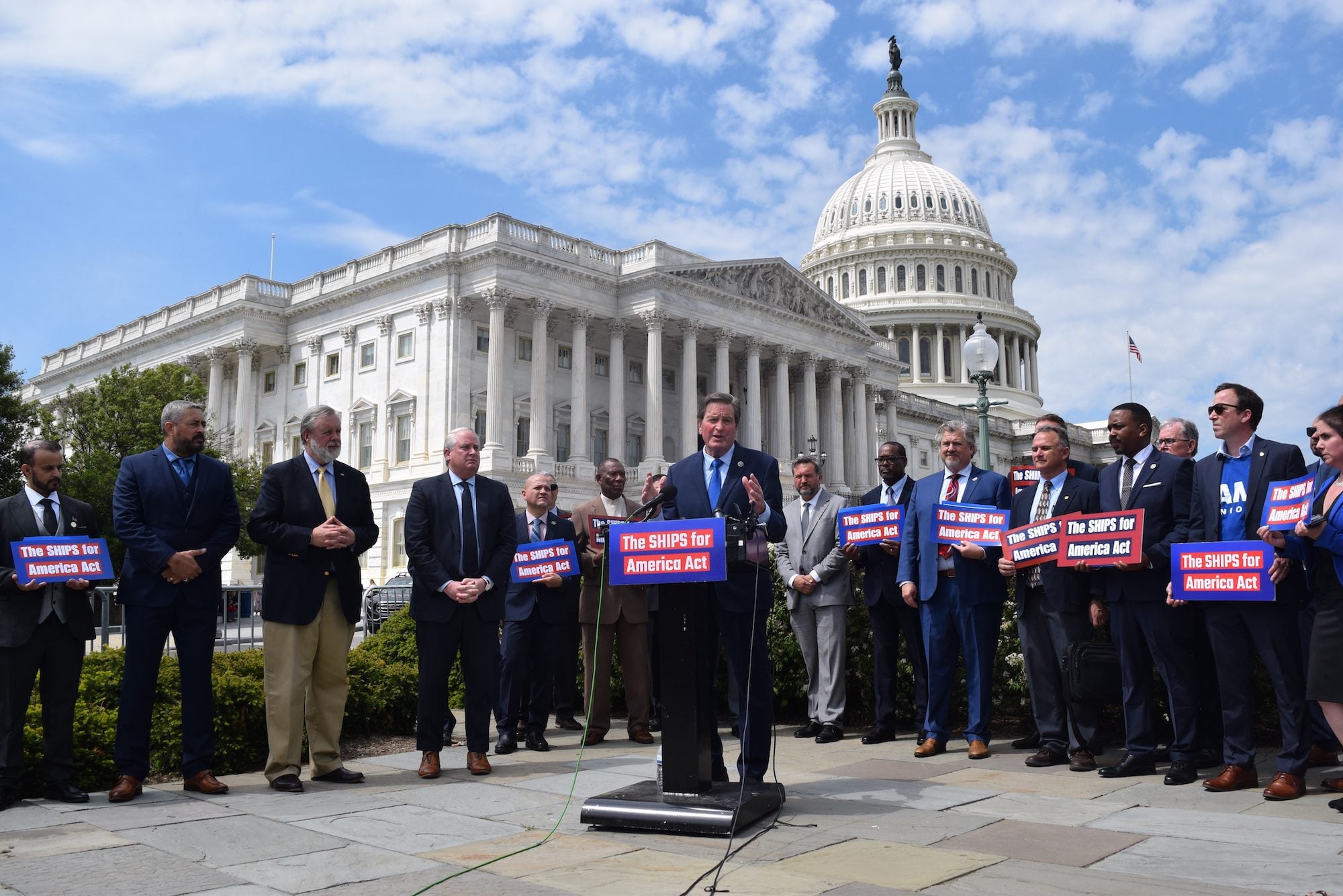
Backers of the SHIPS for America Act mounted a renewed push Wednesday to move sweeping maritime legislation through Congress, with lawmakers, labor leaders and shipbuilding executives portraying the bill as the centerpiece of a growing bipartisan effort to rebuild America’s commercial maritime capacity and industrial base.
At a Capitol Hill press conference following a joint House hearing on revitalizing shipbuilding and the maritime industrial base, Reps. John Garamendi and Trent Kelly urged Congress to capitalize on what they described as rare political momentum behind maritime policy.
“We need to take decisive steps and get this done,” Kelly said, pressing for passage of the SHIPS Act, legislation designed to expand the U.S.-flag fleet, rebuild shipyard capacity, strengthen maritime supply chains, and grow the nation’s mariner workforce.
Garamendi, ranking member of the House Armed Services Readiness Subcommittee and a co-author of the bill, said support for maritime revitalization has broadened significantly over the past year as concerns mount over U.S. shipbuilding decline and China’s industrial dominance.
The Shipbuilding and Harbor Infrastructure for Prosperity and Security (SHIPS) for America Act is a sweeping maritime industrial policy bill designed to rebuild U.S. commercial shipping and shipbuilding capacity, which sponsors describe as the most ambitious maritime legislation in decades. First introduced in December 2024 by Sens. Mark Kellyand Todd Young, alongside Reps. John Garamendi and Trent Kelly, and reintroduced in the 119th Congress in April 2025, the bill aims to reverse decades of decline in the U.S. maritime industrial base.
Supporters repeatedly pointed to a stark imbalance often cited by sponsors of the legislation: fewer than 100 U.S.-flagged ships engaged in international commerce compared with roughly 5,500 tied to China.
“This is about economic security and national security,” Garamendi said, framing the bill as part of a larger effort to restore U.S. maritime power.
The event underscored growing support well beyond Capitol Hill.
Maritime advocates used this week’s event to spotlight the recently launched USA Shipbuilding Coalition, a new labor-management alliance pressing Congress for investment in shipbuilding, repair capacity, workforce development and domestic supply chains.
“This is the broadest coalition we’ve seen in decades around maritime industrial policy,” said Michael Wessel, president of the coalition, which has cast shipbuilding revitalization as a strategic response to Chinese industrial competition.
Support also continues to build from organized labor. The 600,000-member International Association of Machinists and Aerospace Workers this week reaffirmed support for the SHIPS Act, joining the AFL-CIO, United Steelworkers and other unions in urging Congress to move the bill without delay.
IAM President Brian Bryant called the legislation critical to rebuilding domestic shipbuilding and repair capacity, while labor groups linked the push to stronger trade enforcement and long-term industrial investment.
Industry leaders argued the legislation is unusual in scope, tying commercial shipbuilding, sealift readiness, mariner development and port competitiveness into a broader national maritime strategy.
Matt Paxton, president of the Shipbuilders Council of America, called the legislation “the catalyst” needed to restore American shipbuilding capacity, while Brian Schoeneman, chair of USA Maritime, described it as potentially the most consequential maritime legislation in half a century.
The renewed push comes as maritime policy has gained traction in Washington following U.S. findings on China’s shipbuilding practices, the Trump administration’s initiatives to “restore American maritime dominance”, and growing warnings from military and industry leaders that decades of underinvestment have weakened the industrial base underpinning both commercial shipping and sealift readiness.
For supporters, Wednesday’s message was clear: maritime revival has moved from aspiration to legislative campaign.
Whether Congress acts soon remains uncertain, but advocates say the coalition behind the SHIPS Act is broader — and louder — than at any point since the legislation was introduced.
“We can’t afford to wait any longer,” Schoeneman said. “It’s time to get it done.”

 Join The Club