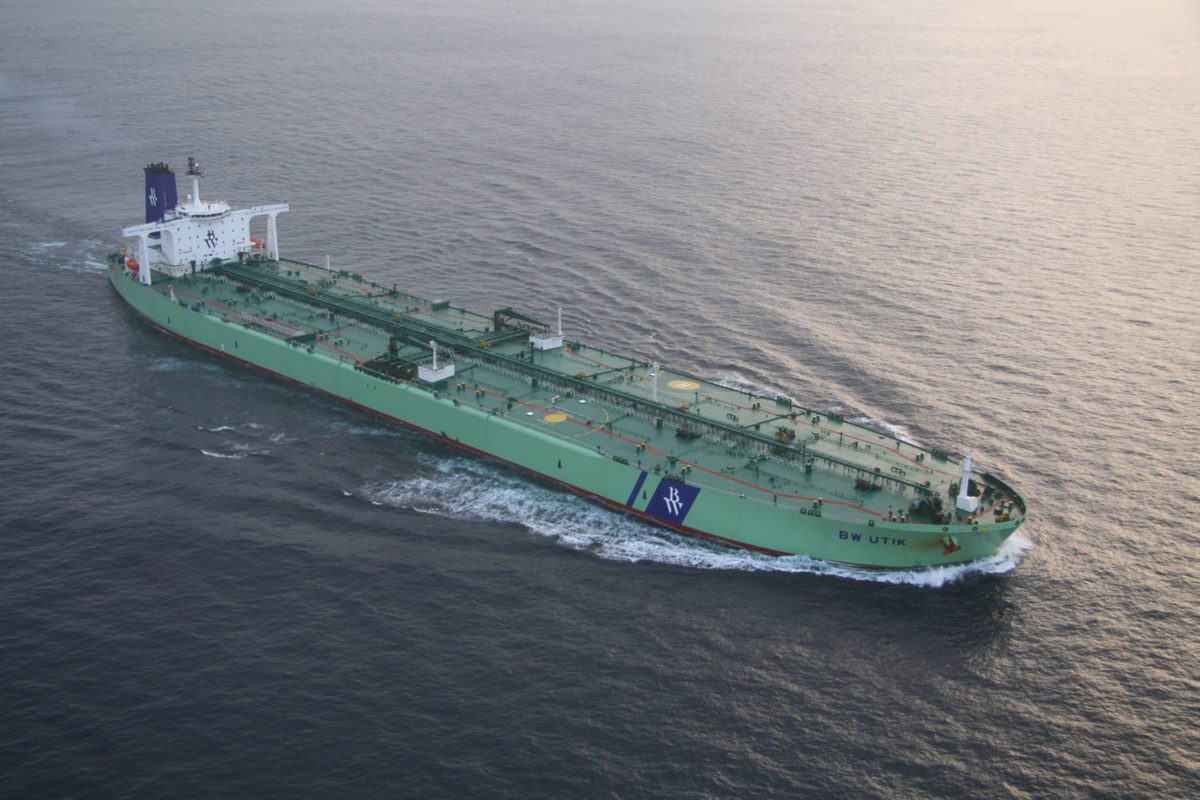
BW Utik, a 299k dwt VLCC built in 2001, image courtesy BW Group(Bloomberg) — Charter rates for the largest oil tankers on the industry’s busiest trade route declined for the first time in three weeks amid speculation the supply of vessels in the Persian Gulf will increase.
Hire costs for very large crude carriers on the benchmark Saudi Arabia-to-Japan voyage slid 1.3 percent to 36.66 industry- standard Worldscale points, data from the London-based Baltic Exchange showed today. That was the first drop since Feb. 28. Rates increased 6.8 percent this week, the fifth climb in six.
Sixty-two VLCCs are expected to arrive in the Middle East over the next 30 days, up from 42 last week, according to an e- mailed report today from Braemar Seascope Ltd., a London-based shipbroker. Shipowners will need “to work hard to keep rates even where they are,” Braemar said. The VLCC fleet’s capacity will expand 5.1 percent this year, in line with demand growth of 5.2 percent, according to data from Clarkson Plc, the world’s biggest shipbroker.
Charterers “started to tuck in heartily to the April program,” London-based E.A. Gibson Shipbrokers Ltd. said in an e-mailed report. “Owners managed to extract some advantage, but it was to a minimal extent and any hopes for the market reaching critical mass seem rather faint.”
Daily returns on the route to Asia fell 12 percent to $4,906, exchange data showed. That’s still a sixfold surge from a week ago. Each VLCC can hold 2 million barrels of crude.
25 Ports
The bourse’s assessments don’t account for owners improving returns by securing cargoes for return-leg voyages or reducing speed to burn less fuel. The price of fuel, or bunkers, the industry’s main expense, slipped 0.3 percent to $624.16 a metric ton, figures compiled by Bloomberg from 25 ports showed. Costs fell for a fourth week in five.
The Worldscale system is a method for pricing oil cargoes on thousands of trade routes. Each individual voyage’s flat rate, expressed in dollars a ton, is set once a year. Today’s level means hire costs on the benchmark route are 36.66 percent of the nominal Worldscale rate for that voyage.
The Baltic Dirty Tanker Index, a broader measure of oil- shipping costs that includes vessels smaller than VLCCs, gained 0.9 percent to 677, a third straight increase, according to the exchange.
Commodity trading giant Trafigura is launching a new tanker company with plans to raise about $500 million and list the business in Oslo, opening its growing VLCC fleet to outside...
The cost of hiring an oil tanker on the industry’s benchmark trade route topped $1 million a day for the first time, as the Iran war leaves too few ships willing to cross the Strait of Hormuz to collect cargoes.
The world’s shipowners have placed orders for a record number of new oil supertankers, surpassing a boom back in 2008 that ultimately led to a glut and a collapse in rates.
June 8, 2026
Total Views: 1301
Get The Industry’s Go-To News
Subscribe to gCaptain Daily and stay informed with the latest global maritime and offshore news
— just like 106,348 professionals
Secure Your Spot
on the gCaptain Crew
Stay informed with the latest maritime and offshore news, delivered daily straight to your inbox
— trusted by our 106,348 members
Your Gateway to the Maritime World!
Essential news coupled with the finest maritime content sourced from across the globe.

 Join The Club