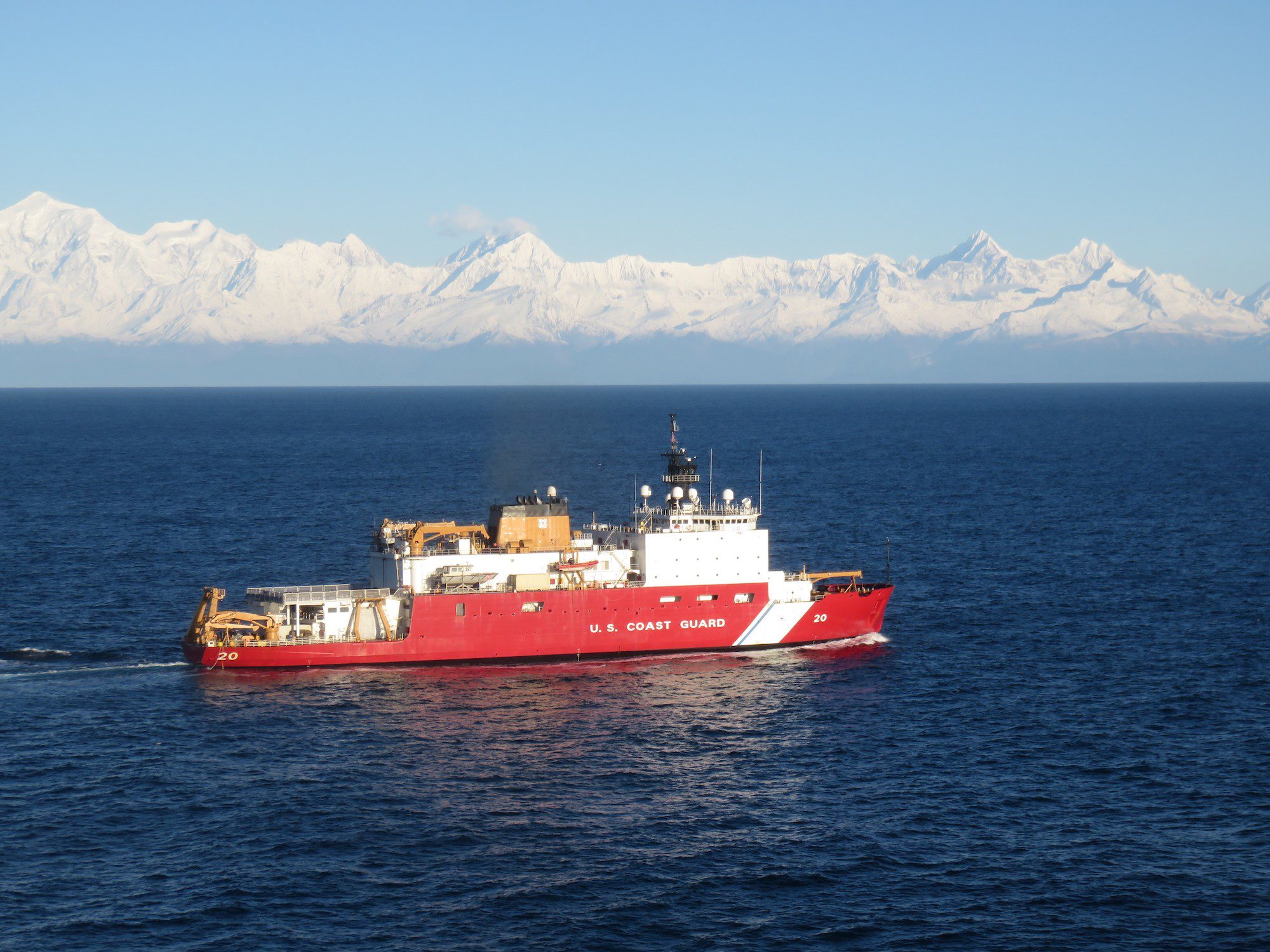
The U.S. Coast Guard’s decision to end icebreaker Healy’s planned high-latitude mission has left the service leaning more heavily on its newest icebreaker during an increasingly active Arctic season.
Healy has remained in Seattle since suffering a significant engineering casualty during sea trials off Washington state on July 13. As gCaptain reported this week, the Coast Guard has confirmed the 420-foot icebreaker will not complete its planned 2026 high-latitude summer mission, although officials are still evaluating whether it could return for other operations.
“The Coast Guard continues investigating the cause of the engineering casualty onboard Coast Guard Cutter (CGC) Healy,” a Coast Guard spokesperson told gCaptain. “CGC Healy will not complete its planned 2026 high-latitude summer mission. However, the Coast Guard is developing repair plans and evaluating the feasibility of additional operations.”
The service has not publicly identified the cause of the casualty or provided a timetable for repairs. A source familiar with the incident previously told gCaptain that the casualty involved a crankcase explosion in one of Healy’s diesel engines during post-refit sea trials. The July casualty forced Healy to be towed back to Seattle. The Coast Guard has not confirmed that account.
The timing is significant.
China dispatched both Xue Long and Xue Long 2 north through the Bering Sea this summer, with the Coast Guard deploying the National Security Cutter Munro to monitor their movements through the U.S. exclusive economic zone and over the U.S. extended continental shelf.
Farther north, Xue Long conducted 12 ice-station operations north of 82 degrees and deployed more than 30 ice-based buoys designed to collect data on sea-ice movement, ocean conditions and the atmosphere. Some are intended to remain in place after the ship departs.
“This summer, CGC Munro monitored two Chinese research vessels transiting north through the U.S. Exclusive Economic Zone and over the U.S. Extended Continental Shelf in the Bering Sea,” the Coast Guard said.
Foreign vessels are permitted to transit the U.S. EEZ under international law, although marine scientific research within the zone or on the U.S. extended continental shelf requires prior U.S. authorization and the sharing of collected scientific data.
Healy’s Long Arctic Record
Commissioned in 1999, Healy has spent more than two decades supporting scientific research and U.S. operations in some of the most remote parts of the Arctic Ocean.
That deployment carried 34 scientists and technicians alongside nearly 100 Coast Guard personnel. Earlier in the patrol, Healy operated in the Beaufort and Chukchi seas as part of the Office of Naval Research’s Arctic Mobile Observing System program, deploying underwater sensors, sea gliders and acoustic buoys to study conditions in the marginal and pack ice zones.
The North Pole transit also gave scientists access to parts of the western central Arctic rarely sampled by research vessels, while the Coast Guard used the deployment to maintain an ice-capable U.S. presence and patrol near the maritime boundary with Russia.
By 2025, Healy was also playing a more visible role in the Arctic.
During a 129-day Arctic patrol covering more than 20,000 miles, the cutter supported Operation Arctic West Summer and Operation Frontier Sentinel while monitoring foreign research vessels operating over the U.S. extended continental shelf and within the U.S. exclusive economic zone.
Among them were the Chinese-flagged JIDI and the Liberia-flagged, Chinese-operated Zhong Shan Da Xue Ji Di north of Utqiagvik.
The same patrol included scientific work across the U.S. Arctic, East Siberian Sea and Laptev Sea, along with a diversion to assist Western Alaska communities affected by severe storms.
The cutter has also suffered repeated engineering setbacks. A propulsion motor fire forced cancellation of its 2020 Arctic deployment, while another engine-room fire cut short its 2024 summer patrol. After repairs in Seattle, Healy returned to Arctic operations that fall.
Storis Takes on a Bigger Role
With Healy sidelined, more of the Coast Guard’s Arctic workload has fallen to Storis, the commercially built icebreaker acquired by the service and commissioned in 2025.
This summer, Storis operated around Alaska and the Arctic, including the extended monitoring operation alongside HMCS Max Bernays as Xue Long moved through the Bering Strait and Beaufort Sea. AIS data showed the American and Canadian ships at times operating only a few nautical miles from the Chinese vessel.
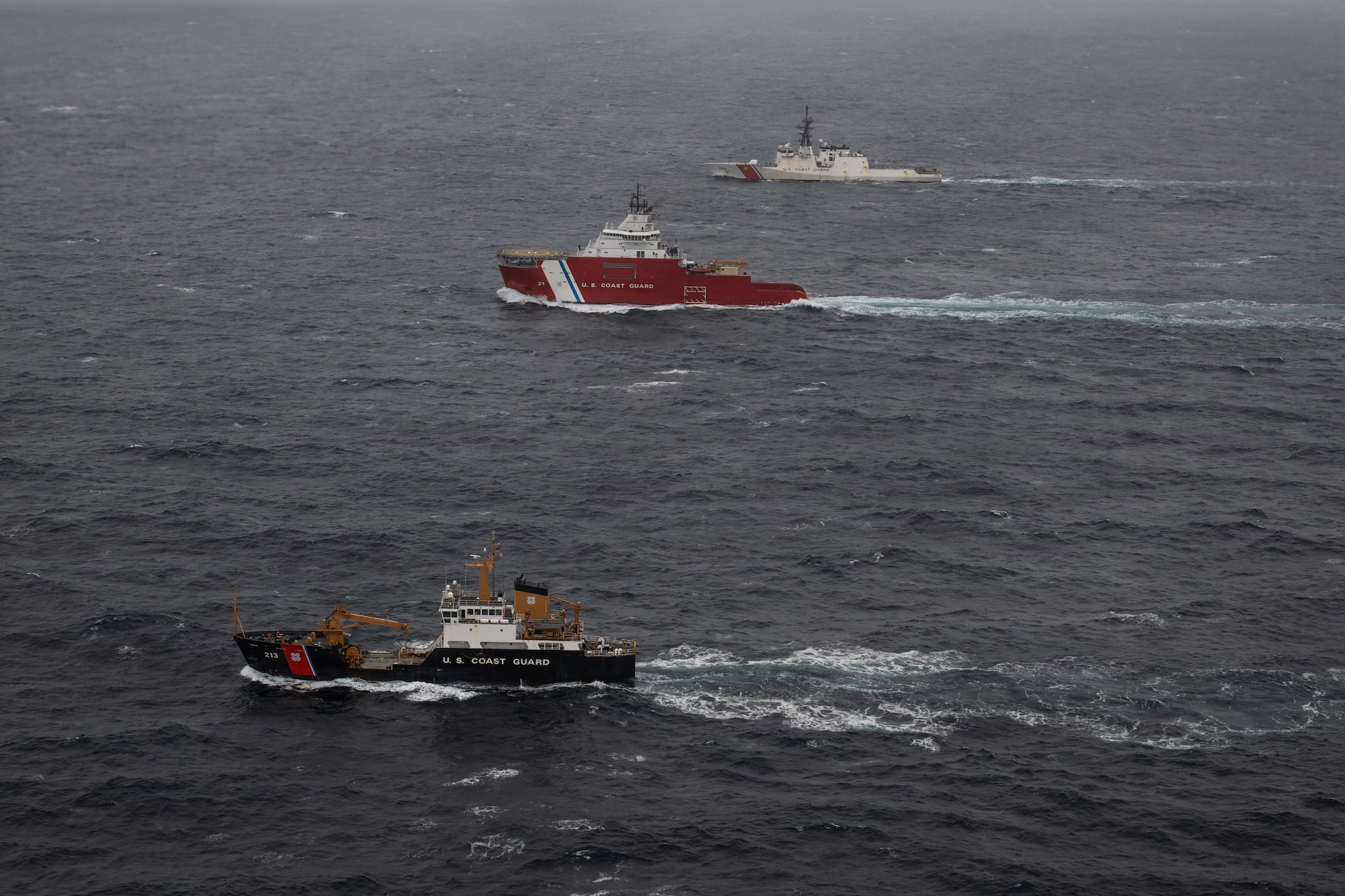
U.S. Coast Guard icebreaker Storis and medium endurance cutter Alex Haley in the Bering Sea in August 2025. (Source: Courtesy of U.S. Coast Guard)
But Storis remains an interim solution while the United States builds a new generation of purpose-built icebreakers.
Work is also progressing on the first Polar Security Cutter, Polar Sentinel, at Bollinger Mississippi Shipbuilding. The heavy icebreaker program remains well behind its original schedule, however, with a recent government watchdog assessment projecting delivery of the first vessel in March 2033.
Until those ships arrive, the Coast Guard remains dependent on a small polar fleet that includes Healy, the 50-year-old heavy icebreaker Polar Star, and Storis.
That is what makes Healy’s latest casualty so consequential. The Coast Guard has temporarily lost a ship that has reached the North Pole three times, supported scientific work across the Arctic Ocean, patrolled near the maritime boundary with Russia and more recently monitored Chinese activity north of Alaska.
For now, the service says it is developing repair plans and evaluating whether Healy can conduct additional operations later this year.
The U.S. Coast Guard Cutter Munro has returned to its homeport in Alameda, California, following a 112-day patrol across the Bering Sea and Arctic Ocean that included monitoring Chinese research...
A fire aboard a seismic research vessel in the Gulf of Mexico forced dozens of crew members to abandon ship Monday, with nearby offshore supply vessels helping bring the evacuees...
The U.S. Coast Guard has intercepted a vessel carrying fuel to Cuba after an international enforcement operation found large quantities of fuel concealed inside the ship’s ballast tanks. The Coast Guard...
October 2, 2026
Total Views: 1644
Get The Industry’s Go-To News
Subscribe to gCaptain Daily and stay informed with the latest global maritime and offshore news
— just like 106,328 professionals
Secure Your Spot
on the gCaptain Crew
Stay informed with the latest maritime and offshore news, delivered daily straight to your inbox
— trusted by our 106,328 members
Your Gateway to the Maritime World!
Essential news coupled with the finest maritime content sourced from across the globe.

 Join The Club