International shipping is being asked to decarbonize before it knows what it will burn.
By Paul Morgan (gCaptain) – Vessels capable of running on methanol, ammonia or ethanol are already entering the fleet, yet a new joint study from the Global Centre for Maritime Decarbonization and Boston Consulting Group makes an uncomfortable point plain: none of these fuels is currently cheap enough to displace conventional bunkers at scale, and the regulation meant to close that gap is still being argued over.
The study models fuel adoption out to 2050 under three regulatory scenarios, built around the International Maritime Organization’s Net-Zero Framework. That framework was approved in principle at MEPC 83 in April 2025, but its formal adoption was pushed back by a full year when member states failed to reach agreement at an extraordinary session that October, following vocal opposition from Washington. The vote has now been rescheduled for 4 December 2026, straight after the IMO’s MEPC 85 session. Until then, shipowners are committing capital to newbuilds without knowing what carbon price they will eventually face.
That price turns out to matter more than almost anything else in the model. Held at the level currently on the table, USD 380 per tonne of CO2 equivalent, the study finds conventional fuel oil paired with onboard carbon capture remains the cheapest compliant option through mid-century, and the fleet stays dominated by fossil fuels. Only if the penalty were to rise toward USD 700 per tonne does the economic balance tip decisively toward methanol, ammonia and ethanol. Whichever version of the Net-Zero Framework eventually clears the IMO, the size of the carbon price looks like the single biggest lever policymakers hold.
IMO Net-Zero Framework Holds Ground After Latest Round of Climate Talks
Regional rules cannot substitute for that global signal, at least not on their own. The EU’s emissions trading system and FuelEU Maritime Regulation together cover only around a fifth of international shipping’s energy use, since they apply solely to voyages touching European ports. Outside that pool, according to the modelling, the fleet simply carries on burning what is cheapest. Brussels appears to have registered as much: on 17 July 2026, the European Commission proposed a revision to its ETS that would reserve up to 110 million emissions allowances between 2028 and 2040 specifically to subsidise the extra cost of low- and zero-emission marine fuels, an implicit admission that regulatory pressure alone was not shifting the economics fast enough. The UK, meanwhile, extended its own emissions trading scheme to domestic shipping from 1 July 2026, adding another layer of carbon cost for operators to navigate.
Two fuels emerge from the analysis as the leading long-term candidates, and neither has a clear advantage over the other. E-ammonia is cheaper to produce than e-methanol, but that saving is largely eaten up by the cost of handling a toxic, refrigerated cargo: specialist storage, larger exclusion zones, additional crew training and more complex bunkering all add up. E-methanol is simpler to handle but needs a sustainable carbon source, and the price of that biogenic CO2 turns out to be the swing factor. The study finds that below roughly USD 150 per tonne of biogenic CO2, methanol tends to win out on cost; above it, ammonia does. For both fuels, though, the price of green hydrogen remains the dominant input, accounting for more than half of the total cost of fuel use out to 2050.
There is a live data point that hints at how quickly this could move. In March 2026, engine maker WinGD and renewable energy group Envision Energy published a study of ammonia bunkering economics on the China-to-Australia route, using a real bunker price of USD 710 per tonne sourced from Envision’s Jinzhou production facility. At that price, the two companies calculated that ammonia-fuelled bulk carriers and container ships could already undercut equivalent VLSFO-powered vessels on operating cost over the first compliance period of the IMO framework. It is one route, one supplier and one moment in a volatile market, but it suggests the cost curve the GCMD-BCG model anticipates for the 2030s may already be visible at the margins today.
IMO Urged to Give Shipping Clear Investment Signal on Net Zero Pathway
Ethanol’s prospects, by contrast, look almost entirely dependent on a single regulatory decision. First-generation, food-crop-based ethanol is currently cost-competitive and available at scale, and the study credits it with supplying close to a tenth of the fleet’s energy needs by 2050 under neutral treatment. But the EU’s FuelEU Maritime Regulation already excludes food-crop biofuels from favourable treatment, assigning them the emissions factor of the dirtiest available fossil pathway instead. If that stance were applied globally, the study finds ethanol’s contribution would collapse to near zero, with the lost volume absorbed almost entirely by conventional fuel oil rather than by other alternatives. The fuel’s future, in other words, rests less on its chemistry than on how regulators choose to classify its feedstock.
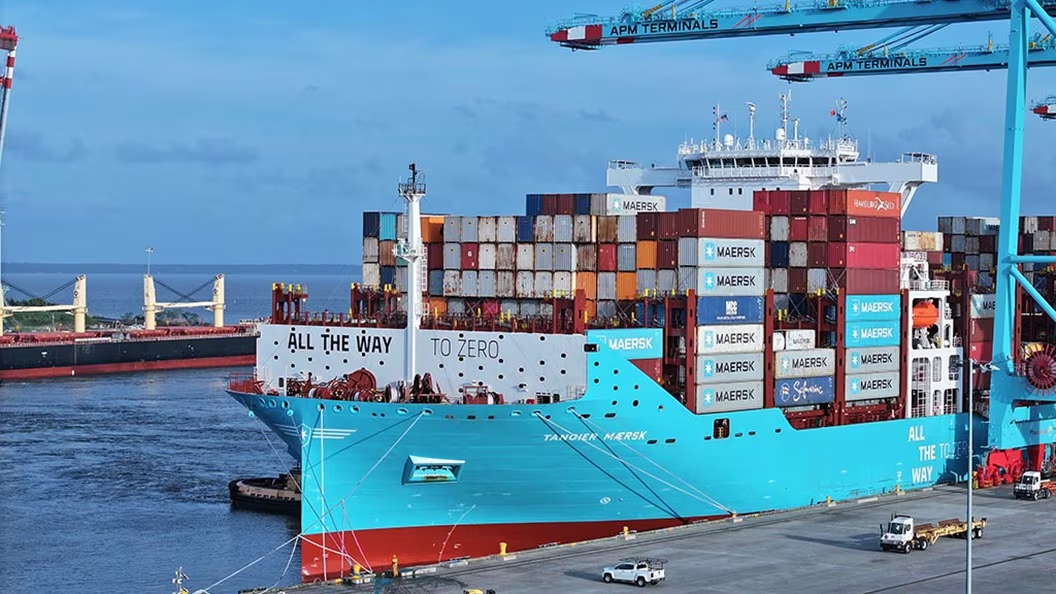
On the technical side, there is encouraging evidence that engine flexibility is real rather than theoretical. Maersk’s methanol-fuelled Laura Maersk completed a full trial on 100 per cent ethanol earlier this year, building on earlier blend tests, and confirmed the fuel could be burned without compromising engine performance. That matters for the study’s central argument about optionality: dual-fuel engines let owners hedge against an uncertain fuel market, switching between compatible new fuels and conventional bunkers as prices move. But the same flexibility cuts both ways. The study shows a persistent gap between engine capacity and actual fuel consumption, with methanol dual-fuel engines making up a tenth of the projected 2050 fleet while methanol itself supplies barely two per cent of energy consumed, because owners keep the option to burn cheaper conventional fuel instead.
That gap is arguably the report’s most important finding for anyone chartering, building or financing ships today. Ordering a dual-fuel vessel does not guarantee the new fuel gets burned. Vessels last 25 to 30 years and only around 4 per cent of the global fleet turns over annually, so the engines ordered in the next few years will still be sailing in 2050 regardless of how the regulatory picture eventually settles. The study’s advice—that fleet strategy should be built around optionality rather than commitment to a single fuel—reads less like a bet on any particular winner and more like an acknowledgment that nobody, including the modellers, yet knows which fuel that will be.
The bunkering map is expected to shift unevenly as a result. Liquid fuels such as methanol and ethanol travel relatively easily, so existing hubs like Singapore and the Amsterdam-Rotterdam-Antwerp region are likely to extend their dominance simply by importing whichever new fuel their customers need. Ammonia is a different proposition. Its toxicity and low boiling point make long-distance transport expensive, which the study argues will split future ammonia bunkering into two distinct types of port: those sitting next to cheap domestic production, and those with enough existing vessel traffic to aggregate demand and justify import infrastructure through scale alone. Which type wins in any given region will depend on decisions being taken now about where hydrogen and ammonia plants get built and which ports choose to commit to the infrastructure first.
For an industry that prizes long asset lives and long-term charters, the honest conclusion is that 2050’s fuel mix is still being decided, not by any single technology breakthrough, but by a carbon price that has yet to be agreed, a biogenic CO2 market that barely exists yet, and a series of regulatory classifications still working their way through Brussels and London. The vessels ordered over the next few years will have to live with whatever answer eventually emerges.

 Join The Club