Don’t Miss Your Daily Briefing for the Maritime Industry
Join the leading maritime news network
— trusted by our 106,720 members
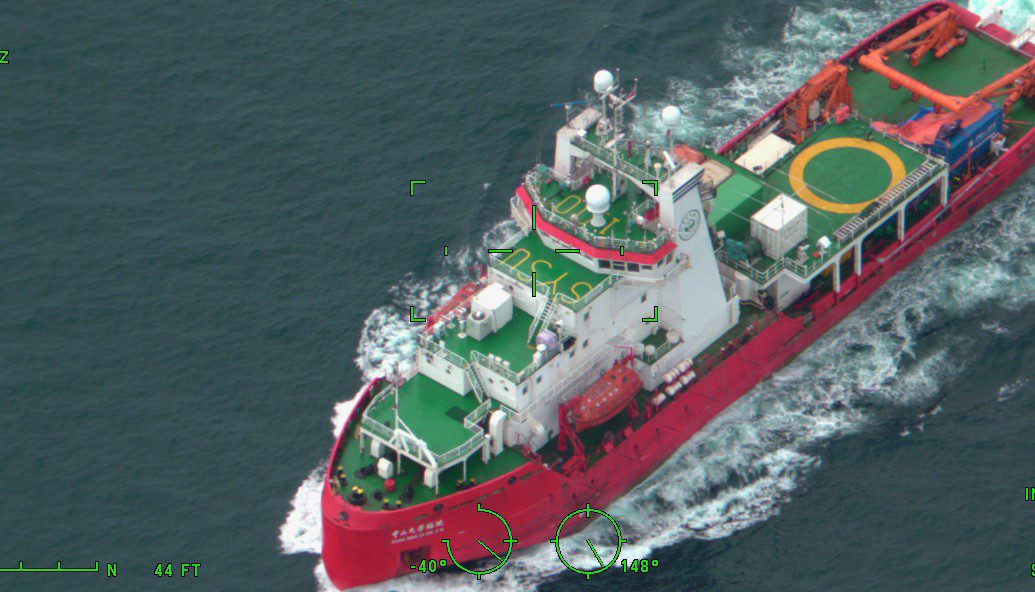
The Zhong Shan Da Xue Ji Di, a Liberian Flagged Research Vessel, owned and operated by the Chinese University Sun Yat-Sen, as detected by a Coast Guard C-130 Hercules aircraft from Air Station Kodiak. U.S. Coast Guard Photo
U.S. Coast Guard Monitors Unprecedented Chinese Icebreaker Flotilla Near Alaska
The U.S. Coast Guard says it is actively monitoring five Chinese research vessels operating in or near U.S. Arctic waters, marking the first time China has deployed this many icebreaking vessels simultaneously in the region.
On August 5, a C-130J Hercules aircraft from Air Station Kodiak responded to the Chinese research vessels Ji Di and Zhong Shan Da Xue Ji Di as they transited northeast in the Bering Sea. The following day, U.S. Coast Guard Cutter Waesche (WMSL 751) again responded to the Zhong Shan Da Xue Ji Di as it transited north in the Chukchi Sea above the Arctic Circle, after passing through the Bering Strait.
The Coast Guard operations are part of Operation Frontier Sentinel, which responds to adversaries operating in and around Alaskan and U.S. Arctic waters. “The U.S. Coast Guard’s responses are intended to counter malign activities, defend sovereign interests, and promote maritime conduct consistent with international law and norms,” the Coast Guard stated.
The Coast Guard’s announcement follows gCaptain’s Thursday report about the vessels operating in the region.
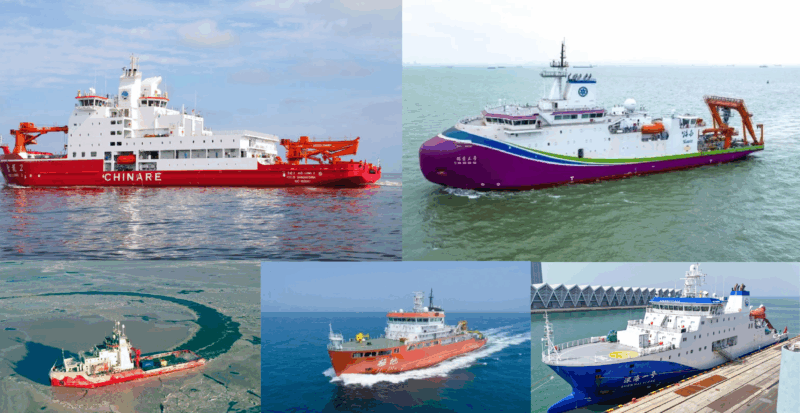
In July, Coast Guard Arctic District had already deployed a C-130J Hercules to monitor the Xue Long 2, another Chinese research vessel, approximately 290 nautical miles north of Utqiagvik, Alaska. The Xue Long 2, China’s largest domestically-built icebreaker with a Polar Class 3 designation, departed from Shanghai on July 5th and has since been operating in the Chukchi and Beaufort Seas.
Xue Long 2, Tan Suo San Hao, Zhongshandaxue Ji Di, Ji Di, and Shen Hai Yi Hao. (Sources: PRIC, Chinese state media, Sun Yat-Sen University, China’s Ministry of Natural Resources, CFP)
The flotilla includes several specialized vessels. The Shen Hai Yi Hao, which joined on July 30, carries the submersible Jiao Long designed for dives down to 7,000 meters. China’s newest icebreaker, Tan Suo San Hao, is currently operating in the northern Bering Sea and is about to enter Arctic waters. This Polar Class 4 vessel, which entered service in December 2024, has already raised questions about its supposed scientific mission after an incident in May when it remained inside the Philippines’ exclusive economic zone, prompting that country’s Coast Guard to dispatch one of its largest cutters.
“The presence of these vessels is consistent with a three-year trend of increased activity from Chinese research vessels operating in the U.S. Arctic,” the Coast Guard noted. Last year, three Chinese research vessels conducted research operations north of the Bering Strait.
Meanwhile, the U.S. Coast Guard is currently operating one icebreaker in the Arctic, the USCGC Healy, with plans to commission its newest icebreaker, the Coast Guard Cutter Storis, at a ceremony in Juneau on August 10.
The Coast Guard emphasized that it “is America’s only surface presence in the Arctic — a growing zone of strategic global competition. A robust national fleet of icebreakers, made possible by historic investment in the Coast Guard, will secure U.S. access, security, and leadership in the Arctic.”
A fire aboard a seismic research vessel in the Gulf of Mexico forced dozens of crew members to abandon ship Monday, with nearby offshore supply vessels helping bring the evacuees...
South Korean President Lee Jae Myung welcomed the PanStar Acro and its crew home on Tuesday after the container ship completed the country’s first round-trip commercial trial through the Arctic to Europe, hailing the voyage as a potential alternative to traditional shipping lanes even as questions remain over commercial viability and cooperation with Russia.
The United Kingdom on Thursday sanctioned 12 oil tankers it identified as part of Russia's shadow fleet, including the 22-year-old Dakar that is currently making an unusual late-season voyage on the Northern Sea Route.
October 8, 2026
Total Views: 548
Get The Industry’s Go-To News
Subscribe to gCaptain Daily and stay informed with the latest global maritime and offshore news
— just like 106,720 professionals
Secure Your Spot
on the gCaptain Crew
Stay informed with the latest maritime and offshore news, delivered daily straight to your inbox
— trusted by our 106,720 members
Your Gateway to the Maritime World!
Essential news coupled with the finest maritime content sourced from across the globe.

 Join The Club