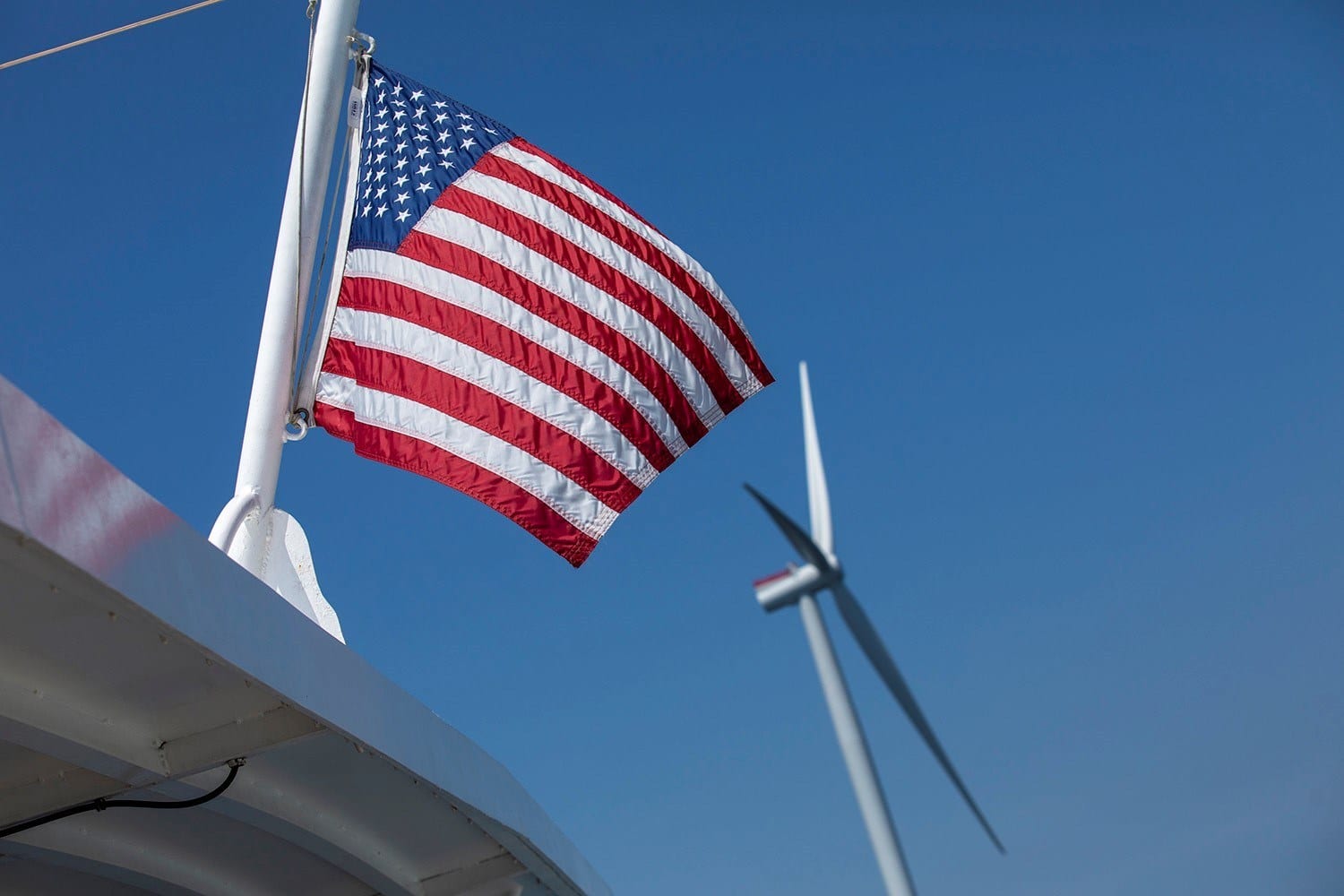
Turbine installation has kicked off at the nation’s largest offshore wind project just days after a federal judge lifted the Trump administration’s controversial work suspension, with Senator Tim Kaine announcing the installation of the first permanent turbine tower at the Coastal Virginia Offshore Wind (CVOW).
Local media footage shows the newly commissioned installation, U.S.-flagged Wind Turbine Installation Vessel (WTIV) Charybdis erecting the first of 176 turbine towers 27 miles off Virginia Beach — a milestone that marks a critical turning point for the $11.2 billion project after weeks of legal uncertainty threatened to derail construction.
“Today, I toured the Portsmouth Marine Terminal and was updated on the progress made on the Coastal Virginia Offshore Wind project,” Kaine wrote on social media. “This incredible project will bolster offshore wind in Virginia, lower costs, and grow the local economy.”
The installation follows a January 16 ruling by Judge Jamar Walker of the U.S. District Court for the Eastern District of Virginia, which granted Dominion Energy a preliminary injunction allowing work to resume while its lawsuit challenging the Interior Department’s December 22 suspension of CVOW and four other offshore wind projects under construction in federal waters proceeds.
The decision marked the third federal court setback in a week for the administration’s offshore wind suspension, following similar rulings favoring Equinor’s $5.3 billion Empire Wind project off New York and Ørsted’s Revolution Wind in the Northeast. All had been halted by a December 22 Interior Department order citing national-security concerns tied to possible radar interference.
At the Norfolk hearing, Judge Walker concluded that Interior’s sweeping stop-work order was not narrowly tailored to Dominion’s project. The court noted that the government’s cited national security concerns — particularly related to radar interference — applied primarily to wind farm operations rather than construction activity.
The timing was critical for Dominion, which has already invested nearly $9 billion into the project and warned that the construction pause was costing roughly $5 million per day. Following the ruling, the company said it would “focus on safely restarting work to ensure CVOW begins delivery of critical energy in just weeks.”
Interior had ordered the suspension on December 22, citing newly classified national security information. But a growing string of courtroom defeats suggests the administration may face difficulty sustaining the policy under judicial scrutiny.
Charybdis Delays Added Pressure
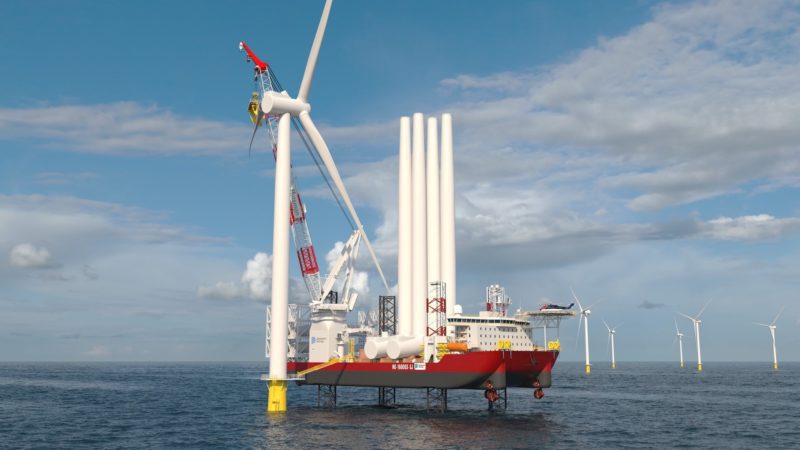
An illustration of the Dominion Energy’s Wind Turbine Installation Vessel (WTIV) built at Seatrium AmFELS in Brownsville, Texas. Illustration courtesy Dominion Energy
Beyond the legal battle, CVOW has already endured a series of operational challenges, including delays surrounding the Charybdis, America’s first domestically built, Jones Act-compliant wind turbine installation vessel.
Commissioning setbacks pushed the start of turbine installation from an initial September target to late November 2025, adding schedule pressure to an already complex project.
Constructed at Seatrium AmFELS’ Brownsville, Texas shipyard, the $715 million vessel required remediation of roughly 200 quality-assurance punch-list items before becoming fully operational. Built with more than 14,000 tons of domestic steel, Charybdis represents one of the largest single investments in U.S. offshore wind maritime infrastructure.
Power by Spring, Completion by Year-End
Despite the turbulence, Dominion says CVOW remains on track to begin delivering power to customers in late Q1 2026, with full project completion expected by year’s end. Once operational, the facility will comprise 176 turbines capable of generating 2.6 gigawatts — enough electricity to power roughly 660,000 homes.
Project costs have risen from $10.7 billion to $11.2 billion, driven by higher grid upgrade expenses and tariff impacts. Dominion, however, continues to characterize CVOW as an affordable energy source, estimating the project will add about 43 cents per month to a typical residential bill.
The development has already generated roughly 2,000 direct and indirect U.S. jobs and more than $2 billion in economic activity. It also builds on Dominion’s two-turbine pilot project, which has been operating since 2020 — making CVOW one of only two offshore wind farms currently producing power in the United States.
While construction is once again moving forward, the broader legal battle and the administration’s opposition to offshore wind continue to cloud the sector’s outlook. Industry observers say the high-stakes litigation now underway could shape the future of offshore wind investment in U.S. waters for years to come.
The U.S. Bureau of Ocean Energy Management (BOEM) generated $46.98 million in high bids at its latest offshore oil and gas auction Wednesday, marking a sharp drop in industry participation compared with...
The U.S. Bureau of Ocean Energy Management (BOEM) announced Wednesday that it will begin preparing a programmatic environmental impact statement (PEIS) to evaluate potential offshore oil and gas lease sales across California’s...
The Bureau of Ocean Energy Management (BOEM) plans to auction roughly 80.4 million acres of federal waters in the Gulf of America next month, advancing the Trump administration’s accelerated offshore oil and...
February 4, 2026
Total Views: 904
Get The Industry’s Go-To News
Subscribe to gCaptain Daily and stay informed with the latest global maritime and offshore news
— just like 107,412 professionals
Secure Your Spot
on the gCaptain Crew
Stay informed with the latest maritime and offshore news, delivered daily straight to your inbox
— trusted by our 107,412 members
Your Gateway to the Maritime World!
Essential news coupled with the finest maritime content sourced from across the globe.

 Join The Club