New tracking data suggests “permission-based” transits may be reshaping one of the world’s most critical shipping lanes
A new routing pattern is emerging in the Strait of Hormuz as vessels begin sailing through Iranian territorial waters to exit the Persian Gulf—one of the clearest signs yet that shipping in the region is shifting toward a controlled, permission-based system.
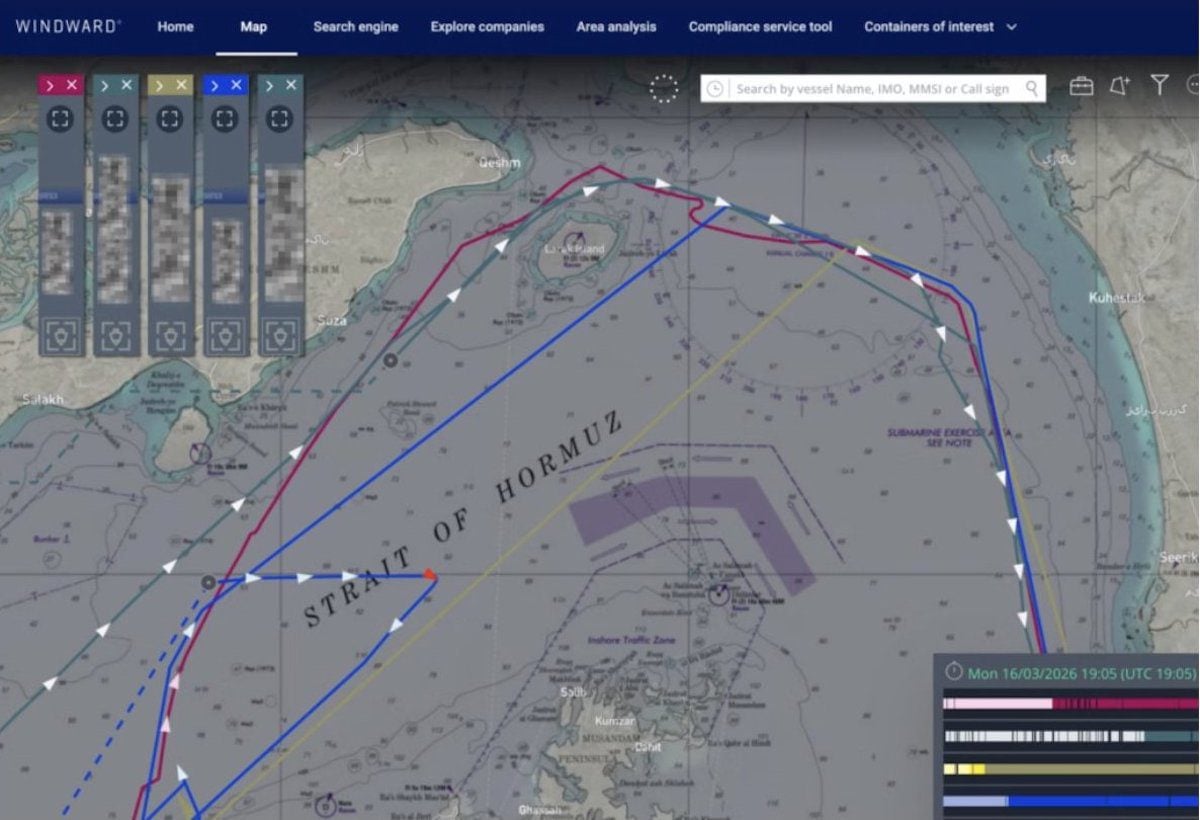
According to maritime analytics firm Windward, at least five bulk carriers were tracked over March 15–16 sailing eastbound along Iran’s coastline, well outside the narrow international navigation channel typically used for transits through the strait.
The vessels’ trajectories show ships hugging the Iranian coast rather than using the internationally recognized traffic separation scheme, effectively rerouting through Iranian territorial waters to reach the Gulf of Oman.
Windward analyst Michelle Wiese Bockmann said the trend only became visible after expanding tracking parameters beyond the standard transit corridor.
“That’s how I saw what I believe is a new trend… ships rerouting via Iran’s territorial waters to exit the Strait,” she said, describing it as one of the first signs of a workaround enabling permission-based transits to friendly countries.
In nearly all cases, the bulk carriers had previously called at Iran’s Imam Khomeini port, one of the country’s primary commercial hubs. Windward also identified two liquefied petroleum gas (LPG) carriers completing similar transits in the past 36 hours, though GPS interference obscured portions of their routes.
The findings come as traffic through the strait—normally one of the busiest energy chokepoints in the world—has effectively collapsed amid escalating attacks on commercial shipping.
Trump Declares U.S. ‘Doesn’t Need Anyone’ After Allies Balk at Hormuz Mission
Traffic Data Shows One-Way Flow Out of the Gulf
Fresh data from MarineTraffic underscores the scale of the disruption. Over the past three days, just 15 vessels transited the Strait of Hormuz, including 8 bulk carriers, 5 tankers, and 2 LPG carriers—a fraction of normal volumes.
The imbalance is even more striking if you look at the directions ships are traveling: approximately 87% of those transits were outbound, with only 13% entering the Gulf.
The data suggests the strait is functioning less as a two-way shipping lane and more as a limited exit corridor, with vessels already inside the Gulf gradually leaving while very few are willing to enter.
MarineTraffic also noted that many of these vessels followed unusual routes through Iranian territorial waters, aligning with Windward’s findings.
From Verification Corridor to Controlled Transit
The new routing pattern builds on earlier reporting by gCaptain, which identified a separate but related anomaly: vessels diverting toward Iran and passing between Larak and Qeshm islands before exiting the Gulf.
Analysis by EOS Risk Group suggested that corridor may be functioning as a de facto verification checkpoint, where vessels are screened before being allowed to transit.
At the same time, U.S. authorities have warned that Iranian forces may attempt to contact vessels via radio or email to request voyage information or instruct course changes—communications that officials say could be used to verify identity, cargo, or destination.
A Strait That Is Open—But Not Neutral
While there is no confirmed evidence that Iran has physically blocked the strait—for example, through naval mining—the combination of credible threat, targeted attacks, and selective routing behavior appears to be achieving a similar effect.
The traditional international shipping lane is now largely avoided, while alternative routes inside Iranian waters are being used by a small number of vessels—many with prior commercial ties to Iran.
The result is a maritime chokepoint that is technically open but operationally constrained, where access appears increasingly influenced by political alignment and coordination.
Western-affiliated shipowners, constrained by insurance, compliance, and security risks, have largely stayed out of the region. But vessels linked to China, India, and other countries maintaining trade ties with Iran may be more willing to transit under these conditions.
If the pattern holds, the Strait of Hormuz may be evolving from a globally accessible shipping corridor into a selectively managed maritime gateway, where passage depends on permission.
More On The Iran Conflict:

 Join The Club