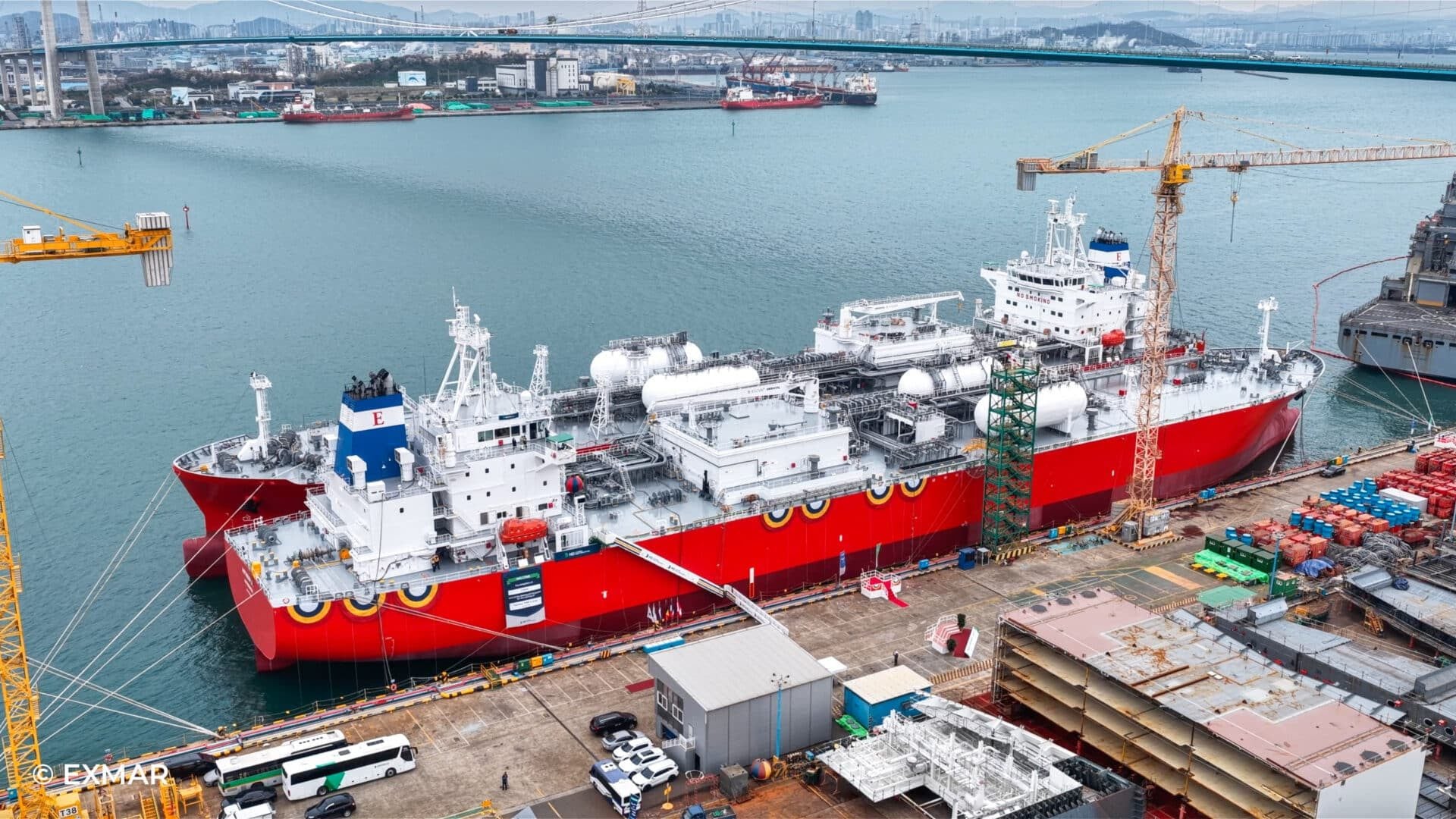
Swiss marine engine developer WinGD and Belgian gas shipping company EXMAR have announced the delivery of what they describe as the world’s first ocean-going vessel designed to operate on ammonia fuel, marking a major milestone in shipping’s efforts to develop zero-carbon propulsion technologies.
The vessel, ANTWERPEN, is a 46,000-cubic-meter LPG and ammonia carrier powered by WinGD’s X52DF-A ammonia-fueled two-stroke engine. Following successful sea trials in South Korea, the ship has been delivered to EXMAR and will enter commercial service as the first of four ammonia dual-fuel midsize gas carriers ordered by the Belgian owner.
The project was developed through a collaboration between WinGD, EXMAR, engine builder HD Hyundai Engine & Machinery Division and shipbuilder HD Hyundai Heavy Industries.
The delivery comes as the maritime industry intensifies efforts to identify scalable low- and zero-carbon fuels capable of meeting increasingly stringent emissions regulations and the International Maritime Organization’s net-zero ambitions.
“We are proud to be part of delivering the world’s first ammonia-fuelled ocean-going vessel, a landmark achievement made possible through an intensive and highly collaborative development effort,” said Sebastian Hensel, Vice President of Research and Development at WinGD.
The X52DF-A engine uses high-pressure ammonia injection combined with a small pilot fuel dose of approximately 5% at full load. According to WinGD, sea trials demonstrated load handling, dynamic response and fuel efficiency comparable to its conventional diesel-fueled X-Engines when operating in both ammonia and diesel modes.
Type approval and factory acceptance testing were completed earlier this year at HD Hyundai’s engine manufacturing facility in South Korea under the supervision of EXMAR and classification society Lloyd’s Register.
“Ammonia propulsion is no longer theoretical—we are deploying it,” said Carl-Antoine Saverys, Chief Executive Officer of EXMAR Group. “This achievement reflects collective expertise and our commitment to drive sustainable shipping forward.”
Ammonia has emerged as one of the leading candidates for decarbonizing deep-sea shipping because it contains no carbon and therefore produces no carbon dioxide emissions at the point of combustion. However, the fuel presents significant technical and safety challenges due to its toxicity and handling requirements, prompting years of development work by engine manufacturers, shipbuilders and classification societies.
WinGD said it has secured 40 orders for its X-DF-A ammonia engine across multiple vessel segments, including gas carriers, bulk carriers, tankers and containerships, suggesting growing industry confidence in ammonia’s commercial potential.
The ANTWERPEN is the first in a series of four sister vessels for EXMAR, each named after a Belgian city, that are expected to provide operational experience and performance data as the industry evaluates ammonia’s role in the future marine fuel mix.

 Join The Club