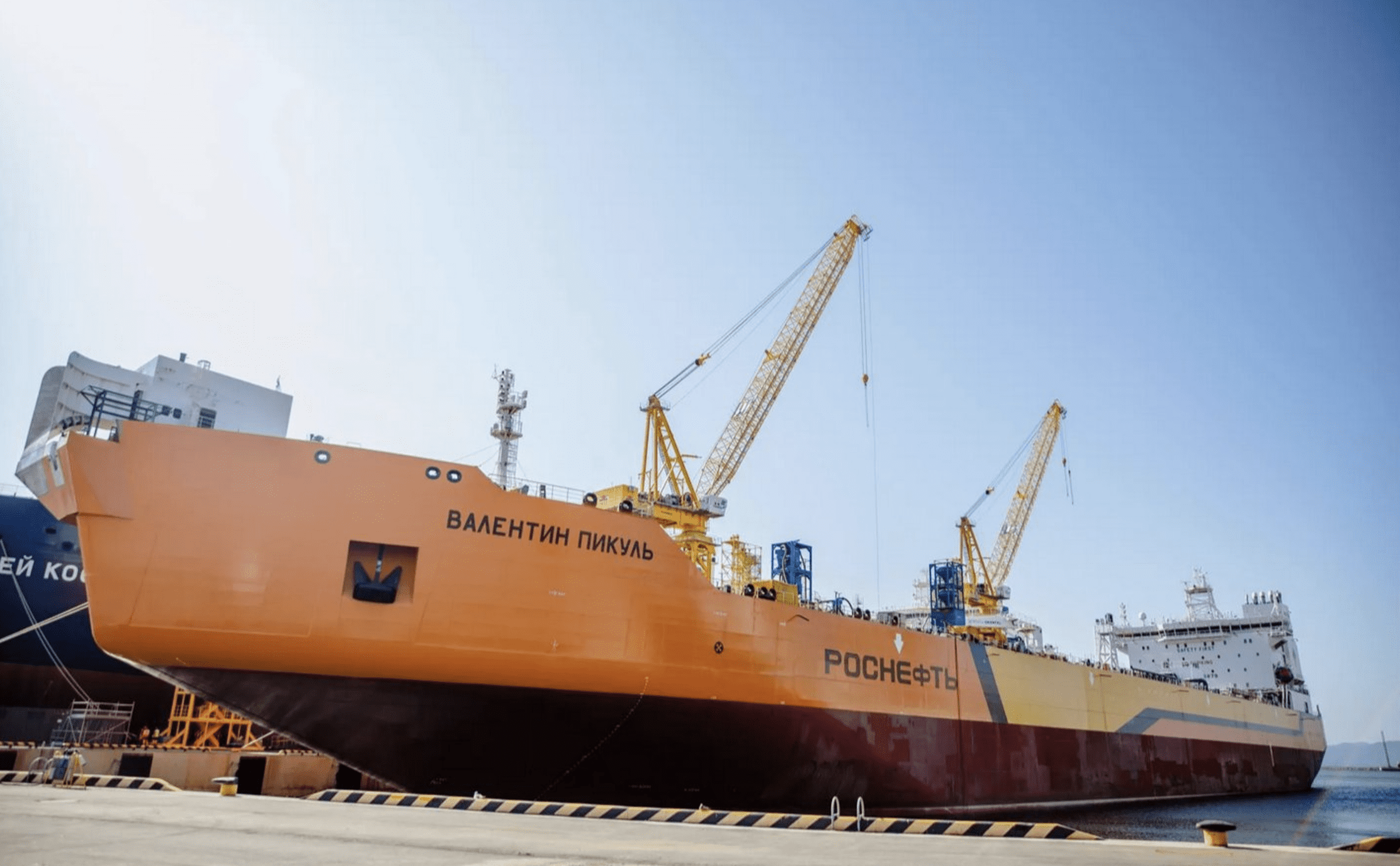
Russia’s first home-built Arc6 ice-class oil tanker continues its voyage from the Zvezda shipyard in the Far East to its service area in the Arctic. After a month at sea the 69,000 dwt Valentin Pikul passed through the Suez Canal on Monday, now displaying Murmansk, above the Arctic Circle, as its destination.
Valentin Pikul will further expand an existing fleet of highly ice-capable oil tankers already in operation for Russia’s Arctic oil projects, the Prirazlomnaya oil platform, and the Arctic Gate and Varandey oil terminals. In 2024 the country shipped around 8.1 million tonnes, or approximately 61 million barrels, of crude oil via the Arctic.
The new tanker is the first in what Russia hopes will become a homegrown fleet of dozens of tankers in support of Arctic operations. The massive Vostok Oil project, currently under development, requires as many as 30 ice-class tankers in its final build-out by the early 2030s.
Though the U.S. included the Valentin Pikul in its January 2025 round of sanctions it is expected to begin shuttling crude oil from the Varandey oil terminal in the Pechora Sea to a reloading point outside Murmansk. Western sanctions have placed a number of Russia’s oil and gas developments in hibernation or delayed their start-up, including the Arctic LNG 2 and Vostok Oil projects. But reprieve may not be far into the future as U.S. officials are reportedly putting together plans for an easing of sanctions.
Earlier reports that the U.S. government was considering lifting sanctions against select projects as part of a future Ukraine peace deal, have now broadened to include Russia’s energy sector as a whole. The news comes ahead of expected talks between Presidents Trump and Putin. Despite more than a dozen rounds of sanctions Russia continues to derive hundreds of billions of dollars from the sale of oil and gas. In 2024 Europe set a new record for LNG imports from Russia.
In terms of easing sanctions against energy projects the flagship Arctic LNG 2 plant would likely be a top priority for Russia. Eight cargoes loaded between August and October 2024 remain undelivered due to sanctions.
‘Valentin Pikul’ en route from the Zvezda shipyard near Vladivostok to Murmansk after passing through the Suez Canal. (Source: Shipatlas)
The release of five completed Arc7 LNG carriers stuck in sanctions limbo at South Korean yard Hanwha would also be indispensable to begin year-round shipments from the Arctic gas facility. One additional vessel remains under construction at the yard.
The lack of ice-capable oil and gas tankers has the potential to become a major choke point for Russia’s Arctic hydrocarbon plans. Domestic yards like Zvezda in the Far East and Baltic Yards in Europe have limited experience and capacity to churn out tankers in sufficient numbers. Even with Samsung Heavy Industries’ help – the South Koreans constructed much of the hull before transferring it to Zvezda – Valentin Pikul took nearly seven years from keel laying to commissioning.
On the gas side, Zvezda’s first completed LNG carrier Aleksey Kosygin continues gas and sea trials. Four more remain in various states of completion, with at least one reportedly close to commissioning. Even if Russia manages to launch some or all of them, without the return of Western companies and access to maintenance facilities the vessels’ future remains uncertain. The Yamal LNG carrier Christophe de Margerie, launched in 2017, has been out of service for nine months reportedly due to difficulties repairing damage to its azimuthing propulsion units.
India temporarily extended permission for four Russian insurers to cover tankers calling at its ports, as the government seeks to sustain crude imports while also managing US pressure to end shipments from Moscow.
New Zealand has imposed its largest-ever maritime sanctions package against Russia, designating 100 vessels linked to the country’s “shadow fleet” and lowering the price cap on Russian crude to $44.10 per barrel. The sweeping move significantly expands Wellington’s enforcement reach and aligns with broader international efforts to curb Moscow’s oil revenues.
Russia has threatened to deploy its navy to protect merchant tankers linked to its oil trade, marking a sharp escalation in the battle over Western sanctions that is increasingly shifting from financial pressure to physical enforcement at sea. Senior Kremlin security official Nikolai Patrushev warned that if blockades cannot be resolved peacefully, the Russian Navy would “break any blockade,” raising the risk of direct confrontation in contested waterways such as the Baltic and North Atlantic.
February 19, 2026
Total Views: 647
Get The Industry’s Go-To News
Subscribe to gCaptain Daily and stay informed with the latest global maritime and offshore news
— just like 107,209 professionals
Secure Your Spot
on the gCaptain Crew
Stay informed with the latest maritime and offshore news, delivered daily straight to your inbox
— trusted by our 107,209 members
Your Gateway to the Maritime World!
Essential news coupled with the finest maritime content sourced from across the globe.

 Join The Club