Russia has conducted two dark ship-to-ship (STS) transfers involving oil cargoes that traveled through the Northern Sea Route, highlighting the increasingly complex logistics to move Russian crude to Asian markets via the Arctic.
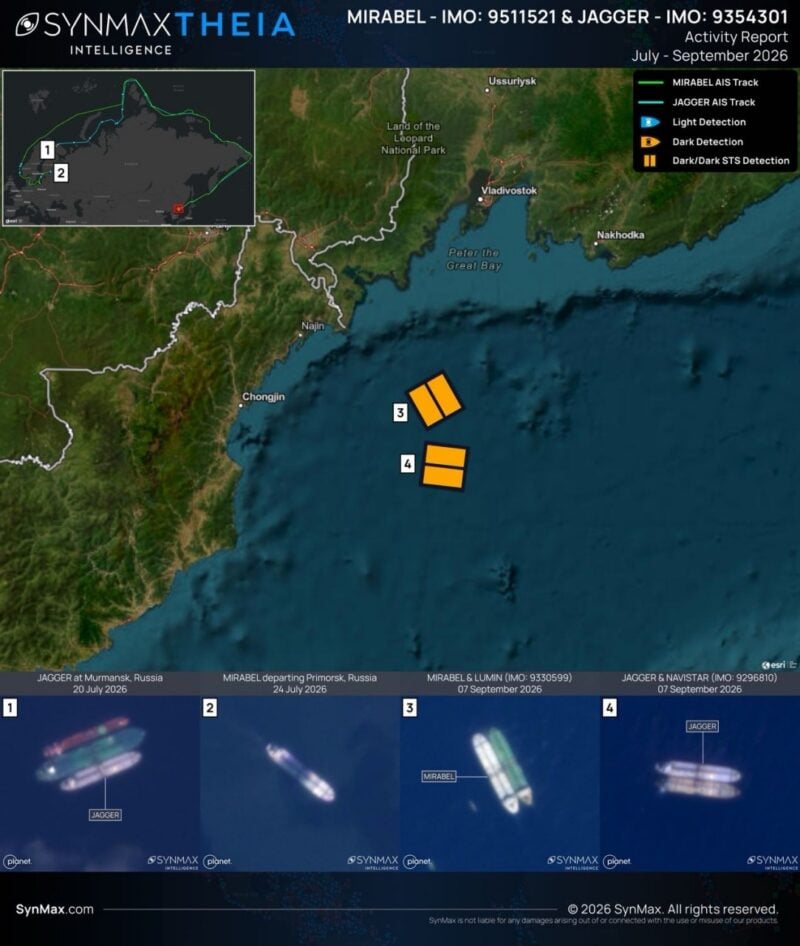
Satellite analytics company SynMax identified two STS operations involving four oil tankers, according to data and imagery provided to gCaptain. The vessels were detected conducting transfers well offshore between Russia’s Far East and the Korean Peninsula.
On September 7 Jagger transferred its cargo to the tanker Navistar, while Mirabel delivered oil to Lumin. Neither receiving vessel was transmitting AIS data during the transfers, according to SynMax.
The operations took place well south of Nakhodka Bay, where Russian tankers have previously conducted STS transfers after completing Northern Sea Route voyages.
Satellite images and AIS tracking of double dark STS transfer in the Sea of Japan on September 7, 2026. (Source: Synmax Intelligence)
“These are the first two STS events we have detected in this particular area, farther south than Nakhodka Bay,” a SynMax representative said. “[The transfers] stand out as they occurred considerably farther offshore than the activity we previously observed around Nakhodka Bay,” the company continued.
The use of dark STS transfers has become an important part of Russia’s oil export system since Western sanctions were imposed after Moscow’s invasion of Ukraine. Ship-to-ship transfers can obscure a cargo’s origin and allow oil to be moved between vessels, sometimes with AIS transponders switched off.
Industry analysts estimate that shadow tankers now carry a substantial share of Russian seaborne oil, with sanctioned shadow vessels accounting for 62% of Russian crude exports in July
SynMax also identified tankers Ligovsky Prospect and Primavera delivering oil directly to Chinese ports via the Arctic. Ligovsky Prospect reached Dongying, while Primavera sailed to Lanshan. Both were detected without AIS signals while in port and appeared to subsequently begin return voyages toward the Arctic.
The Arctic oil trade is likely to grow further. Russia’s Rosneft commissioned the giant Vostok Oil project on September 6, loading the first crude from the new Bukhta Sever terminal onto an Arc7 ice-class tanker. The project is designed to ship 30 million metric tons of oil in the second half of 2027, rising to 50 million tons by 2030, with infrastructure ultimately capable of handling up to 100 million tons annually.
(Bloomberg) — A US plan to rehabilitate sanctioned tankers to boost oil supply may attract only a sliver of the dark fleet, as existing contracts, complex compliance checks and sky-high...
The European Union unveiled a new Arctic strategy Tuesday aimed at strengthening maritime security, expanding icebreaker capacity and protecting critical infrastructure as melting sea ice opens new shipping routes and...
The Trump administration is authorizing the sale of sanctioned oil tankers in an effort to allow the vessels to start legitimately shipping crude, US Energy Secretary Chris Wright said.
18 hours ago
Total Views: 1203
Get The Industry’s Go-To News
Subscribe to gCaptain Daily and stay informed with the latest global maritime and offshore news
— just like 106,597 professionals
Secure Your Spot
on the gCaptain Crew
Stay informed with the latest maritime and offshore news, delivered daily straight to your inbox
— trusted by our 106,597 members
Your Gateway to the Maritime World!
Essential news coupled with the finest maritime content sourced from across the globe.

 Join The Club