Russia sent the first conventional, non-ice-class LNG carrier of the year to the sanctioned Arctic LNG 2 project on Wednesday as a growing fleet of crude oil tankers assembled nearby ahead of a summer push through the Northern Sea Route, underscoring Moscow’s expanding reliance on Arctic shipping to sustain energy exports despite Western sanctions.
The NSR has become increasingly important to Russia as it seeks to reduce exposure to security risks farther south, including Ukrainian drone attacks affecting Black Sea ports and instability around the Strait of Hormuz and the Red Sea.
Both developments reflect Russia’s effort to take maximum advantage of the Arctic’s short summer navigation season, when retreating sea ice allows a wider range of vessels to operate along the Northern Sea Route.
The conventional LNG carrier Arctic Pioneer arrived at the Utrenniy terminal at Arctic LNG 2 on July 29, according to ship-tracking data, becoming the first non-ice-class LNG tanker to reach the project this year.
The Kara Sea and Ob Bay are now largely free of sea ice, allowing conventional LNG carriers to reach the terminal without icebreaking capability. Additional conventional LNG carriers are expected to converge on Arctic LNG 2 in the coming weeks as Russia seeks to maximize exports before winter again limits access primarily to Arc7 vessels.
Conventional LNG carriers can only access Arctic LNG 2 during the relatively short summer navigation season. Once sea ice returns, year-round exports depend on specialized Arc7 icebreaking LNG carriers, whose limited numbers have remained one of the project’s principal logistical constraints since Western sanctions were imposed.
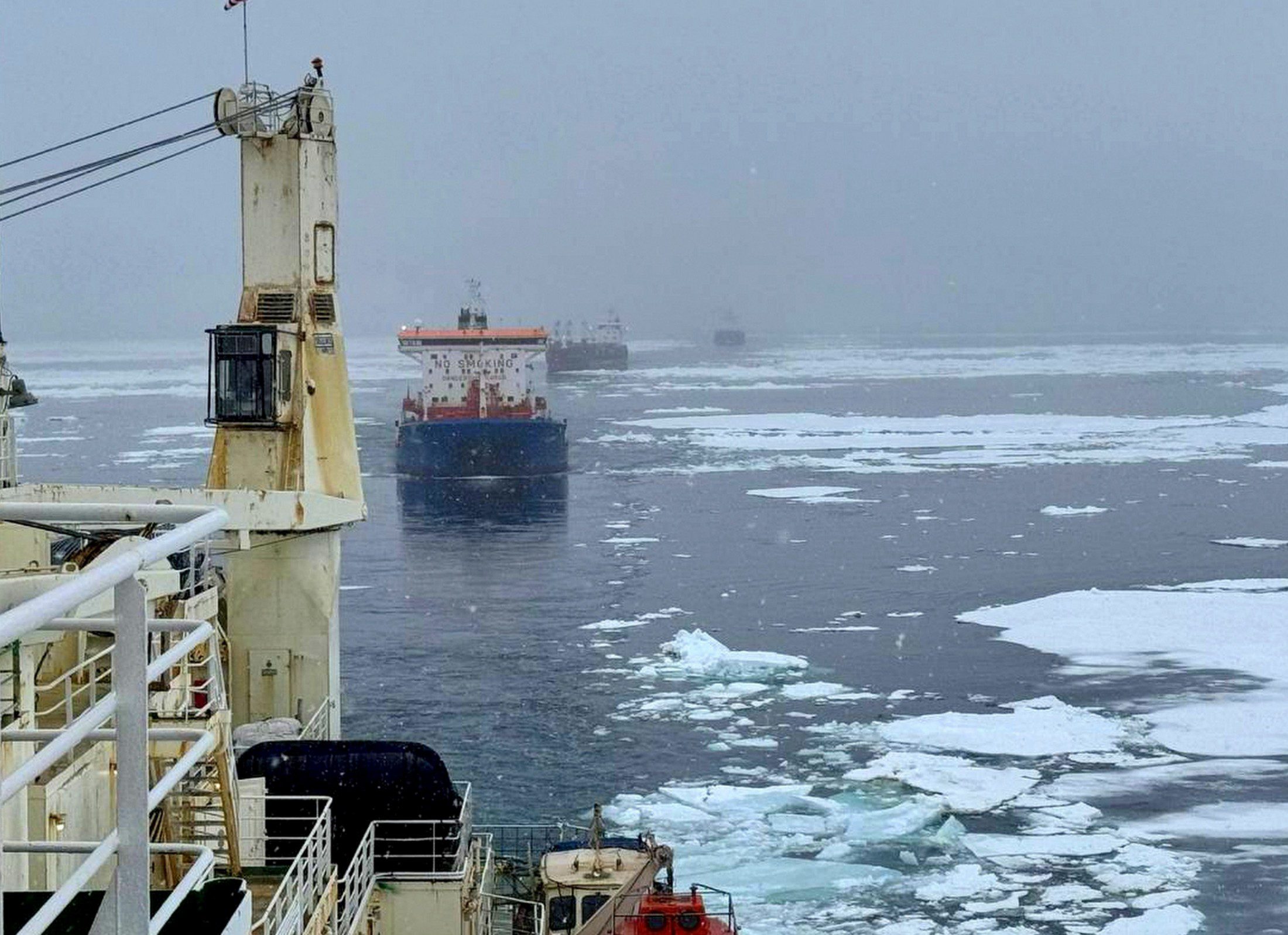
At the same time, a growing fleet of crude oil tankers has assembled farther east in the Kara Sea ahead of the annual eastbound oil export season.
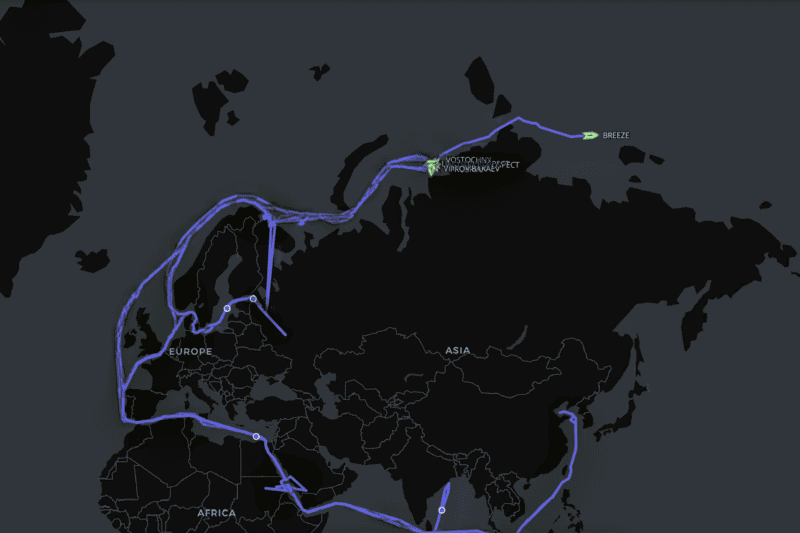
Crude oil tankers along the NSR during July 2026. (Source: MagicPort Maritime Intelligence)
At least seven tankers are now involved in Russia’s eastbound Arctic crude campaign, according to AIS vessel-tracking data. Six were waiting in the eastern Kara Sea on Tuesday while the Aframax tanker Breeze had already begun its eastbound transit. Five Aframax tankers – Viktor Bakaev, Vostochny Prospect, Liteyny Prospect, Jagger, and Ligovsky Prospect – together with the tanker Hyperion are currently holding positions. Collectively, the vessels can transport roughly 5 million barrels of crude oil.
All of the vessels carry at least the lowest category of ice strengthening, suggesting they are awaiting improving ice conditions farther east as well as escort by Russia’s fleet of nuclear-powered icebreakers before proceeding through the eastern stretches of the NSR.
Analysts say the Arctic route has grown increasingly attractive as Moscow looks to shorten voyages to Asia while reducing exposure to security risks farther south, including disruptions affecting the Red Sea and the Strait of Hormuz.
Russia has previously dispatched conventional, non-ice-class oil tankers through the NSR during favorable ice conditions later in the summer. That has not yet occurred this year, although the annual Arctic sea ice minimum typically is not reached until September, meaning the most accessible portion of the navigation season still lies ahead in August and September.
Together, the arrival of conventional LNG carriers at Arctic LNG 2 and the growing crude tanker fleet in the Kara Sea illustrate how the Arctic is becoming an increasingly important export corridor for Russia as sanctions and geopolitical tensions reshape global energy trade.
Accelerating crude exports through the Strait of Hormuz aren’t translating into higher production of a dirty shipping fuel, according to a top Vitol Group executive, tightening supplies and sending prices soaring.
Shipowners are facing an increasingly fragmented fuel market as disruptions triggered by the Middle East conflict raise concerns about the availability and quality of supply.
Saudi Arabia is looking at ways to expand its oil pipeline capacity to destinations outside the Persian Gulf to 10 million barrels a day within two to three years, said Energy Minister Prince Abdulaziz bin Salman.
October 12, 2026
Total Views: 1992
Get The Industry’s Go-To News
Subscribe to gCaptain Daily and stay informed with the latest global maritime and offshore news
— just like 106,659 professionals
Secure Your Spot
on the gCaptain Crew
Stay informed with the latest maritime and offshore news, delivered daily straight to your inbox
— trusted by our 106,659 members
Your Gateway to the Maritime World!
Essential news coupled with the finest maritime content sourced from across the globe.

 Join The Club