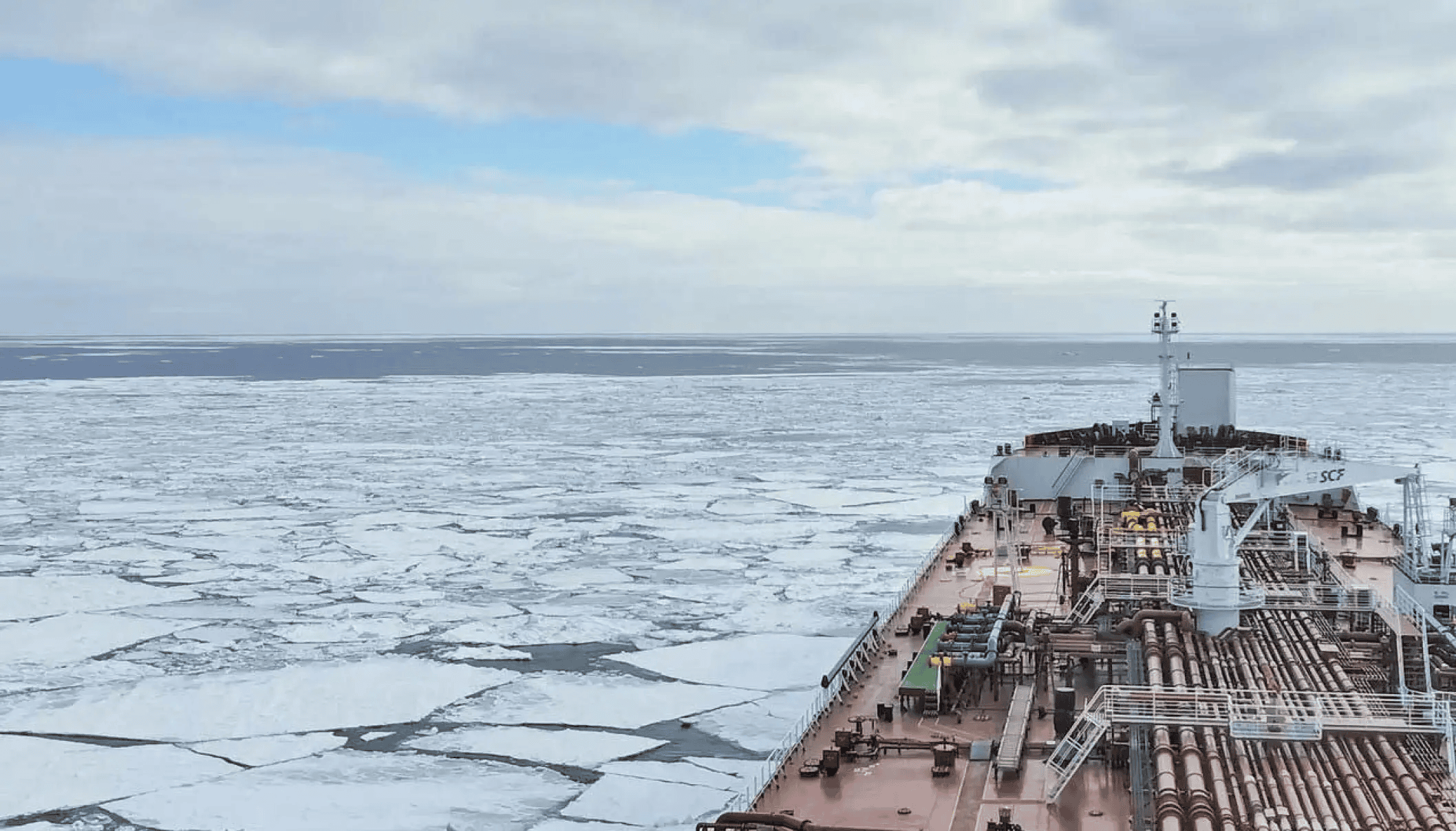
Russia has assembled an unprecedented fleet of oil tankers in the Arctic as it accelerates crude exports to Asia via the Northern Sea Route, with vessels carrying roughly 8 million barrels of oil already transiting or waiting to enter the ice-covered shipping lane; more than half the volume moved during last year’s entire summer navigation season.
More than a dozen Suezmax, Aframax and Medium Range tankers were either underway along the route or gathered in the Kara Sea on Aug. 3, likely awaiting nuclear icebreaker escort or improved ice conditions before continuing east.
The buildup is unprecedented. During last year’s entire four-month Arctic navigation season, about 13.1 million barrels of crude were transported via the Northern Sea Route. Just weeks into this year’s summer shipping window, Russia already has vessels carrying roughly 8 million barrels – equivalent to about 60% of last year’s seasonal total – either transiting the Arctic or waiting to proceed east.
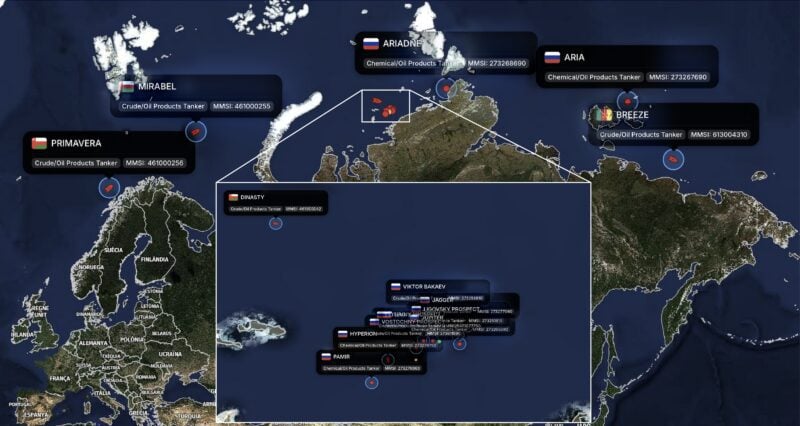
The largest convoy is taking shape in the Kara Sea, where the Suezmax Dinasty, five Aframax tankers – Viktor Bakaev, Vostochny Prospect, Liteyny Prospect, Jagger and Ligovsky Prospect – along with several Medium Range tankers have formed a staging area before proceeding east along the Northern Sea Route.
The vessels are likely waiting either for nuclear icebreaker escort or for sea ice conditions to improve sufficiently to permit unassisted navigation through more challenging sections of the route.
Elsewhere, two additional Aframax tankers, Primavera and Mirabel, are sailing north through the Norwegian and Barents seas toward the Arctic, while Breeze has already completed much of the Northern Sea Route but has remained stationary in the eastern Arctic for the past two days, likely delayed by lingering sea ice. Two additional Medium Range tankers are already transiting the route.
Oil tankers on the NSR or heading for the Arctic on August 3, 2026. (Source: MagicPort.ai Maritime Intelligence)
Although the Arctic melt season is well underway, sea ice typically does not reach its annual minimum until late September, and difficult conditions continue to persist in parts of the route despite the seasonal retreat.
Russia has deployed three nuclear-powered icebreakers along the Northern Sea Route to support this year’s navigation season. Sibir is operating in the central-western Arctic, Yakutiya is deployed in the East Siberian Sea, while Ural is stationed near Wrangel Island, a recurring bottleneck where persistent sea ice has complicated navigation during each of the past two summers.
The growing Arctic convoy underscores Moscow’s increasing reliance on the Northern Sea Route as geopolitical risks mount along more traditional shipping corridors. Tensions around the Strait of Hormuz and continued attacks on commercial shipping in the Red Sea have highlighted the vulnerability of routes through the Middle East.
The Northern Sea Route shortens voyages between northwest Russia and Asia by thousands of nautical miles compared with the Suez Canal route, but remains navigable for conventional tankers only during a limited summer window and often requires nuclear icebreaker assistance in heavier ice.
Russia has steadily expanded Arctic oil shipments since Western sanctions redirected much of its crude exports from Europe toward China and India. This year’s unprecedented concentration of tankers suggests Moscow is seeking to maximize Arctic exports before sea ice once again closes much of the route later this autumn.
A tanker carrying Russian diesel is expected to arrive in Norfolk, Virginia, on November 2, potentially becoming the first such shipment to reach the United States in more than three...
Along Russia’s remote Arctic coast last month, Igor Sechin stood beside a waiting tanker in the freezing cold with a message for Vladimir Putin: After years of construction, the country’s next great oil frontier was finally coming to life.
The European Union unveiled a new Arctic strategy Tuesday aimed at strengthening maritime security, expanding icebreaker capacity and protecting critical infrastructure as melting sea ice opens new shipping routes and...
October 20, 2026
Total Views: 679
Get The Industry’s Go-To News
Subscribe to gCaptain Daily and stay informed with the latest global maritime and offshore news
— just like 106,406 professionals
Secure Your Spot
on the gCaptain Crew
Stay informed with the latest maritime and offshore news, delivered daily straight to your inbox
— trusted by our 106,406 members
Your Gateway to the Maritime World!
Essential news coupled with the finest maritime content sourced from across the globe.

 Join The Club