Don’t Miss Your Daily Briefing for the Maritime Industry
Join the leading maritime news network
— trusted by our 106,659 members
U.S. President Donald Trump attends a meeting with oil industry executives, at the White House in Washington, D.C., U.S., January 9, 2026. REUTERS/Evelyn Hockstein
Opinion: Reality of the Crude Trade Will Come to a Head Around Midterms
By Lori Ann LaRocco – The price of crude is not reflective of the supply reality in the Middle East, and based on crude trade data, the runway left for this crude reality can be felt by the U.S. midterms.
Oil is down below $90 because there have been no military strikes or attacks in a handful of days. Not because of hard supply facts.
Trade takes time to flow.
The last regular cadence of oil out of the Port of Yanbu left seven days ago. It will take weeks for that oil to arrive at its final destinations. The additional $200m in oil exported during the weeks following the Memorandum of Understanding also needs to arrive and be consumed. Also, the newly rerouted tankers avoiding the Bab el-Mandeb Strait will take longer to arrive and will need smaller vessels to travel through the Suez Canal and then transship the oil into a larger tanker.
Tankers have since diverted, either going the long route around the Horn of Africa and then going through the Suez to reach Yanbu. The diversion will boost tanker profits because of the longer transit times. But it also means a delay in crude deliveries.
“It’s going to add about 60 days of transport for oil that’s trying to get to Asia, and you also add this logistical kind of difficulty of going from a very large tanker to these smaller vessels that can either transit the Suez or then you have to put oil from a ship into a pipeline,” explained Dr. Karen E. Young, Senior Fellow, Middle East Institute.
The flow through the two vital waterways: the Strait of Hormuz and the Bab el-Mandeb Strait, is trickling.
The Red Sea was one of the world’s primary economic superhighways, handling roughly 12% to 15% of global trade and up to 9 million barrels of oil per day. The Suez Canal carries roughly 20% of global trade.
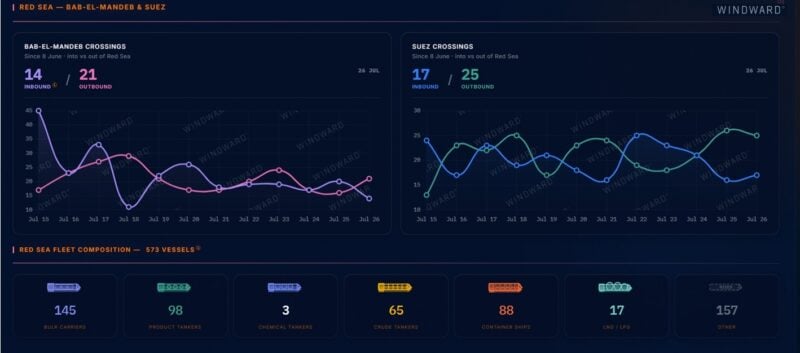
Crossings tracked by Windward tell the current state of transits.
The transits today are a fraction of what should be moving.
The Red Sea impact adds a compounding crunch to the crude shortage: the barrels lost due to the essential closure of the Strait of Hormuz and Russia’s inability to export refined crude products due to Ukraine’s strikes on its infrastructure.
It’s a losing trifecta. The hole in the crude bucket is larger.
Energy analysts say the markets simply do not know how this will all turn out.
“It is optimistic and hopeful that a resolution will be reached that reopens the Strait of Hormuz, while it is also terrified that nothing happens for months and that commercial inventories continue to be drawn down to minimum operating levels, causing a price spike,” said Andy Lipow, president of Lipow Oil Associates. “With all the uncertainty surrounding oil supply and product demand, the longer the Middle East disruption goes on, the closer it gets to affecting the midterm elections.”
Following the U.S. and Israeli strikes on Iran on February 28, 2026, the Port of Yanbu became the symbol of the resiliency of trade. Saudi Arabia was forced to move over 70% of its crude exports overland via pipeline to its West Coast Red Sea terminal at Yanbu. Now that pivot has been pinched. Yes, trade will continue to flow, but the bottom line is you don’t have enough supply to meet overall demand.
As I have warned before in previous gCaptain and Substack writings, it would take time for refinery capacity to go back online. It takes time to repair damage inflicted by Iran as well as to properly start. The new pipelines being built will take time to finish. But let’s not forget, pipelines can also be targets.
In a recent report, the U.S Department of Energy wrote that Middle East refinery activity and product supplies have been much slower to get back up and running to meet demand:
“LPG and refined products of Gulf exports in June remained at less than half their pre-war levels, compared with crude flows that reached nearly three-quarters of their February rates.
Loadings from key export refineries in the Gulf have yet to resume, suggesting operations remain constrained. Against this backdrop, intensifying Ukrainian attacks on Russian refineries and export infrastructure have further tightened product markets in Russia and beyond, with exports and domestic fuel deliveries both significantly impacted.”
The supply and demand dynamics show the world needs more oil. The stop-and-starts could equate to a three-month window, according to Young.
“It largely depends on China,” said Young. “When does Chinese demand rebound? And that’s about 45 million barrels a day, and they have said thanks, we’re good. The real question is, does China decide diplomatically to engage in this war? Do they try to work with the Pakistanis, which there was some talk about over the weekend, to perhaps try to mediate? The second important thing, of course, is the inventories.”
Young cited J.P. Morgan’s latest report saying that China can continue without this 4 million barrels a day for another three months or so.
“That potentially is a little bit of a timing cushion, but if we still have these stress points on both the Strait of Hormuz and the Bab el-Mandab, we are going to have a very strong need for the release of inventories,” stressed Young. “200 million barrels for one month of disruption, about 315 million barrels for two months, and 500 million barrels if it lasted for three months. The question is, do we have another 500 million barrels in strategic reserves to release? Can the U.S. SPR, which really carried the weight of that first coordinated release, do that again? I think most people say, with great difficulty, it would be a hardship.”
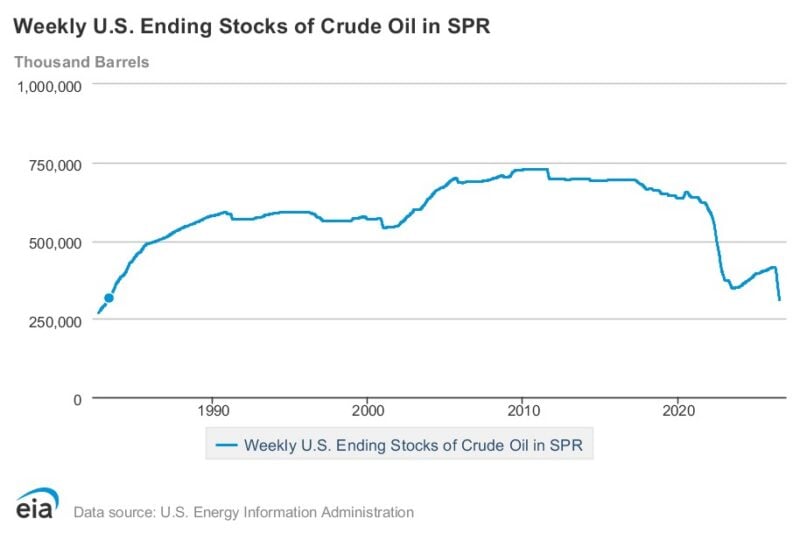
The U.S SPR has fallen to 311.45 million barrels, reaching its lowest level since 1983; roughly 43.6% of its total capacity (714 million barrels).
Companies such as Marathon and Delta Airlines have tapped into the SPR for U.S. consumption.
“So much of the SPR oil is being exported, but some is being consumed here in the U.S,” said Lipow.
Three months is a lifetime in politics.
This war has seen knee-jerk supply injections as talks restart and then crumble. This has helped the Trump Administration to lower crude prices just in time for the nation’s 250th birthday. We will see if there is another “agreement” to inject more crude back into the market as a way to kick the can down the road beyond midterms.
Only time will tell; meanwhile, the runway is getting shorter.
Accelerating crude exports through the Strait of Hormuz aren’t translating into higher production of a dirty shipping fuel, according to a top Vitol Group executive, tightening supplies and sending prices soaring.
Shipowners are facing an increasingly fragmented fuel market as disruptions triggered by the Middle East conflict raise concerns about the availability and quality of supply.
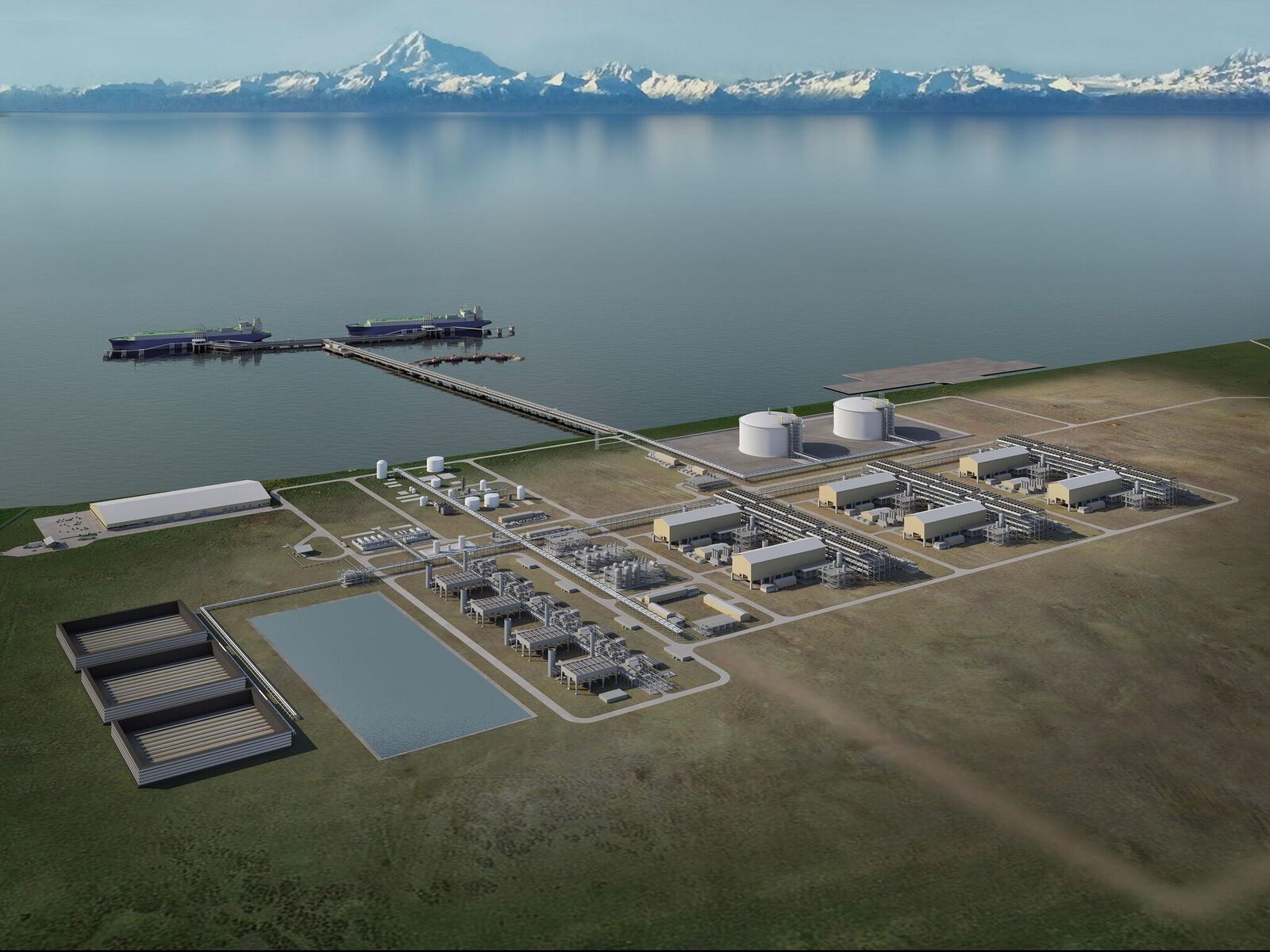
President Donald Trump said Taiwan had agreed to buy 30% of the liquefied natural gas from a planned project in Alaska for 20 years, even as Taipei indicated that no binding commitments have been finalized.
October 14, 2026
Total Views: 560
Get The Industry’s Go-To News
Subscribe to gCaptain Daily and stay informed with the latest global maritime and offshore news
— just like 106,659 professionals
Secure Your Spot
on the gCaptain Crew
Stay informed with the latest maritime and offshore news, delivered daily straight to your inbox
— trusted by our 106,659 members
Your Gateway to the Maritime World!
Essential news coupled with the finest maritime content sourced from across the globe.

 Join The Club