The Port of Virginia has significantly expanded its capacity to handle the world’s largest containerships, positioning itself as a key player in East Coast maritime infrastructure as the port’s ambitious harbor deepening project approaches its final stages.
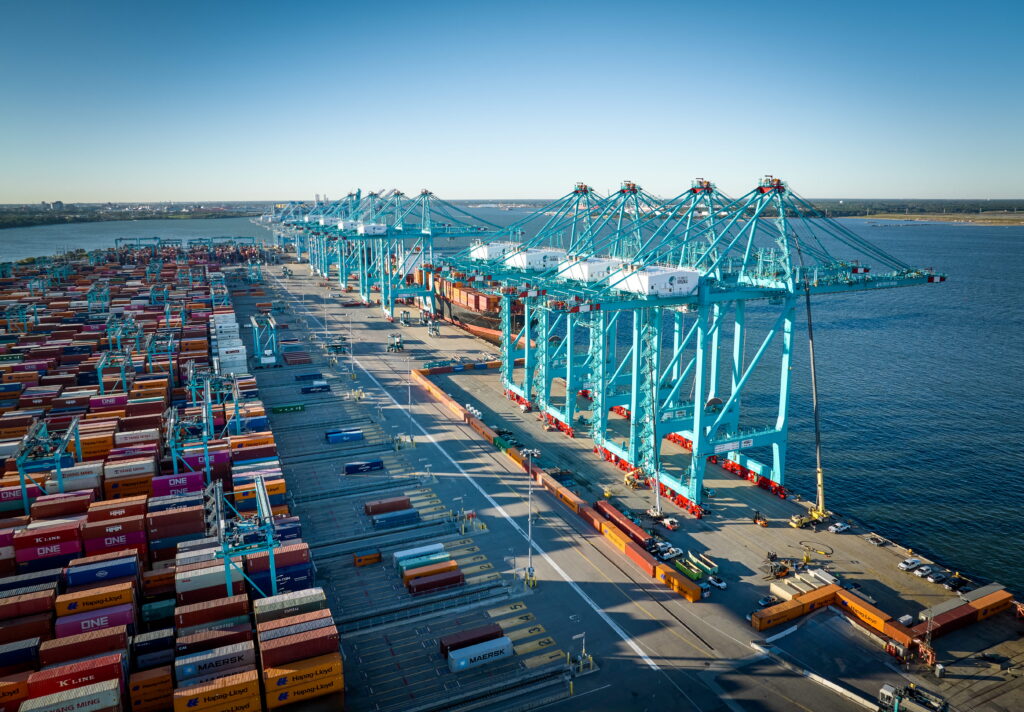
In late January, the port commissioned four new, all-electric, Suez-class ship-to-shore container cranes at Norfolk International Terminals, giving the facility the capability to simultaneously service four ultra-large container vessels. The port now operates 29 ship-to-shore cranes on deep water capable of handling the largest containerships currently serving Atlantic trade routes.
“This is the kind infrastructure investment that lets ocean carriers and cargo owners using The Port of Virginia know they can grow their volumes here,” said Sarah J. McCoy, interim CEO and executive director of the Virginia Port Authority. “Our berth capability is growing. We now have four ULCV berths and we are quickly heading toward having the berth capacity to handle five ultra-large container vessels at once.”
The expanded berth capacity arrives as the port nears completion of its long-planned channel deepening to 55 feet, which will establish Virginia as home to the deepest commercial port on the U.S. East Coast, surpassing the Port of Charleston’s 52-foot depth. The dredging work is scheduled for completion by the end of February, with the fifth ultra-large container vessel (ULCV) berth expected to come online in 2027.
“Our channels are wide enough to handle two-way ULCV traffic and we are in the last phase of deepening,” McCoy said. “When the 55-foot channel opens later this month, multiple ULCVs, loaded to their absolute limits, will be able to call here without water depth restrictions, overhead obstructions, berth capacity or concern for congested ship channels. The Port of Virginia is America’s Most Modern Gateway and it’s ready for the future.”
The harbor deepening project received its final federal approval in July 2018 from the U.S. Army Corps of Engineers’ Chief of Engineers’ Report, clearing the way for channels to be dredged from their previous 50-foot depth to 55 feet and widened in select areas to accommodate two-way ULCV traffic.
The project, originally authorized in 1986 under the federal Water Resources Development Act, represents a combined investment of approximately $350 million from the Commonwealth of Virginia and federal matching funds. The dredging phase was originally scheduled for completion in 2024 at an estimated cost of $330 million.
“The support this project has gotten in Washington, D.C., in Richmond and locally shows true foresight and ensures The Port of Virginia will be able to remain an attractive and competitive global gateway for trade for decades,” said John F. Reinhart, former CEO and executive director of the Virginia Port Authority, at the time of federal approval.
According to an economic impact study from The College of William and Mary, the Port of Virginia drives more than 565,000 jobs and contributes $63 billion to Virginia’s gross domestic product annually. The Virginia Port Authority owns and operates four general cargo facilities through its subsidiary Virginia International Terminals, and leases two additional terminals.

 Join The Club