Don’t Miss Your Daily Briefing for the Maritime Industry
Join the leading maritime news network
— trusted by our 106,374 members
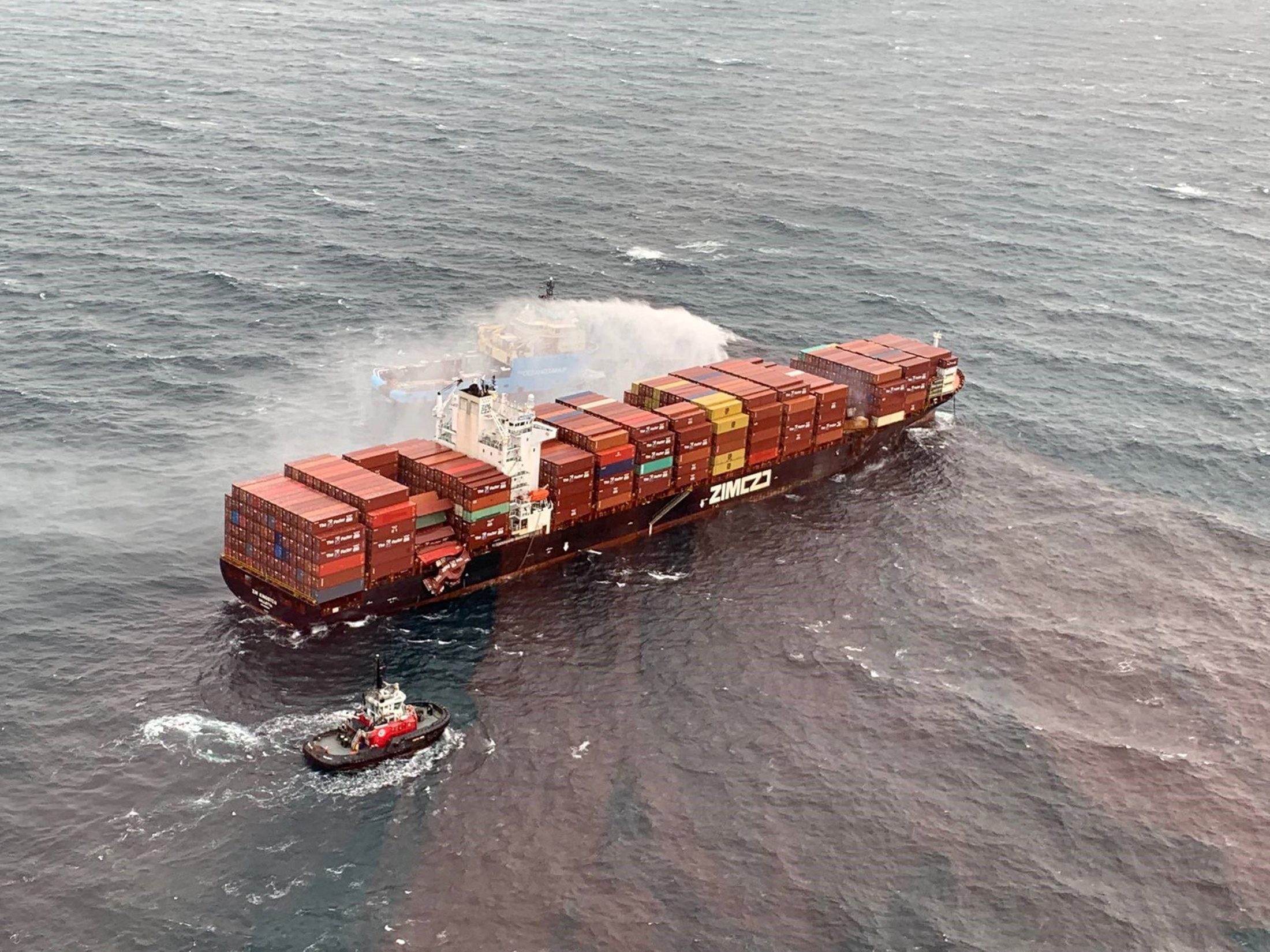
A tugboat pours water on the container ship Zim Kingston after it caught fire off the coast of Victoria, British Columbia, Canada October 25, 2021. Canadian Coast Guard/Handout via REUTERS.
One in Ten Inspected Cargo Units Found With Safety Deficiencies
More than one in ten cargo units inspected by government authorities last year were found with safety deficiencies, highlighting a persistent problem with how containers are declared, packed and secured before reaching ships.
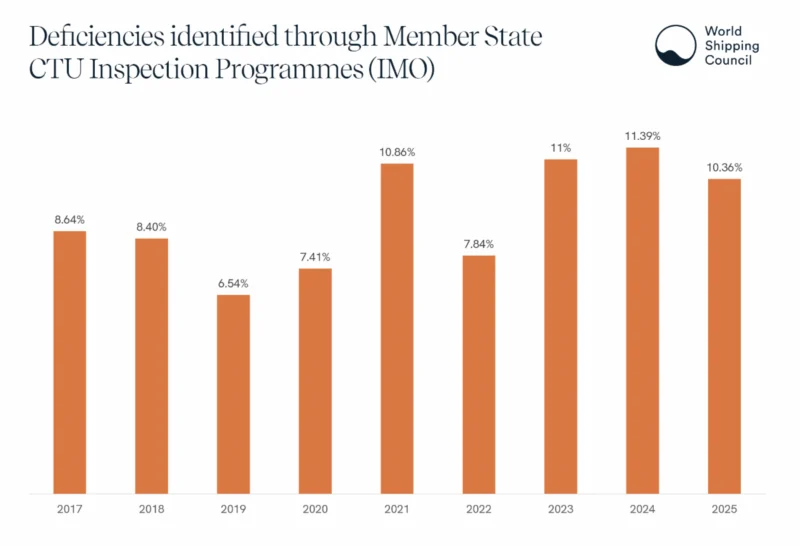
The World Shipping Council said authorities in seven countries inspected 93,079 cargo transport units in 2025 and found deficiencies in 9,645 of them, a rate of 10.36%.
Problems ranged from incorrect documentation, marking and labeling to improper packing and inadequate cargo securing — deficiencies that can contribute to damaged cargo, containers lost overboard and fires at sea.
“Finding deficiencies in more than one in ten inspected units is far too high,” said World Shipping Council President and CEO Joe Kramek. “Correct declaration, packing, securing and marking are fundamental safety obligations. When these requirements are not met, people’s lives are put at risk.”
The 2025 figure was an improvement from the 11.39% deficiency rate reported in 2024, but remains elevated compared with much of the past decade.
Reported deficiency rates stood at 8.64% in 2017, 8.40% in 2018 and fell to 6.54% in 2019. Since 2021, however, the rate has exceeded 10% in three of five years, including 11% in 2023 and 11.39% in 2024.
The latest findings come as the container shipping industry continues to grapple with fires linked to improperly declared or packed cargo.
In June, WSC cited data from Allianz Commercial showing that a container ship fire now occurs somewhere in the world roughly every 17 days. Misdeclared cargo, including chemicals and lithium-ion batteries, remains a major contributor to cargo-related incidents.
Incorrect declarations can be especially dangerous at sea because they may result in hazardous containers being stowed in locations unsuitable for their contents. They can also leave crews without accurate information about what they are dealing with when a fire breaks out.
The problem has become increasingly important as shipments of lithium-ion batteries have grown. Battery fires can be particularly difficult to control once thermal runaway begins, while today’s largest containerships can carry more than 20,000 containers, complicating detection and firefighting.
The latest inspection data was submitted to the International Maritime Organization by Chile, Finland, Germany, the Netherlands, South Korea, Sweden and the United States.
That leaves another concern: only seven of the IMO’s more than 170 member states reported inspection results for 2025.
“States have a responsibility to enforce cargo safety rules, including through effective inspections,” Kramek said. “The fact that only seven Member States reported results is concerning. More governments need to report their inspections so that risks can be consistently identified and action taken.”
The limited reporting also means the 10.36% figure should not be viewed as a failure rate for containers moving through the global supply chain. It reflects deficiencies found among the units inspected and reported by the seven participating governments.
WSC took over consolidating and publishing the inspection results after the IMO discontinued its annual consolidated report in 2024.
The group is also trying to catch dangerous cargo before it reaches the ship.
WSC launched its Cargo Safety Program last year, combining shared screening technology, standardized inspection procedures and feedback from physical inspections to identify potentially misdeclared or undeclared dangerous goods.
At the center of the program is a digital screening system developed by the National Cargo Bureau that scans container bookings for keywords, trade patterns and other risk indicators. Suspicious bookings can then be reviewed by carriers and, where necessary, targeted for physical inspection.
The initiative has previously flagged shipments whose descriptions did not accurately reflect their contents, including cargo declared simply as “hand tools” that was found to contain lithium-ion battery-powered equipment requiring additional handling precautions.
The program does not eliminate the responsibility of shippers to properly declare and pack cargo, WSC says, but adds another layer of scrutiny before containers are loaded.
With roughly one in ten inspected units still showing deficiencies, the latest figures suggest those basic cargo safety failures remain far from solved.
The ports of Los Angeles and Long Beach both set all-time monthly cargo records in September, handling a combined 2.04 million twenty-foot equivalent units (TEUs) as strong imports and shifting...
The Port of Los Angeles handled a record 1,042,652 twenty-foot equivalent units (TEUs) in September, marking the busiest month in its 118-year history as strong consumer demand and shifting global...
October 13, 2026
Total Views: 1155
Get The Industry’s Go-To News
Subscribe to gCaptain Daily and stay informed with the latest global maritime and offshore news
— just like 106,374 professionals
Secure Your Spot
on the gCaptain Crew
Stay informed with the latest maritime and offshore news, delivered daily straight to your inbox
— trusted by our 106,374 members
Your Gateway to the Maritime World!
Essential news coupled with the finest maritime content sourced from across the globe.

 Join The Club