Don’t Miss Your Daily Briefing for the Maritime Industry
Join the leading maritime news network
— trusted by our 105,683 members
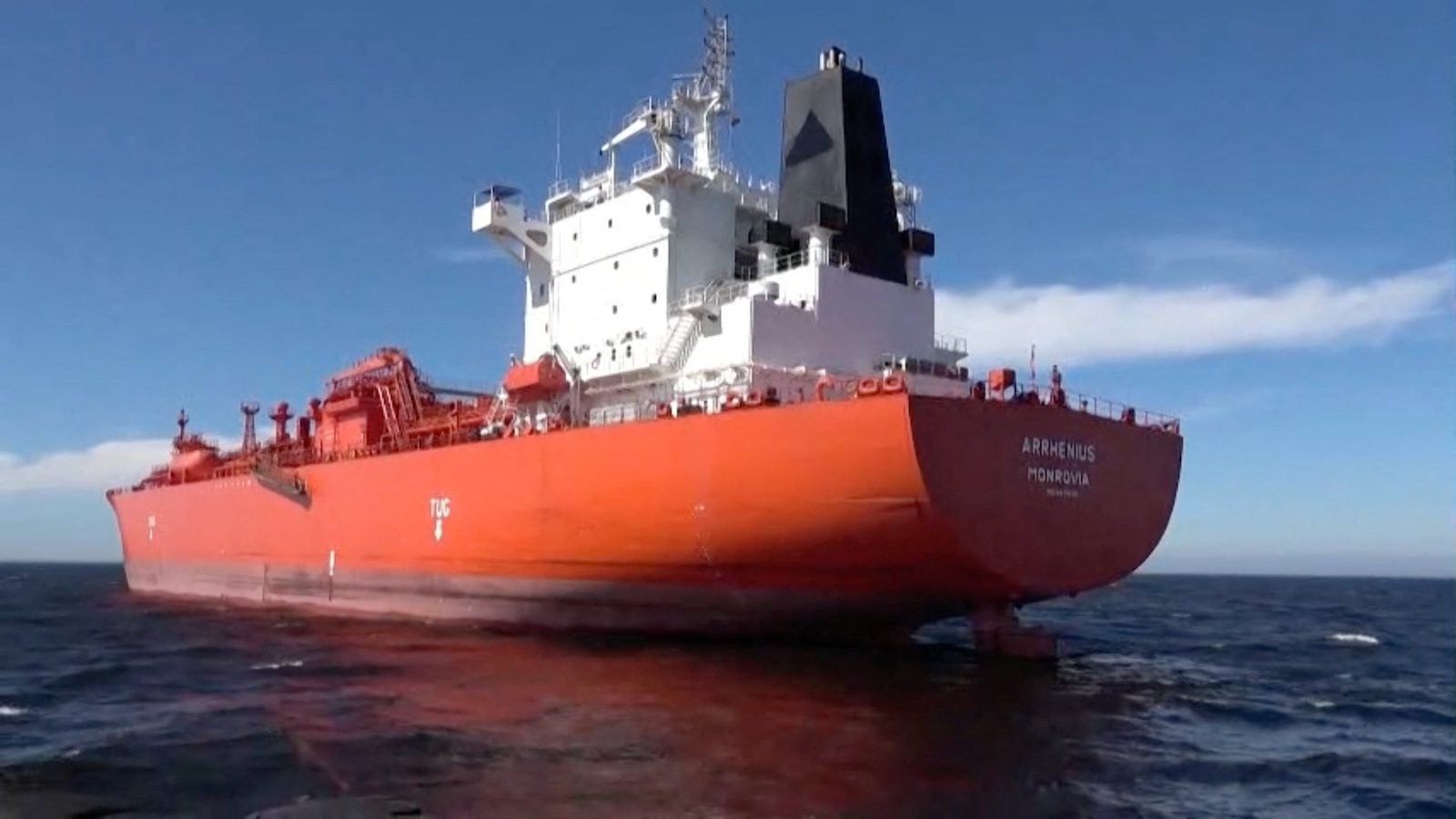
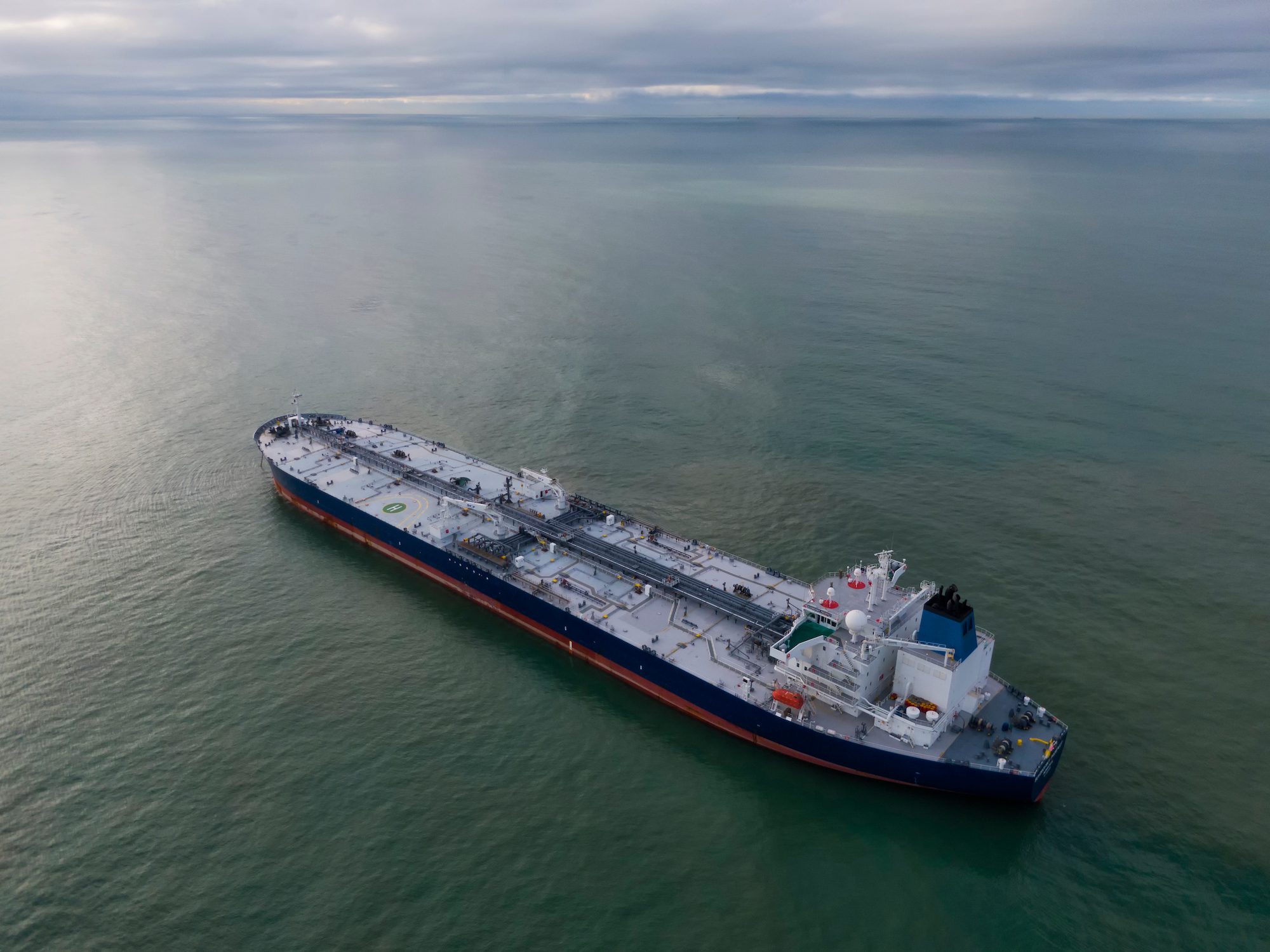
The Liberia-flagged tanker Arrhenius at sea, in this still image from video released by Russian state media on May 25, 2026. Russian State Media/Handout via REUTERS
Mines on LPG Tanker Point to Dangerous New Front in Baltic War
By Paul Morgan (gCaptain) – Russia’s Federal Security Service announced on Monday that divers had discovered magnetic explosive devices attached to the hull of a Liberia-flagged liquefied petroleum gas tanker in the Baltic Sea port of Ust-Luga, in what the Kremlin has described as a thwarted terrorist attack.
The incident, which Russian authorities have attributed to a NATO country without naming one, raises serious questions about the vulnerability of energy shipping to sub-surface sabotage and the potential for further escalation in an already volatile theatre.
The tanker in question, the Arrhenius, arrived at Ust-Luga from the Belgian port of Antwerp. Russia’s Investigative Committee confirmed that the mines were found by divers inspecting the vessel’s hull and were neutralised before any detonation occurred. The Arrhenius, a 174-meter, 26,645-deadweight-tonne LPG carrier built in 2010 at Hyundai Mipo Dockyard in South Korea, sails under the Liberian flag and is commercially managed by Maple Mariner Holding FZ-LLC of Ras Al Khaimah, with ISM management handled by Bernhard Schulte Shipmanagement. AIS data confirmed the vessel arrived at Ust-Luga anchorage on 20 May at 12:21 UTC.
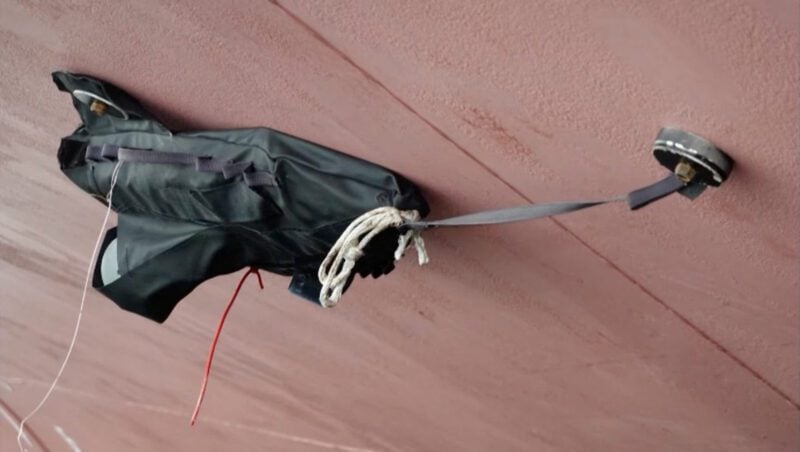
The FSB stated that the devices were found near the engine room and that the mass of plastic explosive in each unit was approximately seven kilograms, though the service did not publicly state the total number recovered. Ports Europe reported that two mines were found and deactivated. Russia’s Investigative Committee spokeswoman Svetlana Petrenko described the devices as factory-made naval magnetic mines manufactured in one of the NATO countries, and confirmed they were neutralised by the FSB in cooperation with the Ministry of Defence and the National Guard, Rosgvardiya.
It must be stressed that the attribution to a NATO member state is the Russian government’s assertion. No Western government or NATO body has confirmed or denied the claim, and NATO did not respond to requests for comment by the time of publication.
A still image from a video released by Russian state media shows what is said to be a mine found on the hull of the Liberia-flagged tanker Arrhenius in the Baltic Sea port of Ust-Luga in the Leningraad region, Russia, the video released on May 25, 2026. Russian State Media/Handout via REUTERS
The vessel had arrived in Russia several days behind schedule. Investigators established that it had departed Antwerp bound for Ust-Luga to take on an LPG cargo before proceeding to the Turkish port of Samsun. The captain told Russian authorities that the ship arrived off Antwerp on 12 May but was directed to anchor offshore because the terminal was not ready, with a dockworkers’ strike cited as the cause. The vessel held at anchor for approximately 36 hours, discharged its outbound cargo over a further 25 hours, and then departed Antwerp on 16 May, proceeding directly to Ust-Luga with no intermediate calls.
The anchorage period is significant because Russian investigators have used it to establish a probable window for the attachment of the devices. The Investigative Committee stated that based on initial investigative actions, it could already be concluded that the mines could not have been installed in Russia’s territorial waters. The 36-hour anchorage outside Antwerp, during which the ship was away from the berth and any surveillance associated with it, is the period investigators are understood to be focusing on.
The claim is consistent with documented industrial disruption at the port: on 12 May, a Belgian national strike disrupted pilot services and cut tug capacity at Antwerp to around 80 per cent, and a further 24-hour National Day of Action had been called for around 20 May, during which PSA Antwerp suspended truck export deliveries. Strike activity at the port during the period the Arrhenius was waiting offshore is therefore independently corroborated, even if its use as cover for any sabotage operation remains an allegation.
Russia’s Investigative Committee confirmed it has opened a criminal case on charges of attempted terrorist act and illegal trafficking of explosive devices under the Russian Criminal Code. A harbour master interview released by the FSB confirmed that all crew members remained aboard and that the vessel and crew were ready to resume cargo operations following deactivation of the devices. The ship remained at Ust-Luga pending a comprehensive structural and security sweep.
The incident did not occur in isolation. Ust-Luga has been the focus of a sustained Ukrainian drone campaign targeting Russian oil export infrastructure throughout 2026, with repeated strikes on the ports of Ust-Luga and Primorsk causing fires and disrupting operations. Ukraine struck Ust-Luga on 25 March in what was reported as the largest overnight drone attack of the year to that point, sparking fires and prompting the port to temporarily suspend crude oil and oil product loadings.
By late March, Ukrainian drone strikes on terminals and refineries had contributed to an estimated 40 per cent loss in Russia’s oil export capacity for that month, according to Reuters. The mines on the Arrhenius represent, if the sabotage interpretation is correct, a qualitative shift in method, from aerial drone strikes to sub-surface attack using commercially transiting vessels as unwitting vectors.
That shift carries profound implications for the shipping industry and for port security globally. An LPG carrier loaded with liquefied petroleum gas, detonated near an engine room, in a port handling 700,000 barrels of oil equivalent per day, would represent a catastrophic event, not merely for the vessel and her crew, but for the port’s infrastructure and for any neighbouring vessels. The fact that Russian divers detected the devices through routine hull inspection raises an immediate question for port authorities worldwide: how many other vessels arriving from European ports, or indeed any port with access to open anchorages, are being subjected to equivalent scrutiny? The honest answer is very few.
Several questions remain unanswered and are likely to drive the story considerably further. Russia has identified the devices as factory-made NATO ordnance but has not named the country of manufacture nor provided independent verification of that claim. No Western intelligence service has publicly commented. Ukraine has neither claimed nor denied any involvement.
The identity and nationality of any individuals who may have attached the mines during the Antwerp anchorage period remains entirely unknown. And crucially, whether this represents a one-off incident or an operational template that has already been applied elsewhere has not been established.
The retaliation question is now openly discussed in Russian state media and commentary channels, with some voices calling for action directed at NATO territory itself. That language is almost certainly posturing, at least in the short term, but Russia has demonstrated a consistent willingness to respond to infrastructure sabotage asymmetrically, through cyber operations, coordinated disruption of Baltic undersea cables, and harassment of commercial shipping in contested waters. A proportionate response targeting European LNG or energy infrastructure through similar sub-surface sabotage methods is well within established Russian doctrine and capability.
Whether Moscow chooses to exercise that capability, or to extract maximum political value from the incident as a narrative of Western aggression, remains to be seen. Either outcome carries consequences for the insurance, security, and operational calculus of every vessel transiting between northern European ports and Russia’s Baltic terminals.
South Korea has preliminarily selected shipping company Panstar Line to operate the country’s first trial container voyage along Russia’s Northern Sea Route (NSR), marking a significant step in Seoul’s ambitions to expand its role in Arctic shipping and develop alternative trade corridors between Asia and Europe.
The Trump administration on Tuesday imposed sanctions on an Iranian foreign currency exchange house and what it said were front companies overseeing transactions on behalf of Iranian banks as the U.S. maintains pressure on Tehran.
U.S. Treasury Secretary Scott Bessent announced Monday that the Treasury Department is issuing a temporary 30-day general license allowing “the most vulnerable nations” to access Russian oil cargoes currently stranded at sea,...
May 18, 2026
Total Views: 483
Get The Industry’s Go-To News
Subscribe to gCaptain Daily and stay informed with the latest global maritime and offshore news
— just like 105,683 professionals
Secure Your Spot
on the gCaptain Crew
Stay informed with the latest maritime and offshore news, delivered daily straight to your inbox
— trusted by our 105,683 members
Your Gateway to the Maritime World!
Essential news coupled with the finest maritime content sourced from across the globe.

 Join The Club