Don’t Miss Your Daily Briefing for the Maritime Industry
Join the leading maritime news network
— trusted by our 106,075 members
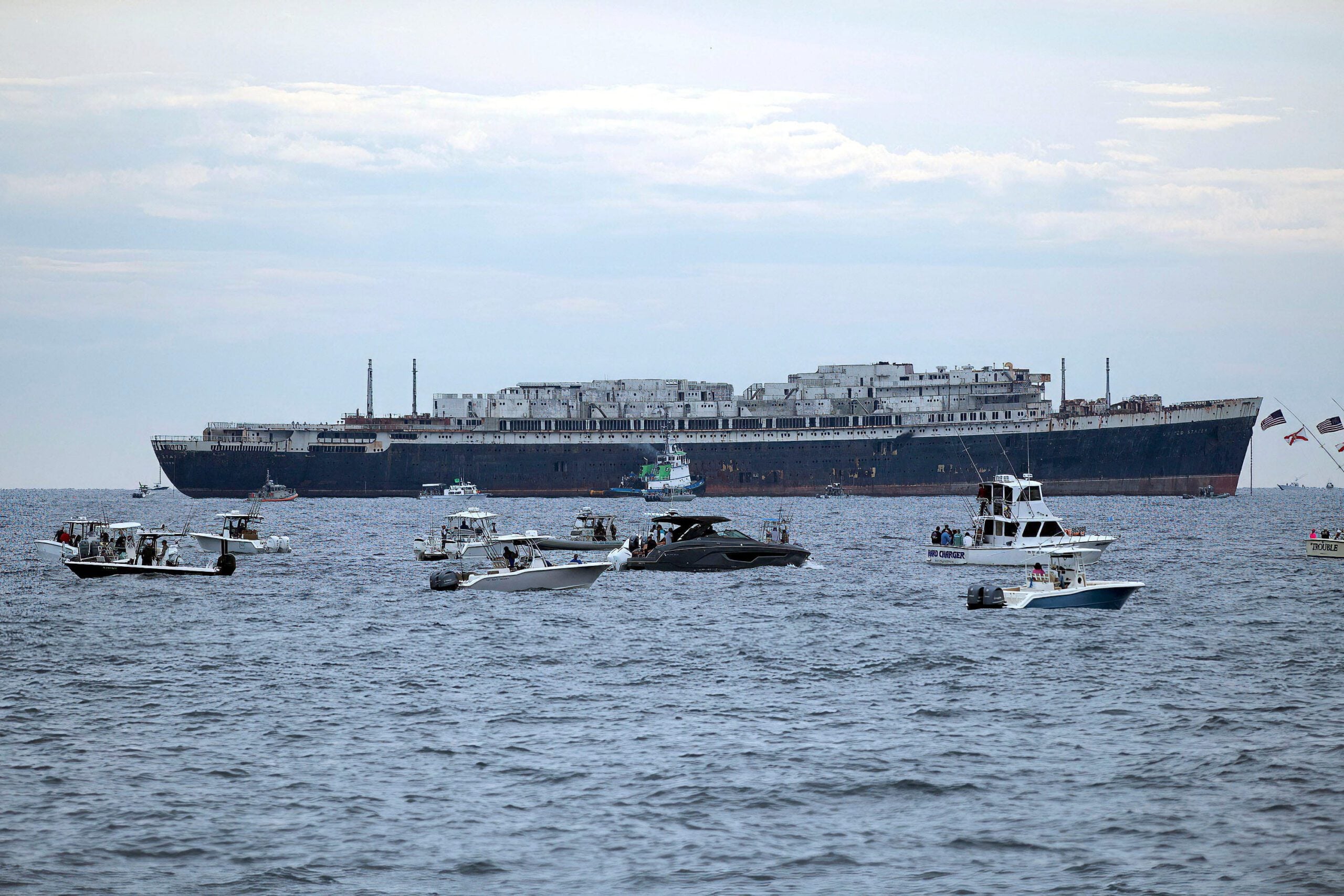
Crews prepare to sink the former ocean liner SS United States to create an artificial reef about 22 miles off the coast of Destin, Florida, US, November 11, 2026. Tony Giberson/USA Today Network via REUTERS.
Farewell to America’s Flagship: SS United States Sinks After 74 Years
The legendary ocean liner, which still holds the transatlantic speed record, took roughly eight hours to sink off Florida’s Gulf Coast, ending a remarkable chapter in American maritime history.
The SS United States, the fastest ocean liner ever built and one of the last great symbols of America’s maritime golden age, sank off Florida’s Gulf Coast Wednesday night, November 11, bringing a 74-year journey to an end.
The 990-foot vessel disappeared beneath the Gulf shortly after 9 p.m. local time, roughly eight hours after crews began the controlled sinking operation about 22 nautical miles southwest of Destin-Fort Walton Beach.
The ship, once celebrated as America’s Flagship, will now begin a new chapter as what officials describe as the world’s largest artificial reef.
But the grand old liner did not go down easily.
Despite extensive preparations to allow seawater to flood the ship, the sinking took considerably longer than initially anticipated. As darkness fell, the SS United States remained stubbornly afloat, slowly settling deeper into the water.
In the final moments, video showed the vessel descending stern-first, with her bow rising sharply as she rolled to port before disappearing beneath the surface.
The dramatic finish raised questions about whether the ship settled upright on the seabed as intended. Her final resting position was not immediately confirmed, with underwater inspections expected Thursday.
After several hours, the SS United States, an ocean liner, is intentionally sunk off the coast of Florida to become the world's largest artificial reef. pic.twitter.com/DwvU2Njf0f
At nearly 1,000 feet long in water approximately 180 feet deep, the ship’s final descent was a complex operation. The stern-first sinking and pronounced port list made it difficult to determine from surface video alone whether the vessel had landed on an even keel.
The operation was overseen by Coleen Marine, a contractor specializing in end-of-life vessel services. Unlike sinkings that use explosives to rapidly open a hull, the SS United States was sent down through controlled flooding.
Crews had removed hundreds of portholes, cut openings between decks and prepared the vessel’s internal tanks to allow seawater to enter. The approach was intended to produce a controlled descent, but the size and internal structure of the ship made the process challenging.
“She’s a big ship,” Okaloosa County spokesperson Nick Tomecek told reporters, acknowledging that the operation took longer than expected. Associated Press reported that the $13.5 million project ultimately concluded Wednesday evening.
For generations of mariners and ocean liner enthusiasts, the sinking marked a bittersweet farewell to a vessel that once represented the height of American passenger shipping.
Built to Be the Fastest
The SS United States was the vision of legendary naval architect William Francis Gibbs, who spent much of his career pursuing the dream of building an American ocean liner capable of outperforming Europe’s finest ships.
Built by Newport News Shipbuilding in Virginia for United States Lines, the ship entered service in 1952 as a technological marvel.
At 990 feet long, she was larger than the RMS Titanic, powered by steam turbines developing approximately 240,000 shaft horsepower, and designed with an extraordinary emphasis on speed, lightweight construction and fire safety.
Her design also reflected the strategic realities of the early Cold War. Developed with federal support, the vessel was intended to serve as a luxury passenger liner and, if needed, a high-speed military troop transport.
But it was her maiden voyage that secured her place in maritime history.
In July 1952, the SS United States crossed the Atlantic in just three days, 10 hours and 40 minutes, averaging 35.59 knots and capturing the coveted Blue Riband from Britain’s RMS Queen Mary.
More than seven decades later, her west-to-east transatlantic speed record remains unbroken by an ocean liner.
The ship became a national showpiece, carrying presidents, celebrities, business leaders and thousands of ordinary passengers between the United States and Europe. Grace Kelly, Elizabeth Taylor and John F. Kennedy were among her famous passengers.
For nearly two decades, her distinctive red, white and blue funnels were an unmistakable presence on the North Atlantic.
The End of an Era
Despite her extraordinary speed and prestige, the SS United States could not escape the transformation of transatlantic travel.
The rise of commercial aviation steadily eroded demand for passenger liners, making it increasingly difficult to justify the enormous cost of operating a ship built for speed.
In November 1969, after approximately 800 transatlantic crossings, the SS United States was withdrawn from service.
She would never carry paying passengers again.
What followed was a succession of ownership changes, failed redevelopment proposals and long periods of inactivity.
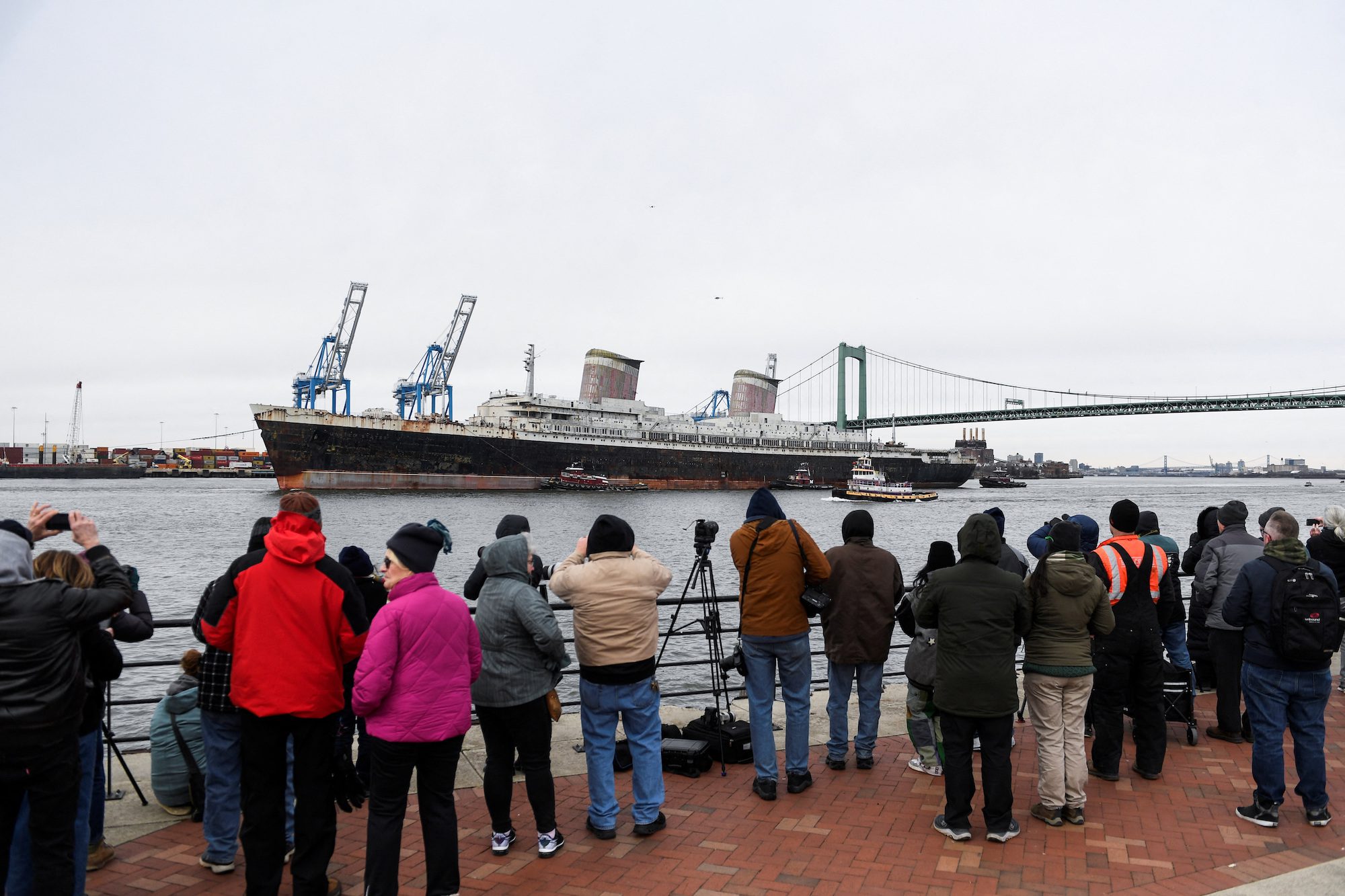
The ship spent years laid up in Virginia before eventually arriving in Philadelphia in 1996. There, she remained for nearly three decades, her once-proud hull gradually deteriorating along the Delaware River.
Although her engines had fallen silent and much of her original interior had been removed, the vessel continued to inspire a passionate preservation movement.
The nonprofit SS United States Conservancy, led for years by Susan Gibbs, granddaughter of the ship’s designer, worked to secure a permanent future for the liner. Proposals envisioned converting her into a floating hotel, museum, entertainment complex or waterfront attraction.
None ultimately succeeded.
As gCaptain reported in June 2024, a legal battle over pier fees and the ship’s longtime berth brought preservation efforts to a crisis.
A federal court ruling requiring the vessel to leave Philadelphia forced her owners to confront an increasingly difficult reality: without a viable redevelopment project or another place to dock, the ship faced the prospect of being scrapped.
The decision offered an alternative to demolition, but it also meant abandoning the longstanding dream of preserving the entire ship above water.
On February 19, 2025, the SS United Statesdeparted Philadelphia under tow, passing down the Delaware River and leaving behind the city that had been her home for nearly 30 years.
She arrived in Mobile, Alabama, the following month, where contractors began the extensive process of preparing the vessel for deployment.
According to Okaloosa County, all 128 fuel and lubricant tanks were emptied and cleaned, environmental remediation was carried out across her 12 decks, and hundreds of historic objects and components were removed for preservation.
Among the items saved were the vessel’s iconic funnels, radar mast and other artifacts intended for a future land-based museum dedicated to her history.
The project faced a last-minute legal challenge from preservation advocates raising environmental concerns, but an emergency request to halt the sinking was denied.
On November 9, the SS United States left Mobile under tow for the last leg of her journey.
Unlike her celebrated Atlantic crossings, there were no passengers aboard, no record to chase and no port of arrival.
Her destination was the ocean floor.
A New Life Beneath the Gulf
The ship’s sinking on Veterans Day carried an additional historical resonance. Although she was never called upon to serve as a troop transport, her design was closely tied to America’s national defense during the Cold War.
Once established on the seabed, the wreck is expected to attract marine life, divers and recreational fishermen, creating a major new attraction along Florida’s Emerald Coast.
The project remains controversial among preservation advocates who had hoped the ship could survive as a museum or waterfront landmark. Others see the artificial reef as a more dignified outcome than dismantling her for scrap.
Both views reflect the extraordinary attachment the vessel inspired long after she ceased to be commercially useful.
The SS United States was built during an era when national prestige could be measured by the speed, size and sophistication of a country’s merchant fleet. She was a product of American shipyards, American engineering and a belief that the nation’s merchant marine could compete with the world’s best.
Today, no American-flagged ocean liner makes the regularly scheduled transatlantic crossings that once defined her career.
Her sinking marks the physical end of that history above the waterline. But the achievement she represented remains.
For 74 years, no ocean liner has surpassed the transatlantic speed record she established on her maiden voyage.
The ship that once raced across the Atlantic faster than any ocean liner before or since now rests beneath the Gulf, her days of crossing oceans finally over.
The SS United States will never sail again, but her record—and her place in American maritime history—will endure.
The historic SS United States, once the fastest ocean liner in the world, is scheduled to leave Mobile, Alabama, on Monday for its final voyage before being intentionally sunk off...
The iconic SS United States, holder of the transatlantic speed record, has departed Philadelphia after nearly three decades at berth, embarking on its final journey to become the world’s largest...
The SS United States, America’s most iconic ocean liner, has encountered another setback in its planned departure from Philadelphia, where the vessel has been docked since 1996. The U.S. Coast...
February 10, 2025
Total Views: 14227
Get The Industry’s Go-To News
Subscribe to gCaptain Daily and stay informed with the latest global maritime and offshore news
— just like 106,075 professionals
Secure Your Spot
on the gCaptain Crew
Stay informed with the latest maritime and offshore news, delivered daily straight to your inbox
— trusted by our 106,075 members
Your Gateway to the Maritime World!
Essential news coupled with the finest maritime content sourced from across the globe.

 Join The Club