By Lou Sola (Editorial) – Amid escalating geopolitical disruptions at the Strait of Hormuz, through which roughly 20% of the world’s oil and liquefied natural gas (LNG) flows, attacks, blockades, and strategic coercion are exposing the fragility of global maritime fuel supply chains. Restricted and unsafe passage through this critical waterway underscores the risks of global reliance on a single, highly vulnerable chokepoint to move strategic energy cargo. Delays, rerouting, and rising shipping costs are driving significant, unpredictable expenses for ship operators. This level of operational, economic, and strategic uncertainty is forcing governments, shipping companies, and investors to race toward viable alternatives as supply timelines grow increasingly unpredictable.
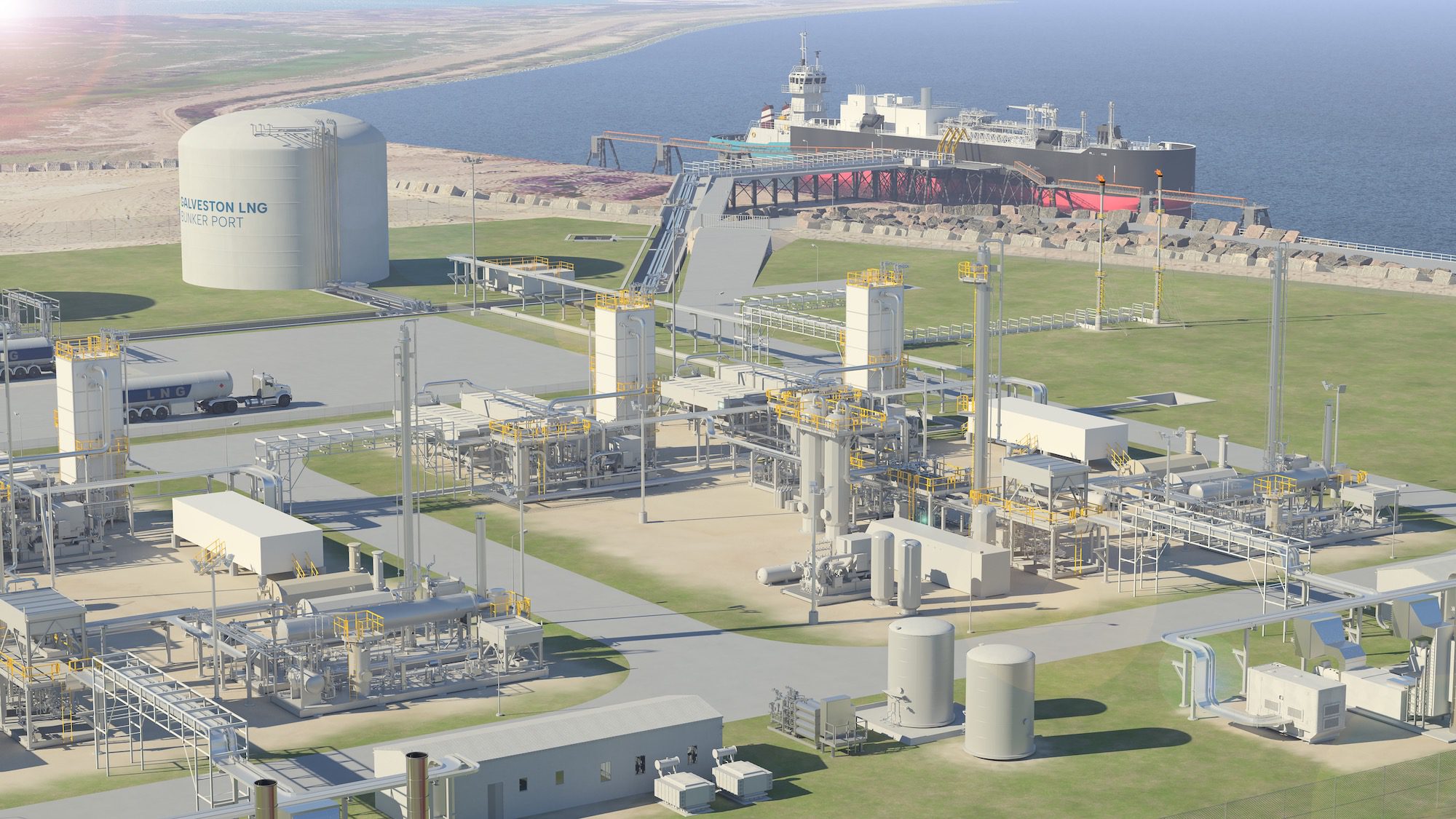
Our nation is the world’s largest liquefied natural gas producer, yet we still lack fully developed maritime fueling infrastructure to efficiently move supply. This gap is widely recognized by many in the industry who are working to fix the issue, particularly as risks continue to mount. Nowhere is this challenge being addressed more significantly than within the Greater Houston Port System, where the Galveston LNG Bunkering Port (GLBP) is advancing the first dedicated marine LNG fueling facility on the U.S. Gulf Coast, with initial bunker deliveries targeted for 2027.
Advancements at the GLBP include two natural gas liquefaction trains with a total expected capacity of 600,000 gallons per day, two 3-million-gallon storage tanks, and a bunker vessel loading berth which will supply LNG by barge to vessels calling at the Port of Galveston, Port Houston and the Port of Texas City. It is a huge step toward strengthening LNG capability in the U.S., where the Gulf Coast lacks dedicated bunkering infrastructure.
This progress comes just as Washington calls for a more resilient and self-sufficient U.S. maritime industrial base, alongside expanded capabilities to increase LNG exports to Europe, which has committed to purchasing $750 billion in U.S. energy to reduce its dependence on Russia’s gas. But while deals are being made, the U.S. continues to lag behind Europe’s facilities, where LNG can be bunkered directly to dual-fuel vessels.
The model GLBP has given us is a simple framework for moving a stable supply of U.S.-produced LNG in a high-traffic shipping corridor. We must think critically about how we will move more LNG at sea—and quickly. While LNG terminals do exist outside of Texas, in Louisiana, Maryland, Georgia, and Alaska, they are geographically concentrated and overwhelmingly designed for export to foreign markets. To scale critical LNG infrastructure, more off-take agreements are essential. In a capital-intensive sector like maritime energy, developers and financiers require clear, durable demand signals before committing to large-scale projects. Off-take agreements give ship operators predictability, while also guaranteeing volumes for producers and demonstrating long-term viability for investors.
Even better news for U.S. LNG, prices have remained stable despite geopolitical tensions. This is largely due to the Henry Hub pricing benchmark, which has hovered near $3 per MMBtu since the Strait of Hormuz closed. This market index underscores a fundamental advantage for U.S. LNG. Compared to highly sensitive global benchmarks like the Title Transfer Facility (TTF) trading point in the Netherlands, or the Japan Korea Marker (JKM), Henry Hub pricing is anchored in abundant domestic production and an extensive pipeline network which largely insulates U.S. LNG from geopolitical risks.
Beyond price reliability, LNG is particularly maritime-friendly in that it gives shipowners a cleaner alternative to reduce emissions without compromising on reliability. This allows operators to meet increasingly stringent International Maritime Organization standards and local environmental regulations without redesigning their vessels.
As global energy markets continue to become interconnected and vulnerable to geopolitical risks, the need for a stronger, more reliable fuel system in the U.S. and abroad becomes increasingly urgent. The widening divide between volatile, import-dependent systems and stable domestic supply, coupled with disruptions that ripple across fuel markets and shipping networks, demonstrates the importance of ensuring access to U.S.-produced LNG. Meeting this moment requires sustained investment in critical infrastructure like that in GLBP to strengthen energy resilience and expand scalable fueling capacity across key U.S. maritime routes and port systems throughout the world.
A Maritime Policy Leader, Infrastructure Strategist and Super Yacht Broker, Louis E. Sola served as the Chairman and Commissioner of the U.S. Federal Maritime Commission (2019–2025). Now a partner at Thorn Run Partners, he advises clients on infrastructure, logistics, and international trade in Washington, DC.

 Join The Club