The U.S. Navy has issued a Request for Proposal for a Vessel Construction Manager (VCM) to oversee production of the Medium Landing Ship, marking a significant departure from traditional shipbuilding contracting methods as the service attempts to accelerate delivery timelines and control costs amid mounting delays across its fleet modernization efforts.
Rather than contracting directly with shipyards, the Navy plans to insert a commercial prime contractor between itself and the builders. That contractor, the VCM, would hold the prime contract and subcontract directly with participating yards, taking responsibility for schedules, quality control, and yard performance.
Navy officials say the structure is designed to reduce risk, streamline oversight, and speed delivery.
For the initial production run, the VCM will manage construction at Bollinger Shipyards and Fincantieri Marinette Marine. Bollinger received a September 2025 contract for long-lead materials and lead ship design work, while Marinette Marine is slated to build four vessels. The VCM will determine how to award the remaining three ships authorized under the base contract.
“The VCM approach not only accelerates construction timelines but also strengthens our industrial base by engaging multiple shipyards,” said Rear Adm. Brian Metcalf, program executive officer for ships. “By providing a mature, ‘build-to-print’ design and empowering a VCM to manage production, we are streamlining oversight for this acquisition.”
A Proven Design — On Paper
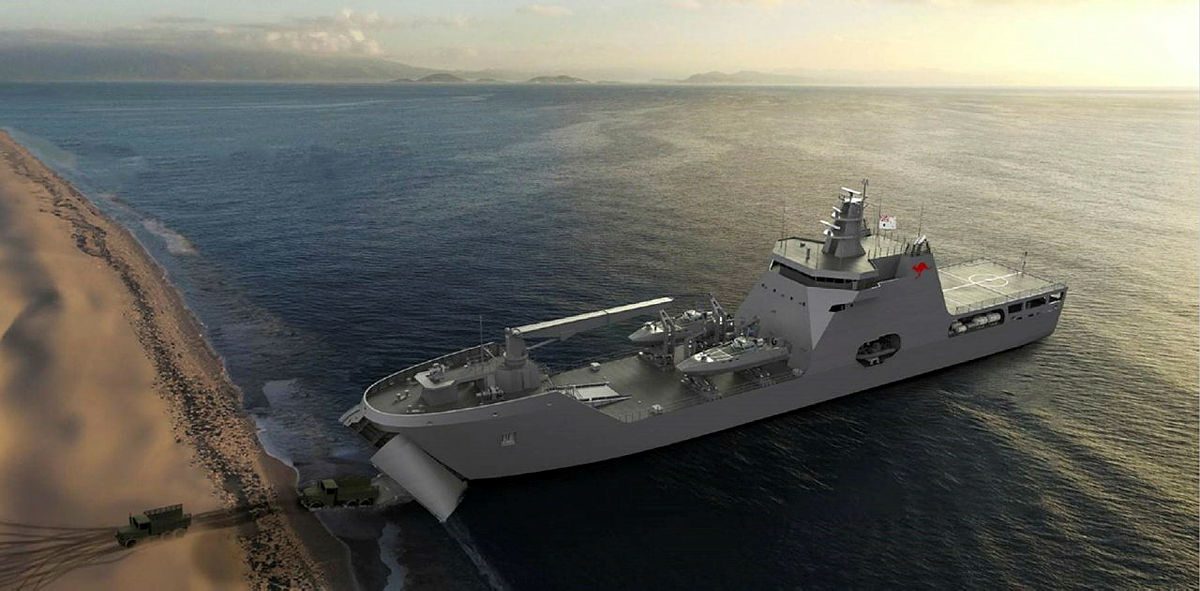
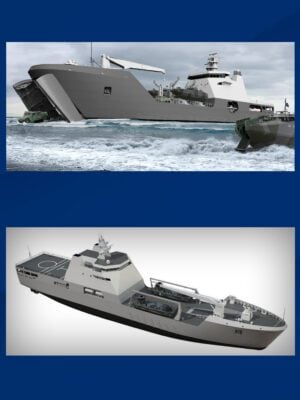
The LSM will be based on Damen Naval’s LST 100 design, selected in December 2025 as a “non-developmental” baseline.
The Medium Landing Ship will be based on Damen Naval’s LST 100 design. Image courtesy U.S. Navy
The roughly 4,000-ton vessel is designed with a range of more than 3,400 nautical miles and is already in production in Australia for that country’s Heavy Landing Craft program. The Navy is betting that starting with an existing design — rather than developing a new one from scratch — will help avoid the kind of engineering delays that have plagued other programs.
The broader LSM plan calls for a 35-ship fleet to fill what the Navy and Marine Corps describe as a critical gap between smaller landing craft and large amphibious warships. The ships are intended to support Marine Corps distributed operations in contested littoral environments — particularly across the Indo-Pacific.
A Response to Mounting Delays
The contracting shift comes at a difficult moment for Navy shipbuilding.
Secretary of the Navy John Phelan recently terminated four Constellation-class frigates at Marinette Marine that had not yet begun construction, after delays pushed the lead ship’s expected delivery from April 2026 to April 2029.
The VCM strategy reflects a broader effort to import commercial shipbuilding discipline into naval programs. Under the model, the Navy provides a mature, build-to-print design while the construction manager oversees production across multiple yards — ideally with fewer government personnel and tighter cost control.
There’s precedent. The U.S. Maritime Administration’s National Security Multi-Mission Vessels (NSMVs) were delivered using the same approach. MARAD hired TOTE Services as Vessel Construction Manager while Philly Shipyard handled construction. The ships were delivered on schedule and within budget, and the program is often cited as a rare modern example of disciplined U.S. ship procurement.
Whether the Navy can replicate that success at scale — and under the far more complex demands of combat ship construction — remains an open question.
A VCM contract award for the LSM program is expected in mid-2026, marking what Navy leaders describe as a fundamental reshaping of how the service builds and fields its fleet at a time when U.S. shipbuilding capacity continues to lag far behind China’s rapidly expanding industrial base.
Secretary of War Pete Hegseth stood at the Pentagon press podium this morning and named Iran’s threat to “global shipping lanes” as a core justification for Operation Epic Fury —...
(Bloomberg) The US and Israel began striking targets across Iran, with President Donald Trump urging Iranians to overthrow the government in a conflict that threatens to spiral across the oil-rich...
The hospital ship USNS Mercy departed Alabama Shipyard on Tuesday, transiting southbound through the Gulf of Mexico at about 10.5 knots, closing out months of drydock work while fresh questions swirl about...
February 24, 2026
Total Views: 6699
Get The Industry’s Go-To News
Subscribe to gCaptain Daily and stay informed with the latest global maritime and offshore news
— just like 107,340 professionals
Secure Your Spot
on the gCaptain Crew
Stay informed with the latest maritime and offshore news, delivered daily straight to your inbox
— trusted by our 107,340 members
Your Gateway to the Maritime World!
Essential news coupled with the finest maritime content sourced from across the globe.

 Join The Club