, is the naval equivalent of Google’s self-driving car, designed to cruise on the ocean’s surface for two or three months at a time – without a crew or anyone controlling it remotely.
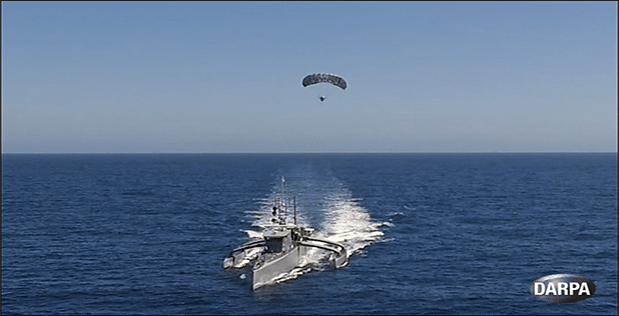
The Pentagon’s new unmanned submarine chaser is currently undergoing at-sea testing off the coast of California and recently set sail with its first-ever payload: some sort of super high-tech (probably) parasail.
The prototype vessel, known as Anti-Submarine Warfare (ASW) Continuous Trail Unmanned Vessel (ACTUV) or Sea Hunter for short, is built to track enemy submarines over thousands of miles of ocean for months at a time and without a single crew member on board.
In the video below, the ACTUV is actually testing its Towed Airborne Lift of Naval Systems (TALONS) system, which could be towed behind boats or ships carry out intelligence, surveillance, reconnaissance (ISR), and communications ops by extending the equipment range compare to a ship’s mast.
The vessel is built by DARPA, an advanced research agency under the Department of Defense, together with the U.S. Navy.
“The demonstration took place over two days with 90 minutes of flight each day. The TALONS prototype started out from its “nest” installed on the back of the ACTUV vehicle. It then expanded its parachute and rose to an altitude of 1,000 feet, where it tested its onboard sensors and communications equipment. Once the test was complete, the prototype reeled itself in back to the nest. The entire process took place as the ACTUV vehicle maneuvered at operationally realistic speeds,” DARPA said in a statement.
DARPA signed a Memorandum of Agreement (MOA) with the Office of Naval Research in September 2014 to jointly fund an extended test phase of an ACTUV prototype. The vessel was christened in 2016 in Portland, Oregon. Pending the results of those tests, the program could transition to the Navy by 2018.
Tags:
Subscribe for Daily Maritime Insights
Sign up for gCaptain’s newsletter and never miss an update
By Nandita Bose and Timothy Gardner Oct 2 (Reuters) – US President Donald Trump said on Friday he did not “jump the gun” on announcing a South Korean investment in Alaska LNG, a liquefied...
Another tanker has been struck in the Strait of Hormuz, bringing the number of vessels reported hit in the strategic waterway since Sunday to at least six. UK Maritime Trade...
Global shipping is not running short of ships. The bigger problem is that a growing share of them are getting caught in congestion. Roughly 12% of global container ship capacity...
October 2, 2026
Total Views: 630
Get The Industry’s Go-To News
Subscribe to gCaptain Daily and stay informed with the latest global maritime and offshore news
— just like 107,122 professionals
Secure Your Spot
on the gCaptain Crew
Stay informed with the latest maritime and offshore news, delivered daily straight to your inbox
— trusted by our 107,122 members
Your Gateway to the Maritime World!
Essential news coupled with the finest maritime content sourced from across the globe.

 Join The Club