Tubes In The Ocean → Bizarre Marine Technology

Share On Facebook Published: July 3rd, 2009 by John

Enjoying the blog?


We welcome you to take the next step and join the community of gCaptain readers by sharing thoughts and opinions on the forum. Click HERE to get started today!


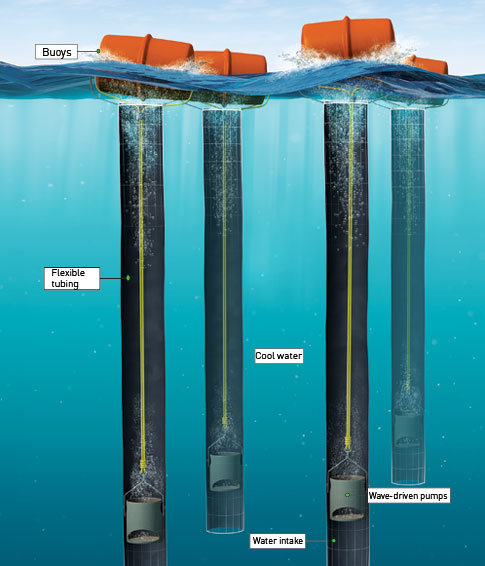
Ocean Straws - Graphics By Popscience

For this week’s pick of Bizarre Marine Technology we wanted to go with Glacier Blankets but, although they would likely be transported to the Artic on ships, the relationship to marine transport is thin. But don’t worry, we have an equally interesting technology for you today… ocean tubes. We’ll let Atomocean, the company developing this technology, explain:

Atmocean is developing its patents-pending wave-driven ocean upwelling system to cool the upper ocean and enhance natural biological processes to absorb CO2. When widely deployed across critical ocean regions, the Atmocean technology may help fight global warming by sequestering significant amounts of CO2 in the deep ocean, reduce hurricane intensity, help revive ocean fisheries, and mitigate coral reef bleaching.

Upwelling is the naturally-occurring mixing of deep, cold, nutrient-rich ocean into the upper sunlit ocean that is critical to growth of most marine species. As the upper oceans absorb more heat from the atmosphere due to the greenhouse effects of CO2 and other heat-trapping gases, they become more stratified, further risking the natural delivery of nutrients to the sunlit zone.

Atmocean believes our wave-driven upwelling technology can play a critical role in mitigating these deleterious effects of CO2-induced warming, in the years and decades ahead.

If your still with us the following video helps explain the technology further.

YouTube Preview Image

.

Also be sure to view the Discovery Channel Video and Popular Science Article featuring atomocean.


Related Posts:

Categories: Marine Technology

Tags: · ,

This Article Was Written By John
Captain John Konrad is co-founder of Unofficial Networks and Editor In Chief of this blog. He is a USCG licensed Master Mariner of Unlimited Tonnage and, since graduating from SUNY Maritime College, has sailed a variety of ships from ports around the world. John currently lives in Morro Bay, California with his wife and two children.

This blog is sponsored by:


  • JKB
    I was at a meeting once to investigate the use of 100% coverage bathymetric surveys for marine biologist. The biologists came up the the requirements for millimeter resolution over 100% of the EEZ every 5 years. Compare that to the estimate of needing over $5 billion to just collect meter resolution data (not counting processing and management) and that with the current survey capability at the time in the US would take over 500 years to do it once.

    As of 2008, NOAA still has 20,000 snm of critical navigationally significant areas to survey with a survey rate of little over 1000 snm a year. The EEZ is about 3.4 million snm.

    http://www.nauticalcharts.noaa.gov/hsd/NHSP.htm
  • John
    The local town council here in Morro Bay is very excited by a "Green Tech" companies promises to move forward on similar technology. The fishing fleet has suffered in recent years and we need a boost to get these guys back out to sea.

    The council was disappointed (to say the least) after asking me if the proposal was realistic.
  • JKB
    Did you ever get the idea these guys don't really appreciate the scale of the forces or areas they are trying to work with.

    Nice concept but $5 billion to deploy, how much to maintain? Does that include vessel costs? 1.6 million pumps would require its own fleet of maintenance vessels. And yet that is only to possibly impact a hurricane in the GOMEX but I doubt that 1.6 million pumps would have much of an impact given how much energy hurricanes consume.

    Not to mention they lost their test pumps is small seas (8ft max over deployment) and presumably not near an ocean front. I've seen fronts tie a longline into 20 miles of rat's nests during a 12 hr soak. The loss rate would mean a lot of plastic drifting around mid-ocean depth or on the seafloor.

    As we all know, the ocean doesn't take to well to harnessing. Best you can hope for is she doesn't find a flaw in your technology that will kill you.
blog comments powered by Disqus