gCaptain.com

A Blog About Ships

Fastream Offshore Leaderboard


Modern Pirate Maps - Avoiding The X Might Be Your Best Option

November 22nd, 2008 · Comments

Pirate maps have long been the a source of intrigue but modern day treasure hunters more often use advance technology like remote operated vehicles and sonar systems than maps stamped with an X. Neverless, pirate maps have survived to modern day and are equally intriguing as those found in archives… but they have a different purpose. Here are a few modern day pirate maps but remember dead men tell no tales and there is no gold to be found on these maps… well unless your in blackwater.

LIVE PIRACY MAP - 2008

This map shows all the piracy and armed robbery incidents reported to the Piracy Reporting Centre during 2008. This division of the International Maritime Bureau (IMB) works to protect the integrity of international trade by seeking out fraud and malpractice. The organization combines traditional reporting tools like a piracy hotline with a wide variety of IT sources to keep member informed of dangerous situation in real time.

In adition to their live piracy map you can also find RSS information feeds as well as updates on the latest attcks worldwide.

UNOSAT Maps, etc…
UNOSAT Piracy Map

This map by UNOSAT, the UN Institute for Training and Research’s (UNITAR) Operational Satellite Applications Programme, illustrates reported incidents of piracy in the Gulf of Aden from January to 30 September 2008. Satellite imagery has been used in this analysis for the identification of suspected hijacked vessel locations and UNOSAT has combined this imagery with public media reports. The result is the map above which highlights the most troublesome incidents with an intensity color scale. You can find the hi resolution version of the map HERE.

[Continue Reading →]

CommentsTags: · , , , ,

Projected Storm Surge From Hurricane Ike - Mapped

September 12th, 2008 · Comments

These are projection maps of flooding from Hurricane Ike released by the Texas Governor’s Office.  The National Hurricane Center is predicting Hurricane Ike to reach the coast sometime late Friday or early Saturday with a storm surge of up to 20 feet.  Ike is currently a Category 2 hurricane but could reach Category 3 status by landfall.

[Continue Reading →]

CommentsTags: · , ,

Antipode Maps: The Far Side of the World

April 7th, 2008 · Comments

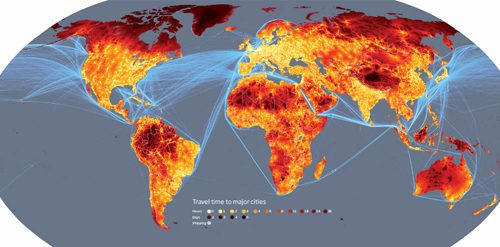
This map shows the antipodes of each point on the Earth's surface – the points where the blue and pink overlap are land antipodes. Notice that most land has an antipode in the ocean.  This map uses the Lambert azimuthal equal-area projection.

This map shows the antipodes of each point on the Earth’s surface – the points where the blue and pink overlap are land antipodes. Notice that most land has an antipode in the ocean. This map uses the Lambert azimuthal equal-area projection.

This map shows the antipodes of each point on the Earth’s surface – the points where the blue and pink overlap are land antipodes. Notice that most land has an antipode in the ocean. This map uses the Lambert azimuthal equal-area projection.

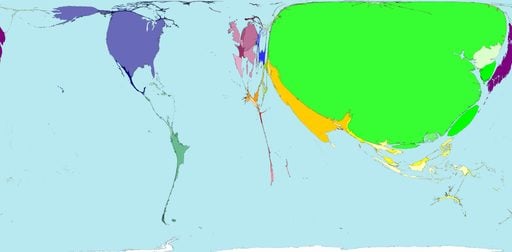
This map shows the antipodes of each point on the Earth’s surface – the points where the blue and pink overlap are land antipodes. Darker shades indicate areas of higher population density. This map uses the Equirectangular projection.

As a kid I wondered where I’d end up if I could drill a hole all the way through the earth. The answer was always China. That was before I knew the concept of Latitude and Longitude.

Thanks to the net, it’s much easier to make the calculation today. It is interesting to note that very little of the earths land mass overlaps.

Any number of Anitpode map links can make the calculation for you.
Wikipedia info here. You can create your own.

For the hooked on trivia buffs, here’s Wendy Carols’ Map Page.
(Ed. note: If you’re of my vintage you may remember Wendy’s (aka Walter) 1968 synthesizer classic Hooked on Bach.

___________________________

This post was written by Richard Rodriguez, Rescue Tug Captain, and US Coast Guard approved instructor for License Training. You can read more of his articles at the BitterEnd of the net.

CommentsTags: · , ,

Live EarthQuake Data and Maps

October 30th, 2007 · Comments

The Exploratorium brings us live earthquake mapping links! Normally I wouldn’t cut an paste so much info but in light of messages I’ve received from mariners worried about their families, here it is:

Southern California Integrated GPS Network Mapsurfer
Mapsurferer is an interactive mapping system that allows visitors to overlay different layers of information on a map of California. These layers include seismic stations, highways, geological features, major faults, and more. While information about the Bay Area and northern California is available, this map focuses on southern parts of the state.

Quakes in the last 7 days: USGS Earthquake Hazards Program
The USGS has many maps of live earthquake data. This section lets visitors see quakes that have occurred anywhere in the world in the last week. You can also focus on geographic regions. Zooming in to a specific quake, you reach a page with specific data and links to the area’s seimic and quake damage history

Shake map of California and Nevada showing fault lines
These maps are nice illustrations of the fact that earthquakes occur along faults. You can click the small boxes to zoom in and get more details on specific quakes

Did you feel it?
Seismometers can measure shaking, but how much does that reflect what people actually feel? On this site, people in the area of a quake can report their experiences to the USGS, and the results are made into a map. This can be compared with other shake maps for the same quake that were generated from seismometer data.

IRIS Seismic Monitor
IRIS (Incorporated Research Institutions for Seismology) has developed their Seismic Monitor that offers data about quake in near realtime, lets you search the Web for information about them, and view seismograms.

Real-time seismograms
Recorded by stations in the Northern California Seismic Network, these seismograms update every 5 minutes. The site also includes information on interpreting seismograms and examples of different magnitudes.

USGS Global Positioning System (GPS) monitors
USGS keeps many stations that track movements of the earth’s plates using GPS. Because plate movement is fairly slow, the data are recorded over long periods of time. So the information on this site records events in the last year, or last decade, rather than the last week.

CommentsTags: · , , , , , ,

Hurricane Tracking Mashup

September 18th, 2007 · Comments

Here is a list of gCaptain’s picks for the most interesting ways to track Hurricanes.

1) IBISeye.com’s Hurricane Tracker. Click on past and future tracking points for more detail on the storm.


[Continue Reading →]

CommentsTags: · , , , , , , , , , , , , , , ,


Comments

Popular Topics


Sponsors


Maritime and Offshore Recruitment


Spurs

Mariner Taxes Logo

Mariner Taxes


The Maritime Executive Magazine


Your Ad Here


Authors


Follow Us


Categories


Recent Posts


Popular

Shipping Archives

Read A Random Story